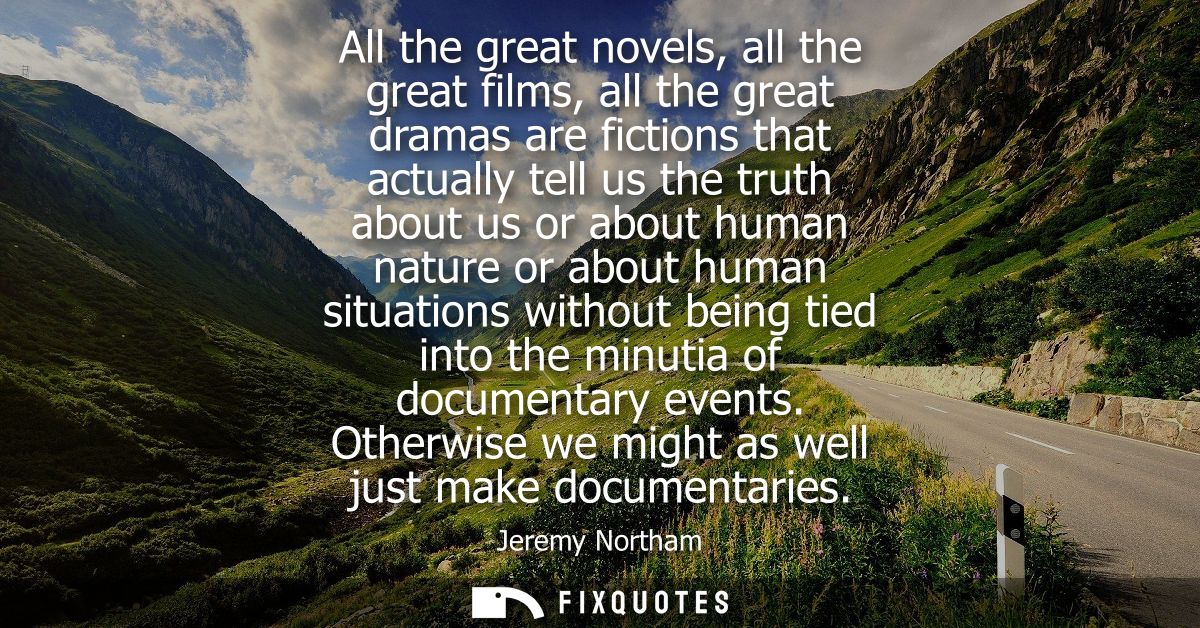
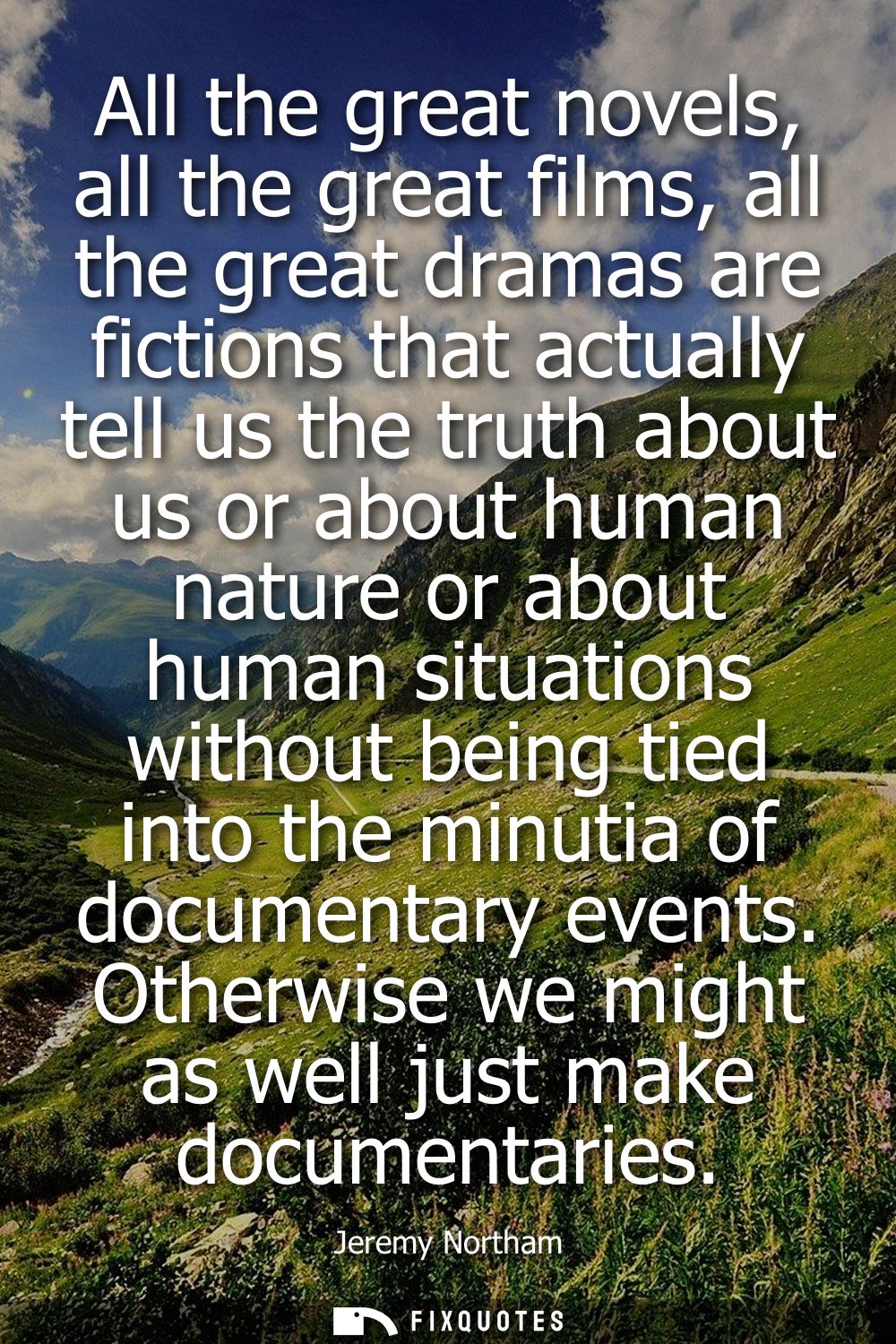
"All the great novels, all the great films, all the great dramas are fictions that actually tell us the truth about us or about human nature or about human situations without being tied into the minutia of documentary events. Otherwise we might as well just make documentaries"
About this Quote
The intent is partly professional self-protection. Actors spend careers inhabiting invented people, then get asked to justify that invention against the yardstick of real events. Northam reframes the job description: the point is not to replicate “minutia,” but to distill motive, contradiction, and consequence. “Human nature” and “human situations” sound broad, but the subtext is specific: audiences don’t come to fiction for data; they come for recognition - the feeling that someone has named the thing they couldn’t.
Contextually, it reads like a late-20th/early-21st century pushback against a culture that equates seriousness with documentation. Prestige cinema leans on doc aesthetics, real-time politics, and biopic authenticity; streaming platforms sell truth as a brand. Northam’s line insists that the deeper contract of narrative is interpretive, not evidentiary. Fiction gets to compress time, invent scenes, sharpen dialogue, and make patterns visible - not to escape reality, but to expose it.
Quote Details
| Topic | Art |
|---|---|
| Source | Help us find the source |
| Cite |
Citation Formats
APA Style (7th ed.)
Northam, Jeremy. (2026, January 17). All the great novels, all the great films, all the great dramas are fictions that actually tell us the truth about us or about human nature or about human situations without being tied into the minutia of documentary events. Otherwise we might as well just make documentaries. FixQuotes. https://fixquotes.com/quotes/all-the-great-novels-all-the-great-films-all-the-55393/
Chicago Style
Northam, Jeremy. "All the great novels, all the great films, all the great dramas are fictions that actually tell us the truth about us or about human nature or about human situations without being tied into the minutia of documentary events. Otherwise we might as well just make documentaries." FixQuotes. January 17, 2026. https://fixquotes.com/quotes/all-the-great-novels-all-the-great-films-all-the-55393/.
MLA Style (9th ed.)
"All the great novels, all the great films, all the great dramas are fictions that actually tell us the truth about us or about human nature or about human situations without being tied into the minutia of documentary events. Otherwise we might as well just make documentaries." FixQuotes, 17 Jan. 2026, https://fixquotes.com/quotes/all-the-great-novels-all-the-great-films-all-the-55393/. Accessed 7 Apr. 2026.