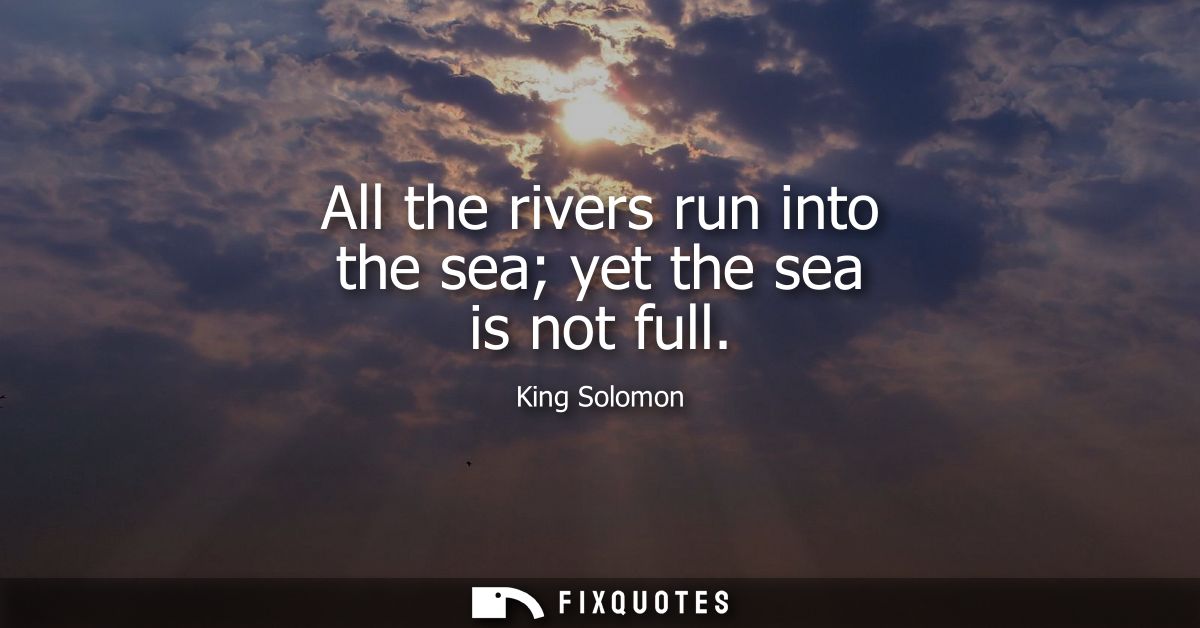
"All the rivers run into the sea; yet the sea is not full"
About this Quote
A king points at a simple hydrological fact and turns it into a quiet indictment of human appetite. “All the rivers run into the sea; yet the sea is not full” works because it sounds like calm observation while smuggling in a worldview: accumulation doesn’t resolve longing; it rehearses it. The line’s power is its inevitability. Rivers don’t debate their destination. They pour in, endlessly, and nothing about the sea’s vastness changes the basic condition: it still has room. That image flattens the fantasy at the heart of wealth, status, conquest - the idea that one more acquisition will finally close the gap.
As a historical leader, Solomon isn’t speaking from poverty or abstraction. Tradition casts him as the monarch who had what everyone is told to want: money, wives, diplomatic reach, a monumental building program. The subtext is almost political. If even a king can’t “fill the sea,” what does that imply about the stability of a kingdom built on expansion, tribute, and spectacle? The metaphor doubles as counsel: rule is a management of limits, not a victory over them.
Contextually, the line sits in Ecclesiastes’ larger argument about cycles: the sun rises and sets, winds return, streams return - motion without final satisfaction. It’s not nihilism for its own sake; it’s a rhetorical cold shower. Solomon’s intent is to reframe success away from hoarding and toward humility, warning that the world is designed to keep desire in circulation, no matter how much pours in.
As a historical leader, Solomon isn’t speaking from poverty or abstraction. Tradition casts him as the monarch who had what everyone is told to want: money, wives, diplomatic reach, a monumental building program. The subtext is almost political. If even a king can’t “fill the sea,” what does that imply about the stability of a kingdom built on expansion, tribute, and spectacle? The metaphor doubles as counsel: rule is a management of limits, not a victory over them.
Contextually, the line sits in Ecclesiastes’ larger argument about cycles: the sun rises and sets, winds return, streams return - motion without final satisfaction. It’s not nihilism for its own sake; it’s a rhetorical cold shower. Solomon’s intent is to reframe success away from hoarding and toward humility, warning that the world is designed to keep desire in circulation, no matter how much pours in.
Quote Details
| Topic | Wisdom |
|---|---|
| Source | Ecclesiastes 1:7 (The Holy Bible, King James Version). Verse traditionally attributed to King Solomon. |
| Cite |
Citation Formats
APA Style (7th ed.)
Solomon, King. (2026, January 18). All the rivers run into the sea; yet the sea is not full. FixQuotes. https://fixquotes.com/quotes/all-the-rivers-run-into-the-sea-yet-the-sea-is-18706/
Chicago Style
Solomon, King. "All the rivers run into the sea; yet the sea is not full." FixQuotes. January 18, 2026. https://fixquotes.com/quotes/all-the-rivers-run-into-the-sea-yet-the-sea-is-18706/.
MLA Style (9th ed.)
"All the rivers run into the sea; yet the sea is not full." FixQuotes, 18 Jan. 2026, https://fixquotes.com/quotes/all-the-rivers-run-into-the-sea-yet-the-sea-is-18706/. Accessed 3 Apr. 2026.
More Quotes by King
Add to List