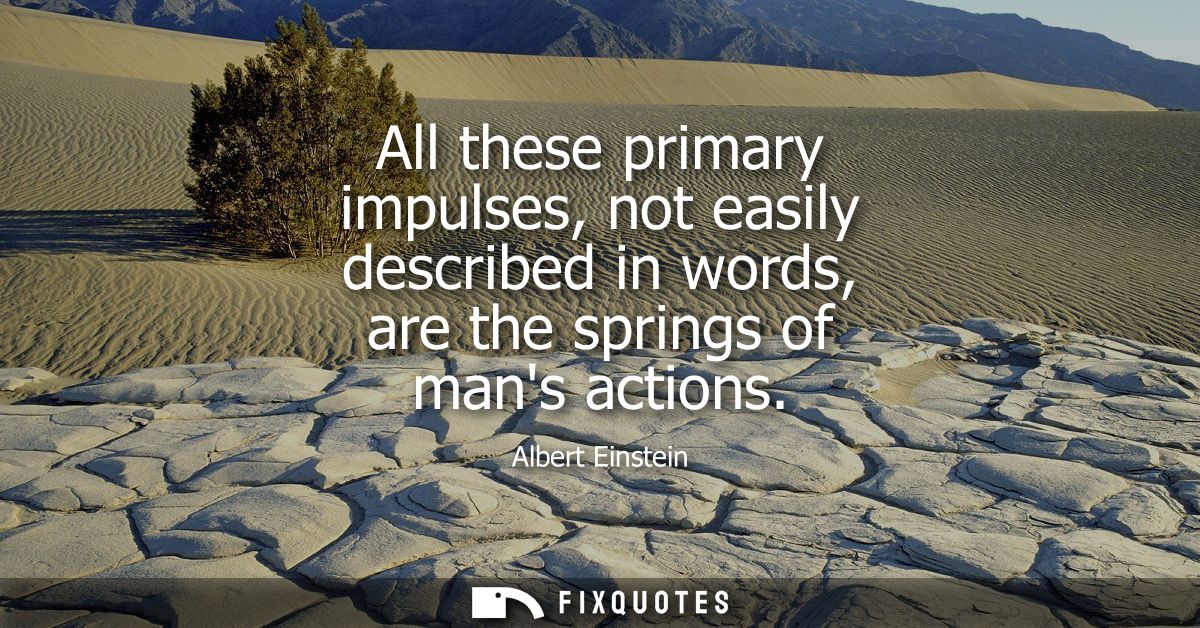
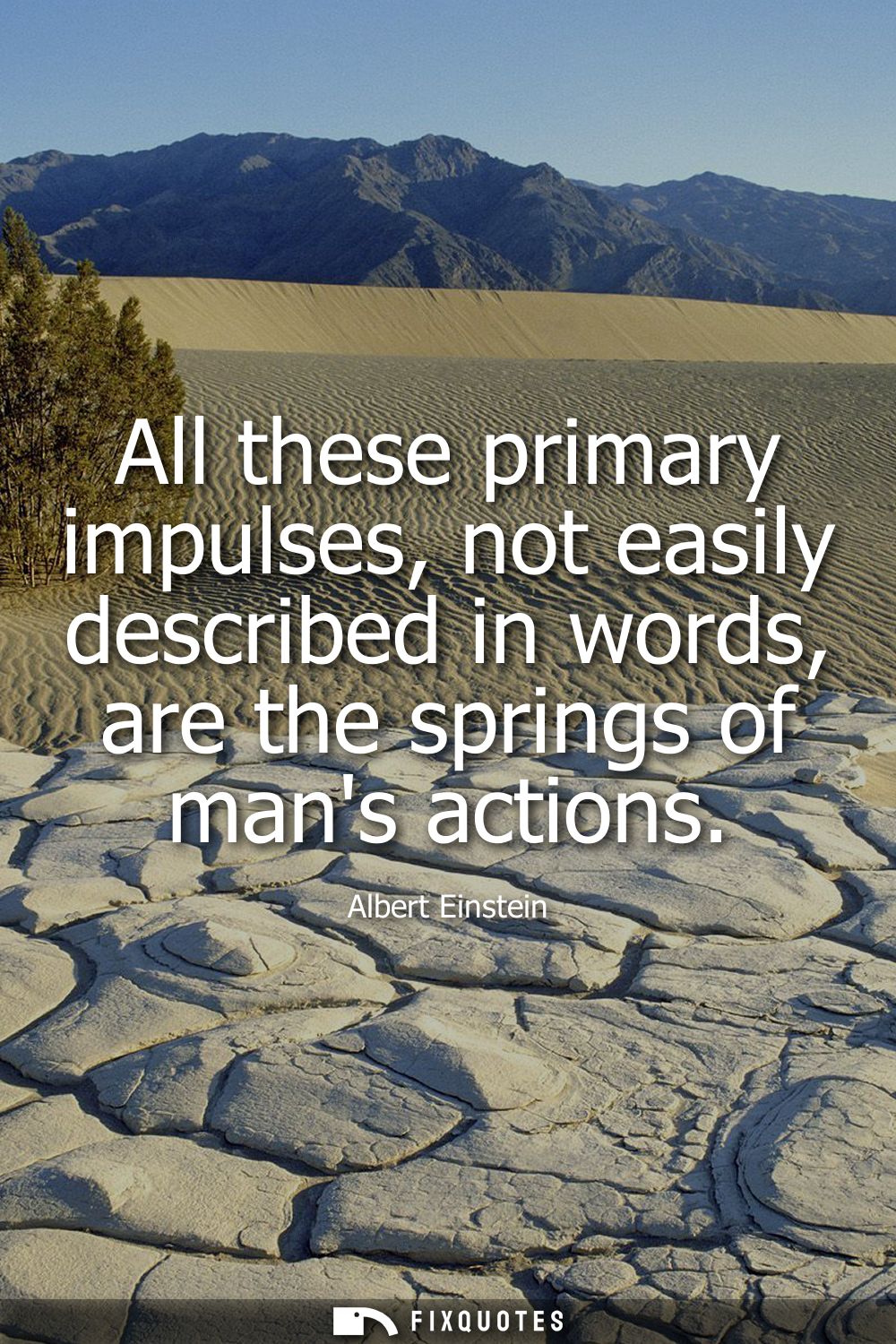
"All these primary impulses, not easily described in words, are the springs of man's actions"
About this Quote
The intent is partly corrective. In an era enthralled by rational planning, industrial efficiency, and the rising prestige of scientific explanation, Einstein reminds us that motive power is often pre-verbal: hunger, fear, status, attachment, curiosity, resentment. Calling them “springs” is telling. Springs store energy, release it suddenly, and keep working even when you ignore them. That metaphor frames human action as driven by compressed, accumulated pressure rather than tidy reasoning. People don’t always decide; they discharge.
The subtext carries a quiet warning to anyone who thinks intellect is the engine. Einstein is the wrong person to dismiss reason, yet he’s insisting that reason is frequently the after-the-fact narrator, not the prime mover. That lands as both humble and unsettling: if the greatest mind of the century thinks our actions originate in hard-to-name impulses, then moral certainty and political technocracy look a little like overconfident storytelling.
Contextually, it echoes early 20th-century crosscurrents (Freud, mass politics, propaganda, world war): a modern world discovering that the deepest drivers of behavior are powerful, contagious, and only partially legible.
Quote Details
| Topic | Wisdom |
|---|---|
| Source | Help us find the source |
| Cite |
Citation Formats
APA Style (7th ed.)
Einstein, Albert. (2026, January 18). All these primary impulses, not easily described in words, are the springs of man's actions. FixQuotes. https://fixquotes.com/quotes/all-these-primary-impulses-not-easily-described-13630/
Chicago Style
Einstein, Albert. "All these primary impulses, not easily described in words, are the springs of man's actions." FixQuotes. January 18, 2026. https://fixquotes.com/quotes/all-these-primary-impulses-not-easily-described-13630/.
MLA Style (9th ed.)
"All these primary impulses, not easily described in words, are the springs of man's actions." FixQuotes, 18 Jan. 2026, https://fixquotes.com/quotes/all-these-primary-impulses-not-easily-described-13630/. Accessed 7 Mar. 2026.