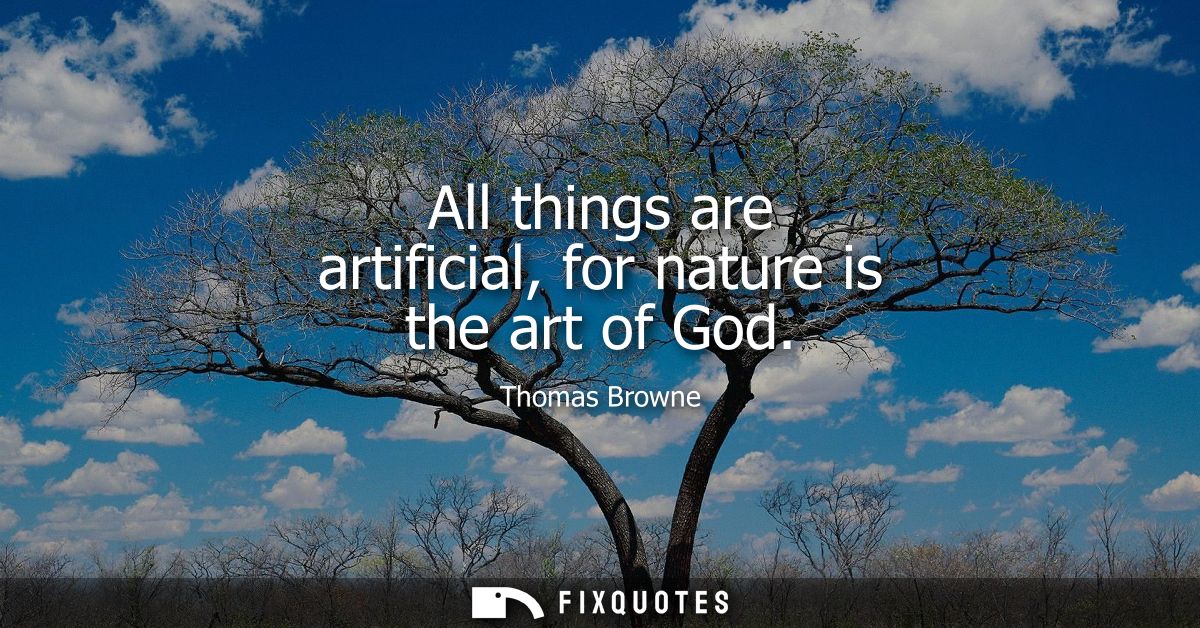
"All things are artificial, for nature is the art of God"
About this Quote
Browne’s line flips a supposedly commonsense hierarchy: “natural” as pure, “artificial” as tainted. He collapses the distinction with a cool provocation - if nature itself is authored, then artifice isn’t an aberration but a family trait. The aphorism works because it weaponizes a theological premise to make an aesthetic and scientific point. Nature, he implies, is not raw material; it’s already a finished composition. Once you accept that, human making becomes less a trespass against nature and more a continuation of its method.
The subtext is 17th-century anxiety about novelty. Browne writes in a period when experimental science is rising, religious certainty is under pressure, and “mechanical” explanations of life can sound like a demotion of the divine. His solution is neither anti-science piety nor secular disenchantment, but a rhetorical marriage of the lab and the church: the more intricate the world appears, the more it reads as deliberate craft. Calling nature “the art of God” sanctifies curiosity and collecting, dissection and classification. It gives permission to handle, measure, and remake the world without sounding like a vandal.
The intent, then, is to disarm moral panic around human artifice - cosmetics, machines, medicine, even the emerging idea of “technology” - by insisting that fabrication is not the opposite of nature but its signature. If everything is already designed, authenticity becomes a shaky virtue, and “artificial” stops being an insult and starts being a clue about how reality is built.
The subtext is 17th-century anxiety about novelty. Browne writes in a period when experimental science is rising, religious certainty is under pressure, and “mechanical” explanations of life can sound like a demotion of the divine. His solution is neither anti-science piety nor secular disenchantment, but a rhetorical marriage of the lab and the church: the more intricate the world appears, the more it reads as deliberate craft. Calling nature “the art of God” sanctifies curiosity and collecting, dissection and classification. It gives permission to handle, measure, and remake the world without sounding like a vandal.
The intent, then, is to disarm moral panic around human artifice - cosmetics, machines, medicine, even the emerging idea of “technology” - by insisting that fabrication is not the opposite of nature but its signature. If everything is already designed, authenticity becomes a shaky virtue, and “artificial” stops being an insult and starts being a clue about how reality is built.
Quote Details
| Topic | God |
|---|---|
| Source | Verified source: Religio Medici (Thomas Browne, 1642)
Evidence: In brief, all things are artificial; for Nature is the Art of God. (Part I, §XVI (often numbered §16; the sentence appears just before §XVII)). This line appears in Sir Thomas Browne’s Religio Medici (Part I). Many later sources quote it without the surrounding context. As for 'FIRST published': Religio Medici circulated in manuscript earlier, but it was first printed in 1642 in London in an unauthorized edition; Browne then issued a corrected/authorized edition in 1643. Library and rare-book catalog descriptions (e.g., Morgan Library records) explicitly identify the 1642 printing(s) as unauthorized first editions and note the 1643 authorized edition, which is why 1642 is the best-supported 'first publication' date for the quote in print. Other candidates (1) What is the Good of Art? (Harold Speed, 1936) compilation95.0% ... Thomas Browne says in the Religio Medici , “ All things are artificial , for nature is the art of God . " And whe... |
| Cite |
Citation Formats
APA Style (7th ed.)
Browne, Thomas. (2026, February 13). All things are artificial, for nature is the art of God. FixQuotes. https://fixquotes.com/quotes/all-things-are-artificial-for-nature-is-the-art-125988/
Chicago Style
Browne, Thomas. "All things are artificial, for nature is the art of God." FixQuotes. February 13, 2026. https://fixquotes.com/quotes/all-things-are-artificial-for-nature-is-the-art-125988/.
MLA Style (9th ed.)
"All things are artificial, for nature is the art of God." FixQuotes, 13 Feb. 2026, https://fixquotes.com/quotes/all-things-are-artificial-for-nature-is-the-art-125988/. Accessed 30 Mar. 2026.
More Quotes by Thomas
Add to List