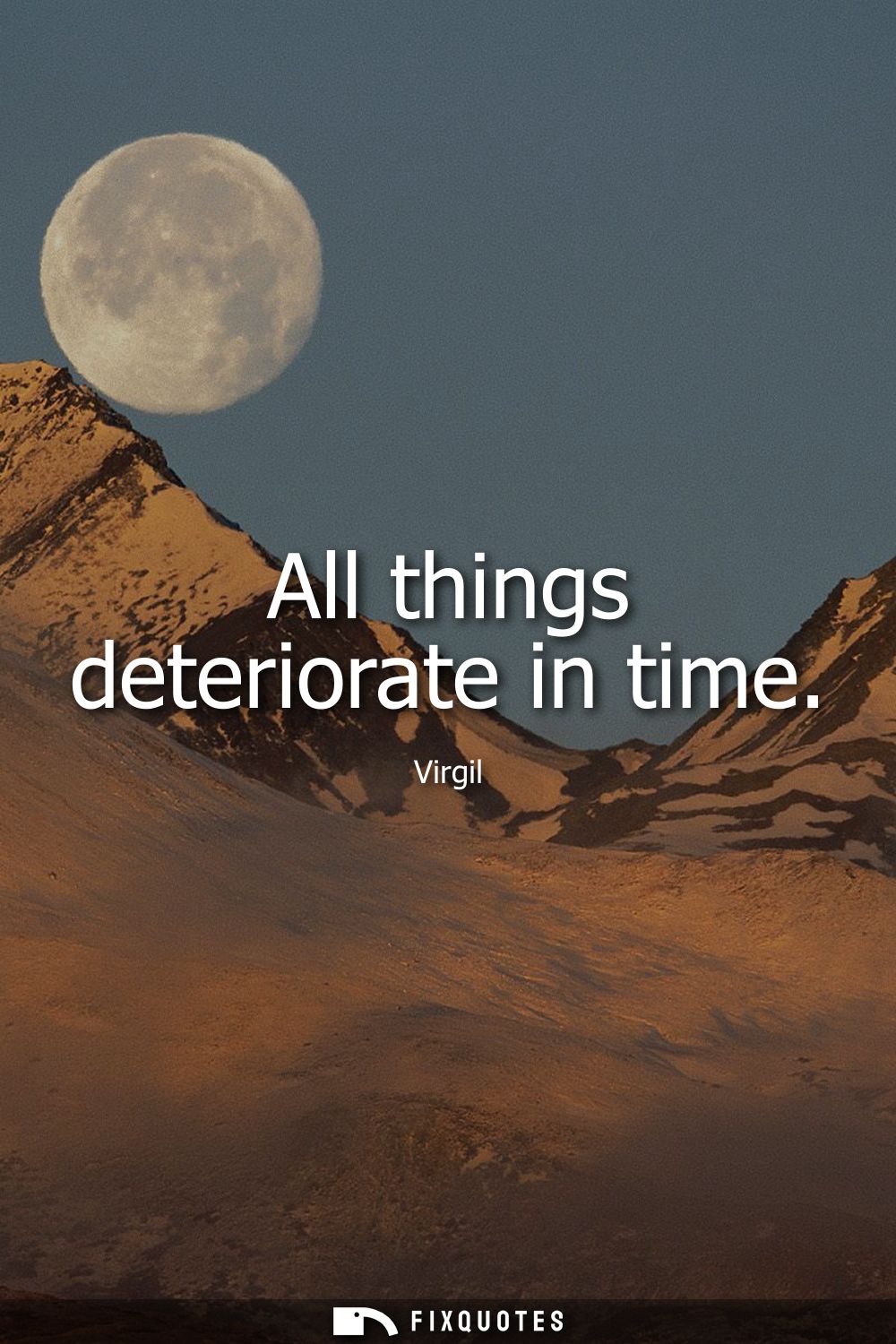
"All things deteriorate in time"
About this Quote
“All things deteriorate in time” lands with the clean inevitability of a carved inscription: not an observation so much as a verdict. Virgil writes from inside a Roman world that’s obsessed with permanence - marble, monuments, lineage, empire - and he punctures that fantasy with a line that refuses consolation. The intent isn’t merely to note that stuff breaks. It’s to insist that time is the quiet conqueror Rome can’t defeat, the one force that erodes even what looks most solid.
The subtext is sharper than the stoic calm suggests. Deterioration here isn’t just physical decay; it’s the fading of memory, the corrosion of institutions, the way glory becomes anecdote and then becomes dust. Virgil’s age was steeped in restoration rhetoric: Augustus selling a narrative of renewed order after civil war. Against that political promise of renewal, the line reads like an anti-slogan, a reminder that “restored” is always temporary and often cosmetic. It’s a sentence that can live comfortably inside empire while also quietly undermining it.
Context matters because Virgil is a poet of origins and endings: he builds epic architecture (Rome’s mythic backstory) while keeping an eye on what epic tries to hide - fragility, loss, the cost of continuity. The power of the line is its universality without uplift. It doesn’t flatter the reader with wisdom; it drafts them into time’s jurisdiction. Even the poem that preserves it becomes evidence: words endure, but only as everything else deteriorates.
The subtext is sharper than the stoic calm suggests. Deterioration here isn’t just physical decay; it’s the fading of memory, the corrosion of institutions, the way glory becomes anecdote and then becomes dust. Virgil’s age was steeped in restoration rhetoric: Augustus selling a narrative of renewed order after civil war. Against that political promise of renewal, the line reads like an anti-slogan, a reminder that “restored” is always temporary and often cosmetic. It’s a sentence that can live comfortably inside empire while also quietly undermining it.
Context matters because Virgil is a poet of origins and endings: he builds epic architecture (Rome’s mythic backstory) while keeping an eye on what epic tries to hide - fragility, loss, the cost of continuity. The power of the line is its universality without uplift. It doesn’t flatter the reader with wisdom; it drafts them into time’s jurisdiction. Even the poem that preserves it becomes evidence: words endure, but only as everything else deteriorates.
Quote Details
| Topic | Time |
|---|---|
| Source | Help us find the source |
| Cite |
Citation Formats
APA Style (7th ed.)
Virgil. (2026, January 18). All things deteriorate in time. FixQuotes. https://fixquotes.com/quotes/all-things-deteriorate-in-time-8664/
Chicago Style
Virgil. "All things deteriorate in time." FixQuotes. January 18, 2026. https://fixquotes.com/quotes/all-things-deteriorate-in-time-8664/.
MLA Style (9th ed.)
"All things deteriorate in time." FixQuotes, 18 Jan. 2026, https://fixquotes.com/quotes/all-things-deteriorate-in-time-8664/. Accessed 27 Mar. 2026.
More Quotes by Virgil
Add to List