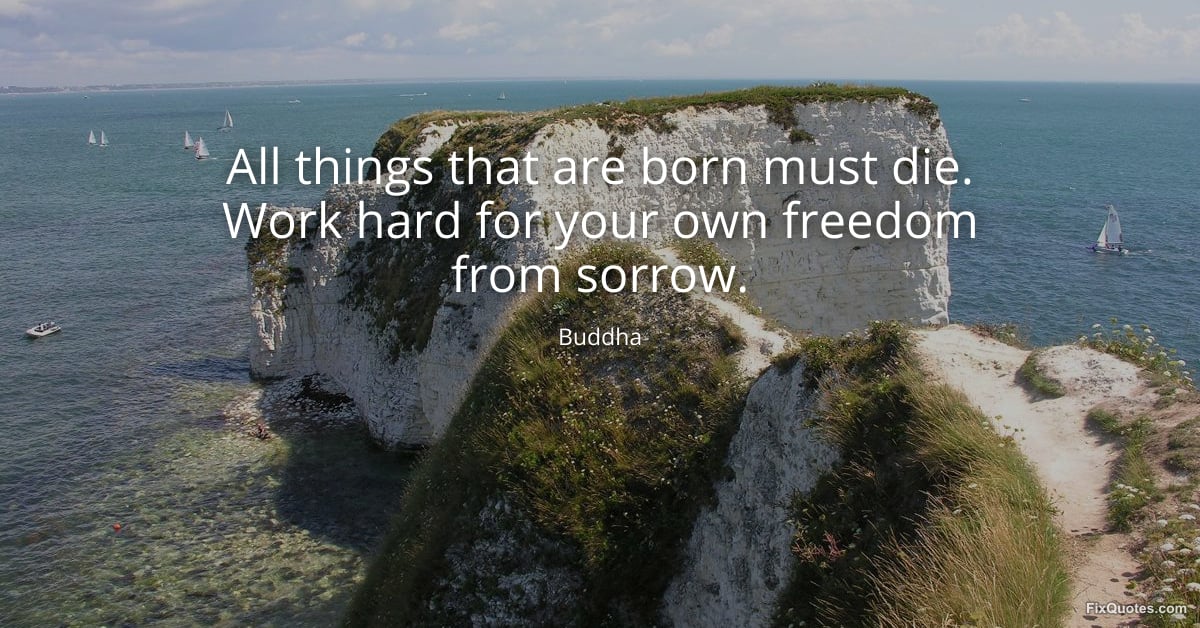
"All things that are born must die. Work hard for your own freedom from sorrow"
About this Quote
That is the quote's severity and its mercy. Buddha is not offering comfort in the ordinary consoling sense. There is no promise that the world will become less fragile, no appeal to divine rescue, no sentimental exemption for the grieving heart. The burden shifts inward. "Work hard" matters because liberation is neither inherited nor granted by authority. It demands discipline, attention, and a ruthless honesty about attachment, desire, and illusion.
In historical context, this is the language of a religious founder breaking with ritual status and metaphysical speculation in favor of practice. The urgency reflects a culture saturated with suffering, impermanence, and cycles of rebirth, but its rhetorical power is strikingly modern: face reality without anesthesia, then train the mind. The subtext is almost political in its insistence on self-cultivation over dependence. Freedom from sorrow is treated not as a mood but as an achievement. That is why the line endures. It refuses both despair and fantasy, asking for the harder thing: liberation through clear seeing.
Quote Details
| Topic | Mortality |
|---|---|
| Source | Help us find the source |
| Cite |
Citation Formats
APA Style (7th ed.)
Buddha. (2026, March 10). All things that are born must die. Work hard for your own freedom from sorrow. FixQuotes. https://fixquotes.com/quotes/all-things-that-are-born-must-die-work-hard-for-185984/
Chicago Style
Buddha. "All things that are born must die. Work hard for your own freedom from sorrow." FixQuotes. March 10, 2026. https://fixquotes.com/quotes/all-things-that-are-born-must-die-work-hard-for-185984/.
MLA Style (9th ed.)
"All things that are born must die. Work hard for your own freedom from sorrow." FixQuotes, 10 Mar. 2026, https://fixquotes.com/quotes/all-things-that-are-born-must-die-work-hard-for-185984/. Accessed 3 Apr. 2026.