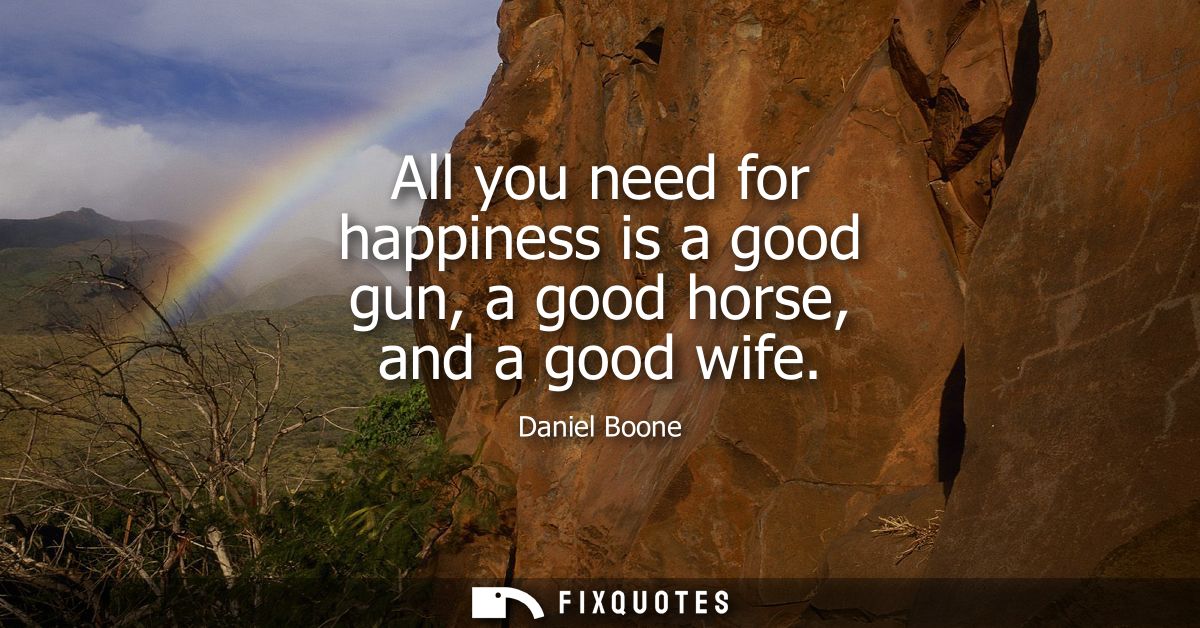
"All you need for happiness is a good gun, a good horse, and a good wife"
About this Quote
The phrase "a good wife" is the most revealing clause, not because it's quaint but because it exposes the social architecture behind the myth of rugged independence. The frontier man gets cast as solitary, yet Boone's list quietly admits that endurance depends on unpaid labor: childcare, food preservation, medical care, emotional ballast, and the maintenance of a household that makes roaming possible. Calling her "good" turns a person into a function, the same way "good gun" and "good horse" do, flattening relationship into reliability.
Intent-wise, it's a boast dressed as practicality: happiness is not cultivated through refinement but secured through competence and control. Subtext-wise, it's also a political statement about masculinity and property - happiness as something you own, carry, and manage, rather than something negotiated with a community. Read today, it lands as both a time capsule of frontier realities and a blunt reminder of how American freedom narratives often rest on someone else's invisibilized work.
Quote Details
| Topic | Happiness |
|---|---|
| Source | Help us find the source |
| Cite |
Citation Formats
APA Style (7th ed.)
Boone, Daniel. (2026, January 15). All you need for happiness is a good gun, a good horse, and a good wife. FixQuotes. https://fixquotes.com/quotes/all-you-need-for-happiness-is-a-good-gun-a-good-19009/
Chicago Style
Boone, Daniel. "All you need for happiness is a good gun, a good horse, and a good wife." FixQuotes. January 15, 2026. https://fixquotes.com/quotes/all-you-need-for-happiness-is-a-good-gun-a-good-19009/.
MLA Style (9th ed.)
"All you need for happiness is a good gun, a good horse, and a good wife." FixQuotes, 15 Jan. 2026, https://fixquotes.com/quotes/all-you-need-for-happiness-is-a-good-gun-a-good-19009/. Accessed 19 Feb. 2026.