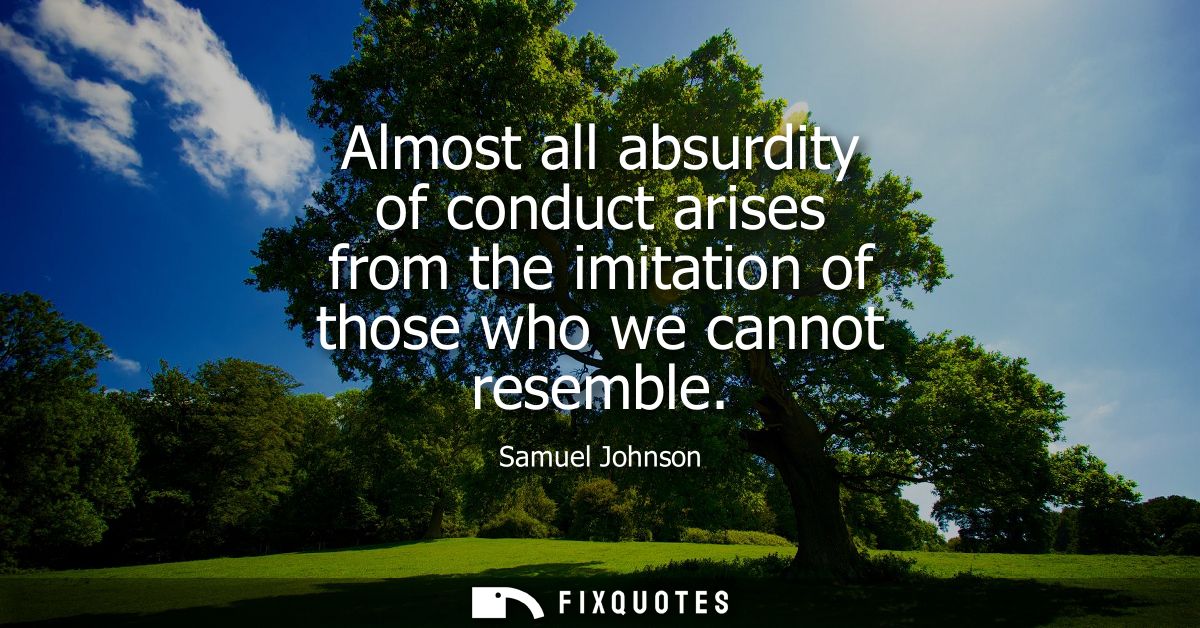
"Almost all absurdity of conduct arises from the imitation of those who we cannot resemble"
About this Quote
The intent is practical and corrective, very Johnsonian: he wants to yank readers back from the vanity of comparison toward a sturdier self-knowledge. In 18th-century Britain, that’s also a social critique. Status and refinement were marketed through manners, accent, taste, even leisure itself. If your station didn’t permit the full costume of gentility, imitation became a trap: spend beyond your means, adopt affectations you can’t sustain, chase reputations that won’t stick. Absurdity, here, is what happens when social mobility is pursued through surfaces rather than substance.
The subtext is sharper: imitation isn’t just harmless mimicry; it’s a surrender of judgment. You outsource your values to someone else’s image and then wonder why your choices don’t fit. Johnson catches a timeless mechanism of culture: envy laundering itself as “inspiration,” until the gap between self and model turns ordinary life into a series of awkward poses.
Quote Details
| Topic | Wisdom |
|---|---|
| Source | Help us find the source |
| Cite |
Citation Formats
APA Style (7th ed.)
Johnson, Samuel. (2026, January 18). Almost all absurdity of conduct arises from the imitation of those who we cannot resemble. FixQuotes. https://fixquotes.com/quotes/almost-all-absurdity-of-conduct-arises-from-the-1732/
Chicago Style
Johnson, Samuel. "Almost all absurdity of conduct arises from the imitation of those who we cannot resemble." FixQuotes. January 18, 2026. https://fixquotes.com/quotes/almost-all-absurdity-of-conduct-arises-from-the-1732/.
MLA Style (9th ed.)
"Almost all absurdity of conduct arises from the imitation of those who we cannot resemble." FixQuotes, 18 Jan. 2026, https://fixquotes.com/quotes/almost-all-absurdity-of-conduct-arises-from-the-1732/. Accessed 1 Apr. 2026.