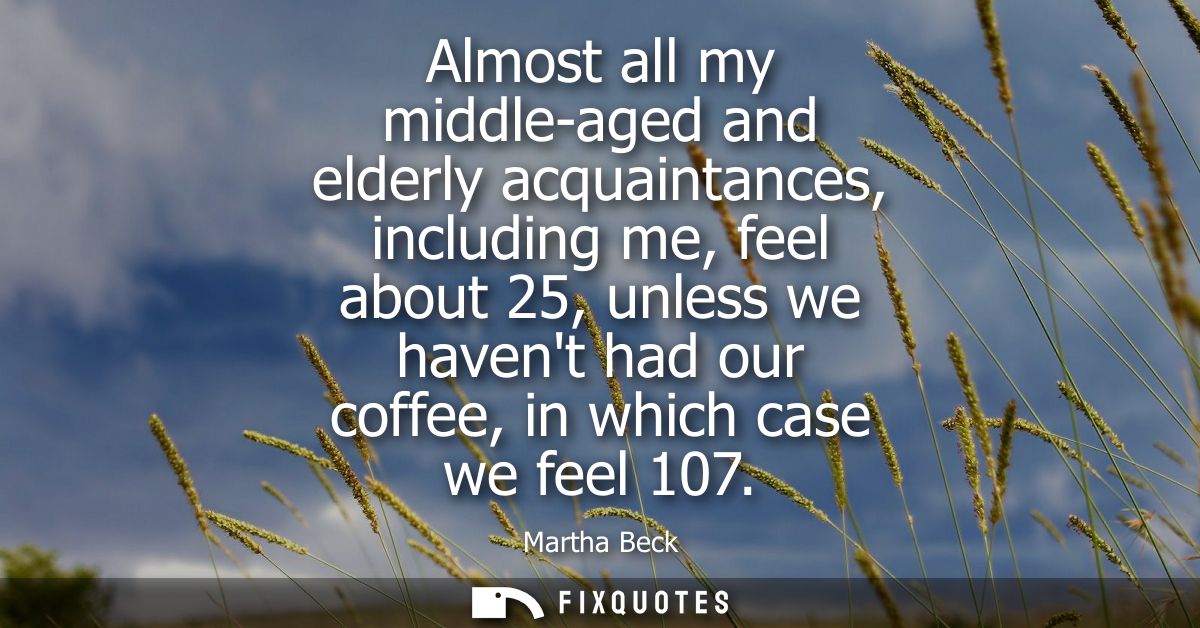
"Almost all my middle-aged and elderly acquaintances, including me, feel about 25, unless we haven't had our coffee, in which case we feel 107"
About this Quote
The coffee punchline is doing more than getting a laugh. It’s a sly acknowledgment that “old” is often a sensation problem before it’s an identity: stiffness, fatigue, low blood sugar, bad sleep. Take away the immediate discomfort and the self snaps back to its familiar age. That’s both comforting and slightly unsettling, because it implies maturity isn’t a steady achievement so much as a mood with props. The number “107” is cartoonish on purpose, exaggerating the morning’s fragility to expose how thin the veneer is between “I’m fine” and “I am ancient.”
Context matters: Beck writes in a culture obsessed with youth as currency while quietly building lives that demand endurance. Her intent isn’t to deny aging’s realities, but to puncture the moralism around it. If you still feel 25, you’re not failing to “act your age”; you’re experiencing a common cognitive continuity. The subtext is permission: to treat the inner self as durable, to treat the body with pragmatic care, and to laugh at the gap between how we narrate ourselves and how we wake up.
Quote Details
| Topic | Aging |
|---|---|
| Source | Help us find the source |
| Cite |
Citation Formats
APA Style (7th ed.)
Beck, Martha. (2026, January 17). Almost all my middle-aged and elderly acquaintances, including me, feel about 25, unless we haven't had our coffee, in which case we feel 107. FixQuotes. https://fixquotes.com/quotes/almost-all-my-middle-aged-and-elderly-57825/
Chicago Style
Beck, Martha. "Almost all my middle-aged and elderly acquaintances, including me, feel about 25, unless we haven't had our coffee, in which case we feel 107." FixQuotes. January 17, 2026. https://fixquotes.com/quotes/almost-all-my-middle-aged-and-elderly-57825/.
MLA Style (9th ed.)
"Almost all my middle-aged and elderly acquaintances, including me, feel about 25, unless we haven't had our coffee, in which case we feel 107." FixQuotes, 17 Jan. 2026, https://fixquotes.com/quotes/almost-all-my-middle-aged-and-elderly-57825/. Accessed 26 Mar. 2026.