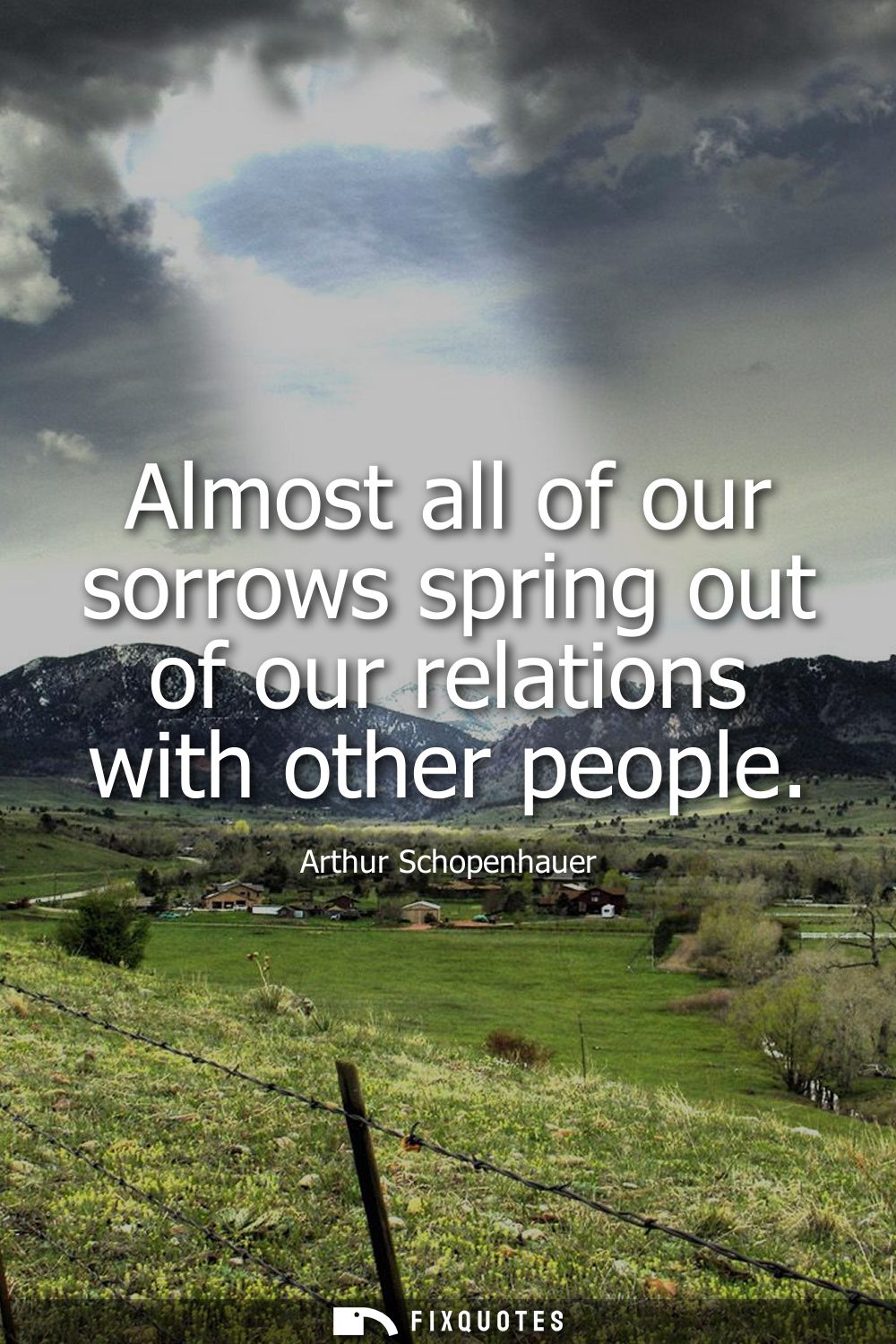
"Almost all of our sorrows spring out of our relations with other people"
About this Quote
The intent isn’t to diagnose sadness as a personal flaw; it’s to reframe it as a structural feature of human contact. Schopenhauer’s worldview treats the self as a bundle of restless wanting, and other people as the loudest amplifiers of that wanting. Relationships don’t merely add complications; they create new forms of vulnerability. What hurts is not just what others do, but what they represent: competition, comparison, rejection, dependency. Social life becomes a marketplace where you’re always priced, judged, and occasionally returned.
The subtext has a cold consolation. If sorrow is socially produced, it’s also socially avoidable - at least in theory. That’s where Schopenhauer’s ascetic streak shows: solitude as damage control, detachment as mental hygiene. Written in a 19th-century Europe obsessed with etiquette, class, and reputation, the quote reads like an early critique of what we’d now call social pressure. It lands today because the stage has expanded: the “relations” now include strangers with opinions, algorithms with incentives, and an endless, anxious audience.
Quote Details
| Topic | Wisdom |
|---|---|
| Source | Help us find the source |
| Cite |
Citation Formats
APA Style (7th ed.)
Schopenhauer, Arthur. (2026, January 15). Almost all of our sorrows spring out of our relations with other people. FixQuotes. https://fixquotes.com/quotes/almost-all-of-our-sorrows-spring-out-of-our-379/
Chicago Style
Schopenhauer, Arthur. "Almost all of our sorrows spring out of our relations with other people." FixQuotes. January 15, 2026. https://fixquotes.com/quotes/almost-all-of-our-sorrows-spring-out-of-our-379/.
MLA Style (9th ed.)
"Almost all of our sorrows spring out of our relations with other people." FixQuotes, 15 Jan. 2026, https://fixquotes.com/quotes/almost-all-of-our-sorrows-spring-out-of-our-379/. Accessed 10 Feb. 2026.