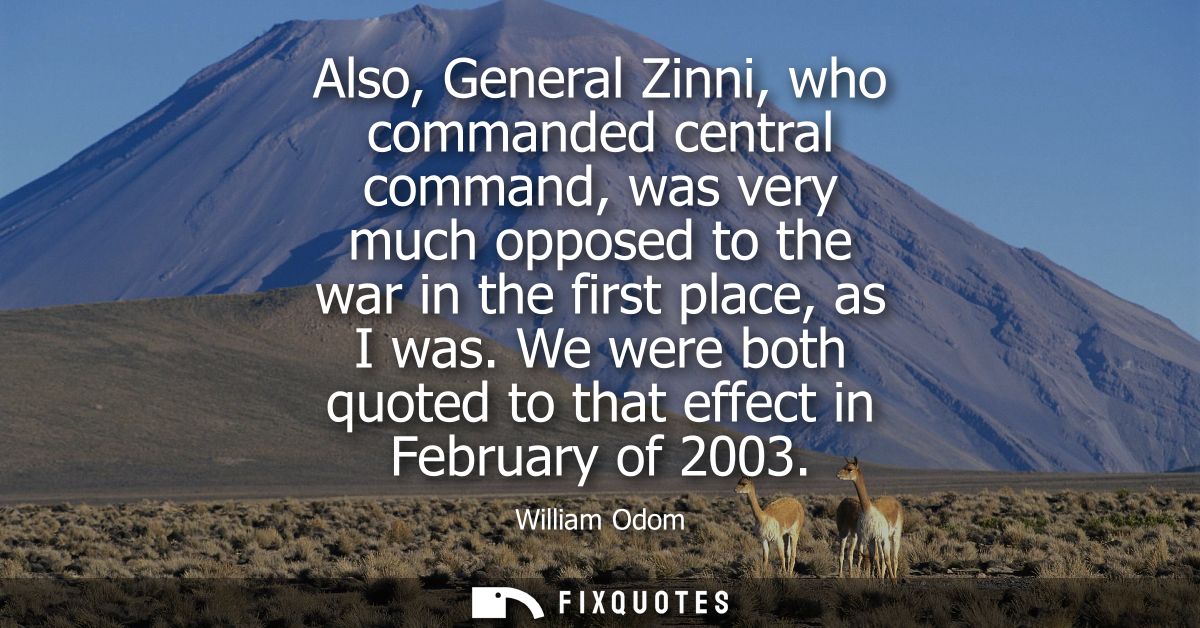
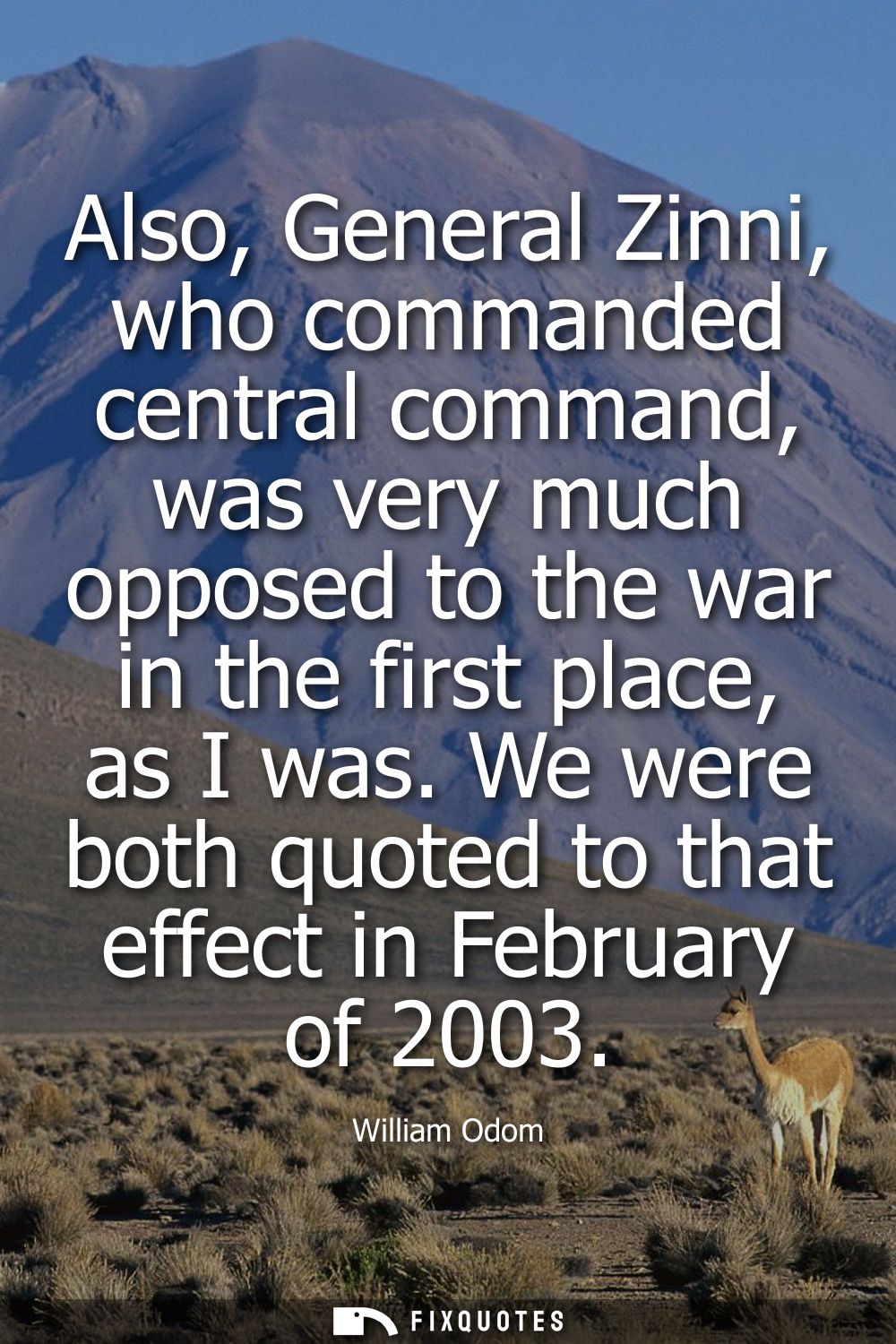
"Also, General Zinni, who commanded Central Command, was very much opposed to the war in the first place, as I was. We were both quoted to that effect in February of 2003"
About this Quote
The syntax does quiet work. “Also” suggests a dossier already on the table, as if this is one item in a longer list of professional objections. “Very much opposed” is blunt, unadorned, almost military in its refusal to entertain euphemism. Then comes the key move: “as I was.” Odom pairs himself with Zinni to frame dissent as a shared institutional judgment, not a lone contrarian’s memoir-branding.
The phrase “quoted to that effect” signals something else: this wasn’t whispered skepticism after the fact. It was on the record, time-stamped, and therefore ethically radioactive for the war’s architects. “February of 2003” matters because it’s the moment when certainty was being manufactured and sold; being publicly opposed then means you resisted the gravitational pull of the consensus-building machine before the first shock-and-awe frame hit TV.
Subtext: we warned you, in public, from a position of operational literacy. If the war went badly, don’t pretend no one in uniform foresaw the mismatch between aims, intelligence, and occupation realities. This is less self-exoneration than a challenge to the mythology that the military uniformly wanted what Washington decided.
Quote Details
| Topic | War |
|---|---|
| Source | Help us find the source |
| Cite |
Citation Formats
APA Style (7th ed.)
Odom, William. (2026, February 16). Also, General Zinni, who commanded Central Command, was very much opposed to the war in the first place, as I was. We were both quoted to that effect in February of 2003. FixQuotes. https://fixquotes.com/quotes/also-general-zinni-who-commanded-central-command-131455/
Chicago Style
Odom, William. "Also, General Zinni, who commanded Central Command, was very much opposed to the war in the first place, as I was. We were both quoted to that effect in February of 2003." FixQuotes. February 16, 2026. https://fixquotes.com/quotes/also-general-zinni-who-commanded-central-command-131455/.
MLA Style (9th ed.)
"Also, General Zinni, who commanded Central Command, was very much opposed to the war in the first place, as I was. We were both quoted to that effect in February of 2003." FixQuotes, 16 Feb. 2026, https://fixquotes.com/quotes/also-general-zinni-who-commanded-central-command-131455/. Accessed 28 Mar. 2026.