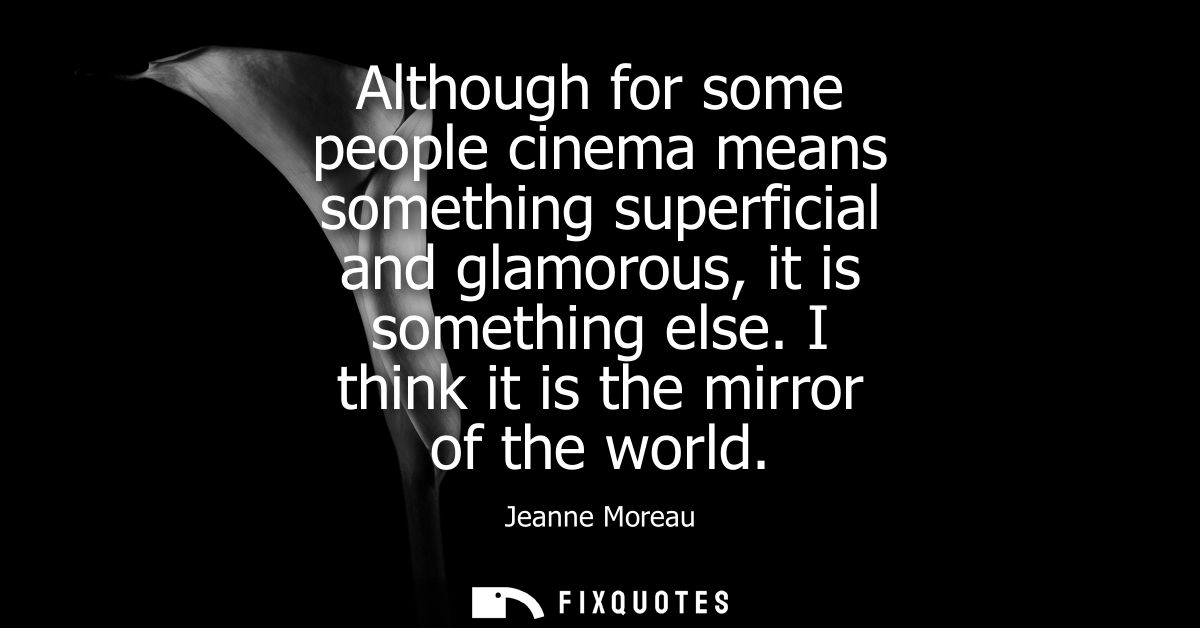
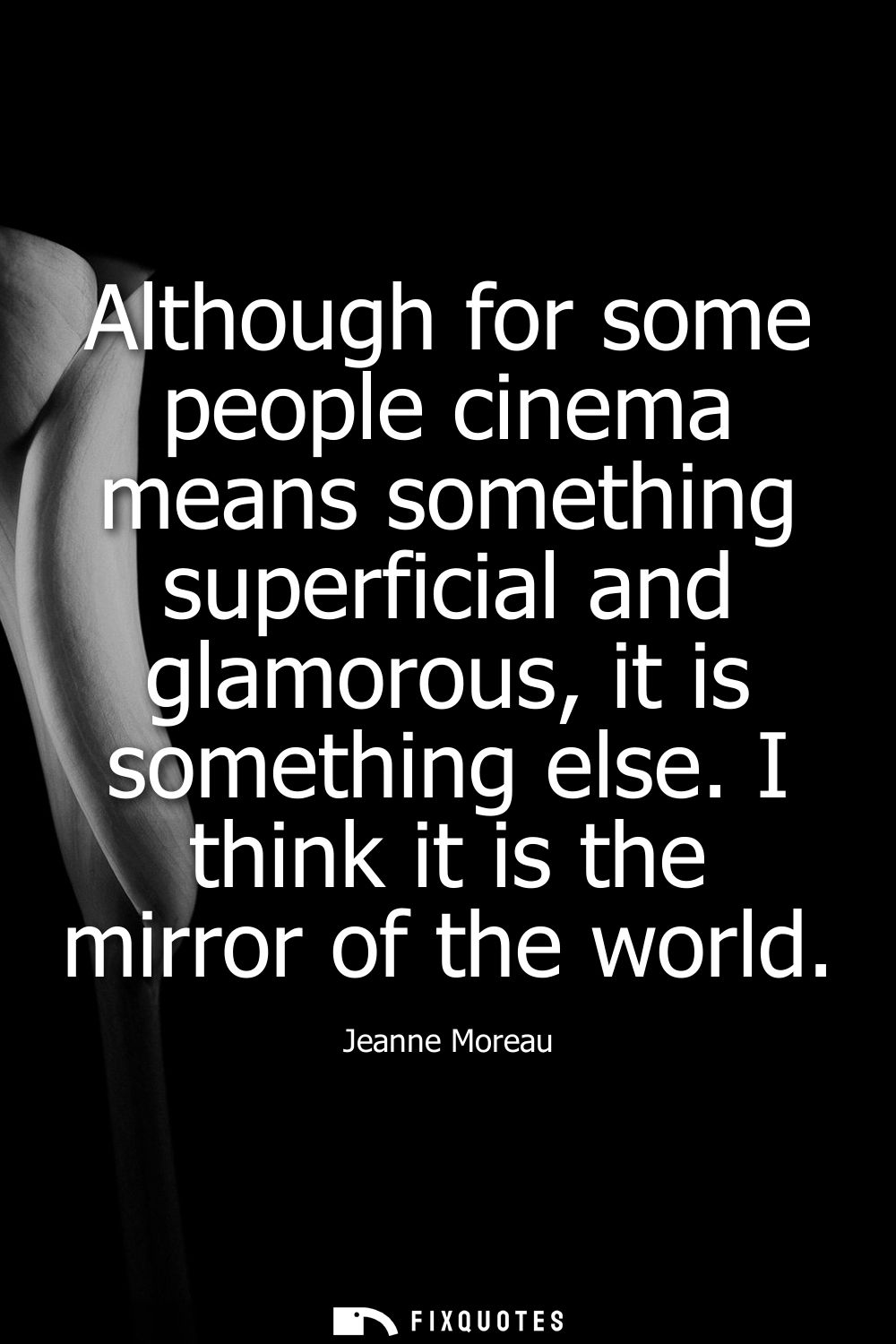
"Although for some people cinema means something superficial and glamorous, it is something else. I think it is the mirror of the world"
About this Quote
The subtext is Moreau drawing a boundary around seriousness at a moment when “movie star” could easily mean commodity. Coming out of postwar French cinema and the New Wave orbit, she lived through an era when film was fighting to be treated as literature’s equal: a form capable of moral inquiry, political argument, and intimate truth. Her phrasing suggests impatience with audiences who consume movies as lifestyle accessories. It’s also a warning to filmmakers: if cinema mirrors the world, you’re responsible for what you choose to reflect and what you leave outside the frame.
There’s a clever ambiguity in “mirror,” too. Mirrors don’t generate reality; they select an angle, depend on light, and can be staged. Moreau’s point lands because it refuses both cynicism (“it’s only escapism”) and naive reverence (“it’s pure truth”). Cinema is implicated. It’s entertainment that doubles as evidence.
Quote Details
| Topic | Movie |
|---|---|
| Source | Help us find the source |
| Cite |
Citation Formats
APA Style (7th ed.)
Moreau, Jeanne. (2026, January 15). Although for some people cinema means something superficial and glamorous, it is something else. I think it is the mirror of the world. FixQuotes. https://fixquotes.com/quotes/although-for-some-people-cinema-means-something-53716/
Chicago Style
Moreau, Jeanne. "Although for some people cinema means something superficial and glamorous, it is something else. I think it is the mirror of the world." FixQuotes. January 15, 2026. https://fixquotes.com/quotes/although-for-some-people-cinema-means-something-53716/.
MLA Style (9th ed.)
"Although for some people cinema means something superficial and glamorous, it is something else. I think it is the mirror of the world." FixQuotes, 15 Jan. 2026, https://fixquotes.com/quotes/although-for-some-people-cinema-means-something-53716/. Accessed 12 Feb. 2026.