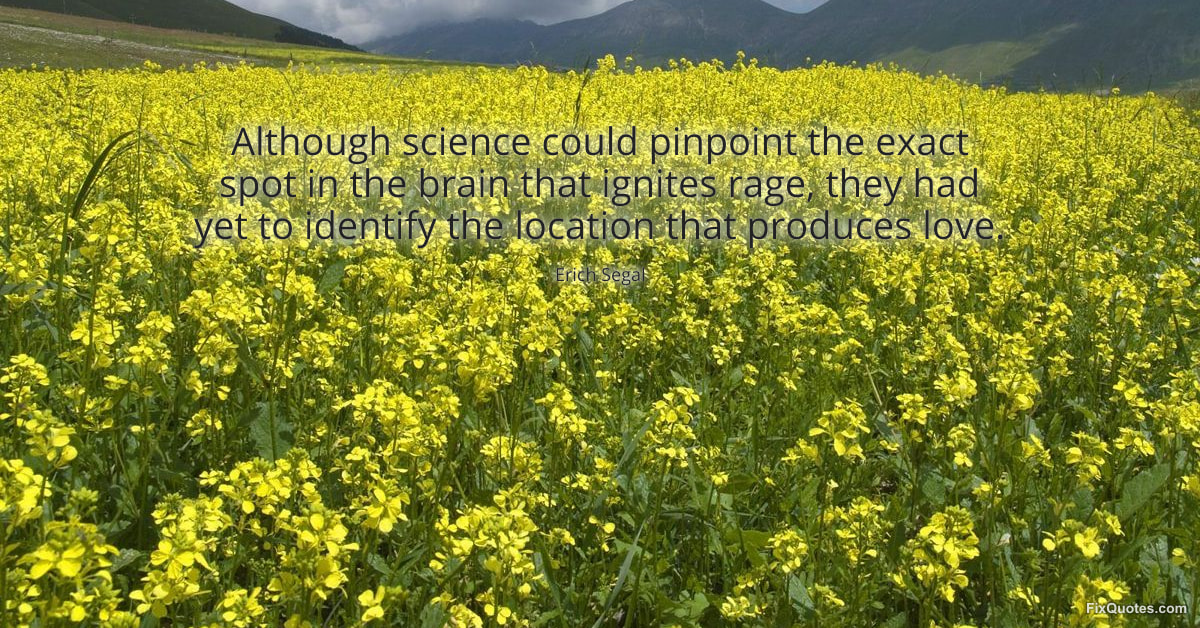
"Although science could pinpoint the exact spot in the brain that ignites rage, they had yet to identify the location that produces love"
About this Quote
Segal’s line trades on a delicious asymmetry: rage is a switch we can supposedly map, while love remains stubbornly unlocatable. The intent isn’t to dunk on neuroscience so much as to stage a romantic defense of mystery. By giving anger an “exact spot,” he makes it sound mechanical, almost cheap - a lab result you could circle with a pen. Love, by contrast, becomes the one experience that refuses to be reduced to coordinates. That contrast flatters the reader’s private life: your worst impulses are explainable, but your best attachments still feel singular.
The subtext carries a quiet moral preference. Rage is framed as a problem science can manage; love is framed as an achievement science can’t fully claim. It’s a clever inversion of modern prestige. In a culture that treats measurement as truth, Segal suggests that the most important human force might be precisely the one that eludes instrumentation. He’s also smuggling in a narrative strategy familiar from his work: love as fate, love as a story we live inside rather than a symptom we observe from outside.
Context matters. Segal wrote at a time when brain science was gaining popular authority and pop culture was beginning to speak in the language of “wiring” and “chemistry.” The quote taps that moment’s confidence, then punctures it with a novelist’s bias: interior life is not a diagram. Even now, when we can image correlations for affection and attachment, the line still lands because it’s less a factual claim than a cultural critique of what we think knowledge is for - prediction, control, and the comforting illusion that everything meaningful has an address.
The subtext carries a quiet moral preference. Rage is framed as a problem science can manage; love is framed as an achievement science can’t fully claim. It’s a clever inversion of modern prestige. In a culture that treats measurement as truth, Segal suggests that the most important human force might be precisely the one that eludes instrumentation. He’s also smuggling in a narrative strategy familiar from his work: love as fate, love as a story we live inside rather than a symptom we observe from outside.
Context matters. Segal wrote at a time when brain science was gaining popular authority and pop culture was beginning to speak in the language of “wiring” and “chemistry.” The quote taps that moment’s confidence, then punctures it with a novelist’s bias: interior life is not a diagram. Even now, when we can image correlations for affection and attachment, the line still lands because it’s less a factual claim than a cultural critique of what we think knowledge is for - prediction, control, and the comforting illusion that everything meaningful has an address.
Quote Details
| Topic | Love |
|---|
More Quotes by Erich
Add to List