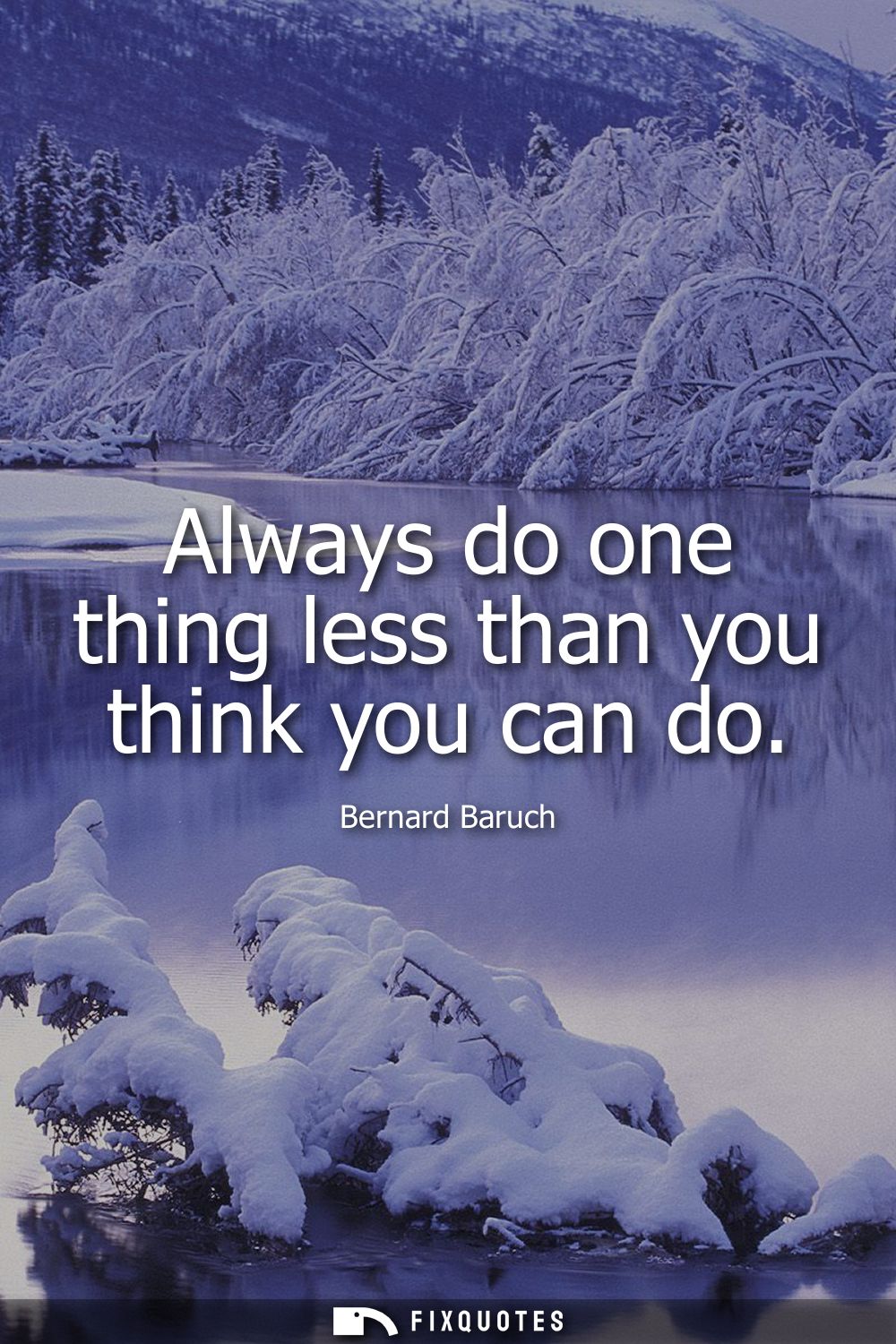
"Always do one thing less than you think you can do"
About this Quote
Self-restraint is the flex here, not hustle. Baruch’s line reads like a paradox until you hear the voice of a man who made and kept money in a world where overreach is the standard way fortunes evaporate. “Always do one thing less” isn’t a call to underachieve; it’s a strategy for longevity. In business, the fatal mistake is rarely laziness. It’s the extra deal, the extra leverage, the extra promise you make because you feel invincible and the market hasn’t corrected you lately.
The intent is surgical: build a margin. Baruch is prescribing slack as a form of discipline. Leave one bullet in the chamber. Leave time unbooked. Leave a little capital uncommitted. That “less” is a hedge against the two forces that humiliate confident people: randomness and ego. The subtext is an old investor’s suspicion that your self-assessment is inflated precisely when you most trust it. When you “think you can do” five things, do four, because the fifth is where hidden costs live: exhaustion, errors, reputational damage, the deal you take just to prove you can.
Context matters: Baruch operated through booms, panics, and wars, advising presidents and navigating markets before modern guardrails. In that era, one bad bet could mean ruin, not a rough quarter. The aphorism works because it smuggles prudence into ambition. It doesn’t tell you to stop striving; it tells you to survive your own striving.
The intent is surgical: build a margin. Baruch is prescribing slack as a form of discipline. Leave one bullet in the chamber. Leave time unbooked. Leave a little capital uncommitted. That “less” is a hedge against the two forces that humiliate confident people: randomness and ego. The subtext is an old investor’s suspicion that your self-assessment is inflated precisely when you most trust it. When you “think you can do” five things, do four, because the fifth is where hidden costs live: exhaustion, errors, reputational damage, the deal you take just to prove you can.
Context matters: Baruch operated through booms, panics, and wars, advising presidents and navigating markets before modern guardrails. In that era, one bad bet could mean ruin, not a rough quarter. The aphorism works because it smuggles prudence into ambition. It doesn’t tell you to stop striving; it tells you to survive your own striving.
Quote Details
| Topic | Self-Discipline |
|---|---|
| Source | Help us find the source |
| Cite |
Citation Formats
APA Style (7th ed.)
Baruch, Bernard. (2026, January 17). Always do one thing less than you think you can do. FixQuotes. https://fixquotes.com/quotes/always-do-one-thing-less-than-you-think-you-can-do-41567/
Chicago Style
Baruch, Bernard. "Always do one thing less than you think you can do." FixQuotes. January 17, 2026. https://fixquotes.com/quotes/always-do-one-thing-less-than-you-think-you-can-do-41567/.
MLA Style (9th ed.)
"Always do one thing less than you think you can do." FixQuotes, 17 Jan. 2026, https://fixquotes.com/quotes/always-do-one-thing-less-than-you-think-you-can-do-41567/. Accessed 12 Feb. 2026.
More Quotes by Bernard
Add to List