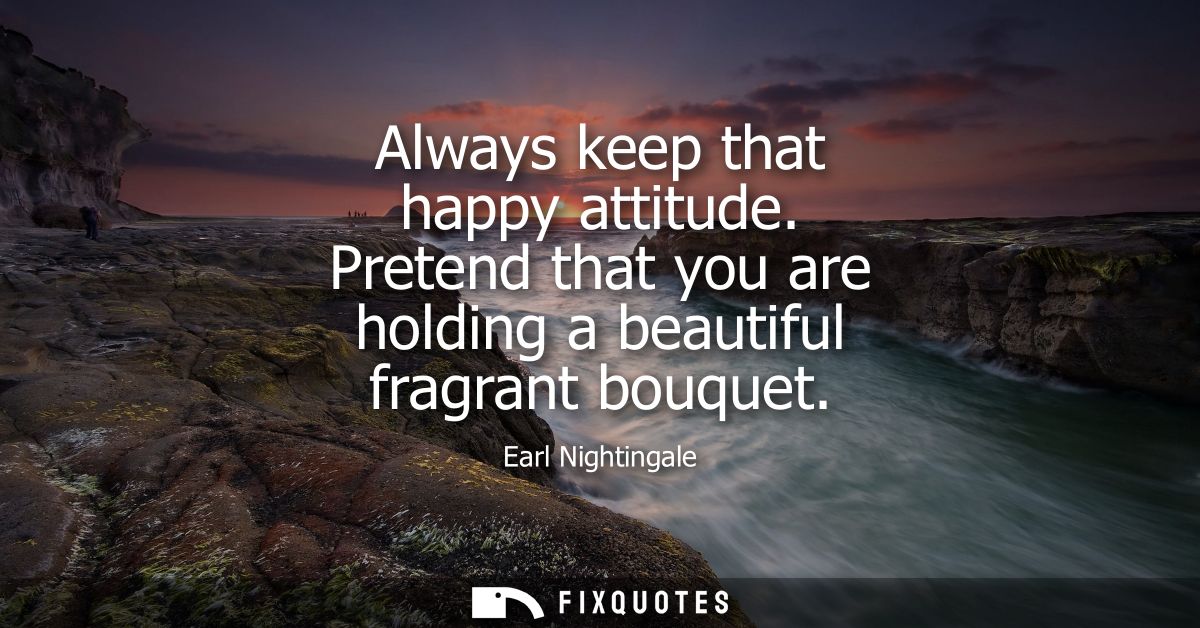
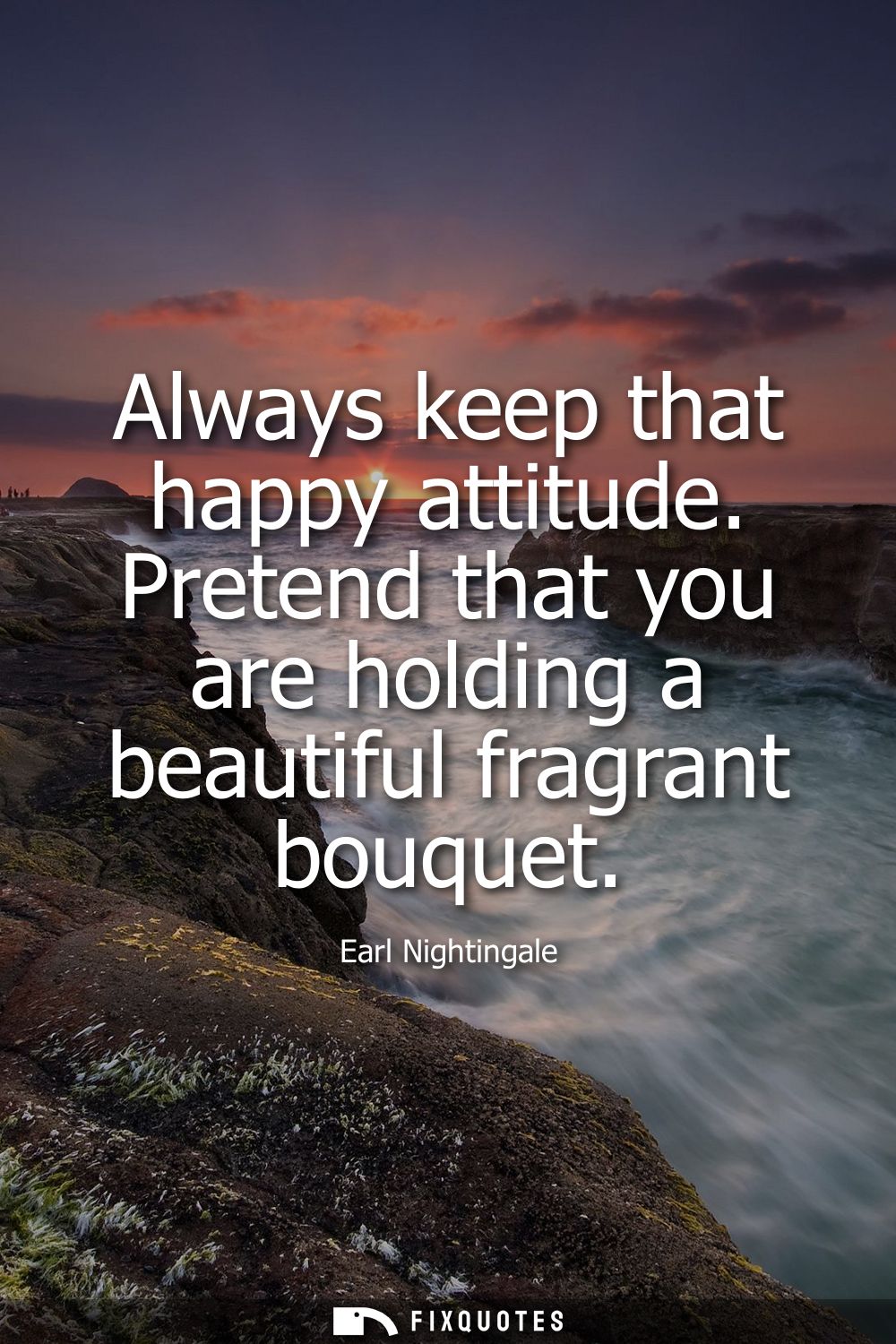
"Always keep that happy attitude. Pretend that you are holding a beautiful fragrant bouquet!"
About this Quote
The bouquet image does a lot of quiet labor. It’s tactile and social. You don’t hold a bouquet the way you hold a briefcase; your shoulders open, your grip softens, your chest lifts. A “beautiful fragrant” bouquet recruits multiple senses, implying that attitude is not just a thought but an embodied atmosphere. And a bouquet is a gift, a prop of celebration, a sign you’re on your way to something pleasant or you’ve just been chosen. The subtext is aspiration-by-association: borrow the cues of joy and your nervous system will follow.
Context matters. Nightingale came up in mid-century American prosperity culture, when personal success was marketed as a trainable skill and optimism was treated as both virtue and instrument. His line sits squarely in that tradition: emotional self-management as a kind of everyday professionalism. It’s tender, but also disciplinary: happiness as something you rehearse until it becomes your default setting.
Quote Details
| Topic | Happiness |
|---|---|
| Source | Help us find the source |
| Cite |
Citation Formats
APA Style (7th ed.)
Nightingale, Earl. (2026, February 20). Always keep that happy attitude. Pretend that you are holding a beautiful fragrant bouquet! FixQuotes. https://fixquotes.com/quotes/always-keep-that-happy-attitude-pretend-that-you-14388/
Chicago Style
Nightingale, Earl. "Always keep that happy attitude. Pretend that you are holding a beautiful fragrant bouquet!" FixQuotes. February 20, 2026. https://fixquotes.com/quotes/always-keep-that-happy-attitude-pretend-that-you-14388/.
MLA Style (9th ed.)
"Always keep that happy attitude. Pretend that you are holding a beautiful fragrant bouquet!" FixQuotes, 20 Feb. 2026, https://fixquotes.com/quotes/always-keep-that-happy-attitude-pretend-that-you-14388/. Accessed 22 Mar. 2026.