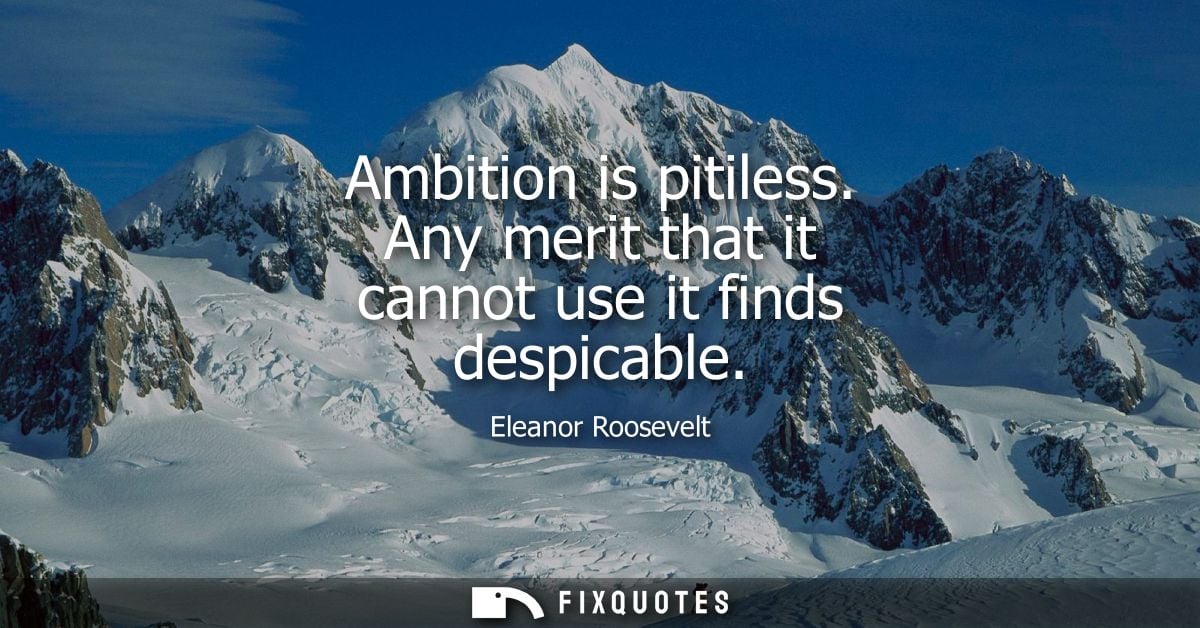
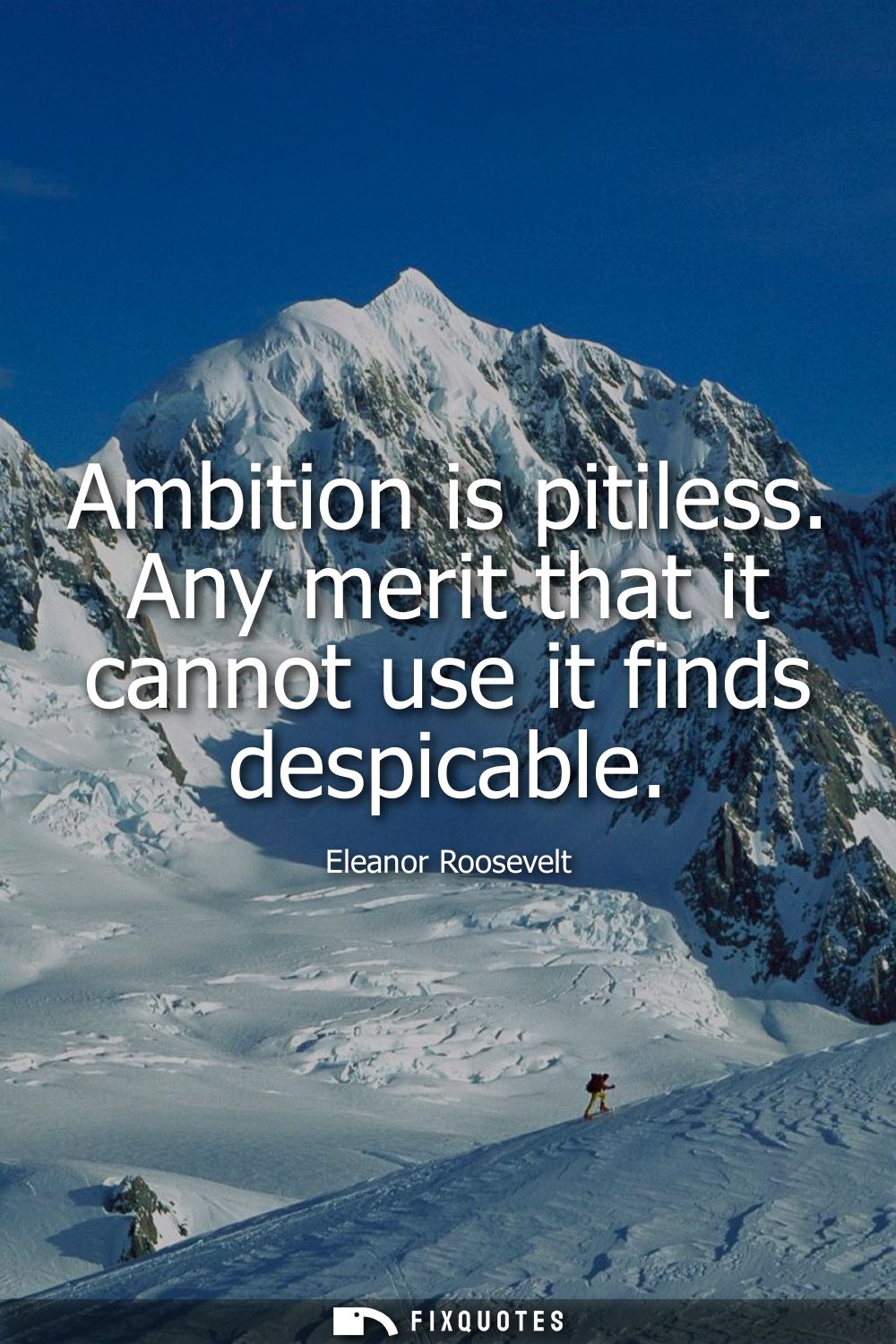
"Ambition is pitiless. Any merit that it cannot use it finds despicable"
About this Quote
Ambition, in Roosevelt's telling, isn't the glittering self-help virtue we like to pin to a blazer. It's an instrument: cold, selective, and essentially transactional. "Pitiless" does the heavy lifting here. Not cruel in a melodramatic way, but indifferent - the kind of moral blankness that shows up when a person (or an institution) decides the end is so important that other people become scenery.
The second sentence is the blade. Merit isn't denied; it's judged irrelevant. If ambition "cannot use" your talent, your integrity, your quiet competence, it doesn't merely ignore it - it brands it "despicable". That's a sharp diagnosis of how status games work: the qualities that can't be converted into leverage get mocked as naivete, weakness, or pretension. It's not just personal psychology; it's a social sorting mechanism. Ambition doesn't only climb. It polices the ladder by redefining virtue as whatever advances the climb.
Roosevelt knew this terrain intimately. As First Lady, she operated inside a political machine that rewarded loyalty, utility, and optics, while her own moral project - human rights, labor protections, racial justice - often required valuing people the system treated as politically expendable. The subtext reads like a warning from someone who watched "pragmatism" excuse a lot of ugliness: if you let ambition set the standards, it won't just change what you do. It will change what you are allowed to admire.
The second sentence is the blade. Merit isn't denied; it's judged irrelevant. If ambition "cannot use" your talent, your integrity, your quiet competence, it doesn't merely ignore it - it brands it "despicable". That's a sharp diagnosis of how status games work: the qualities that can't be converted into leverage get mocked as naivete, weakness, or pretension. It's not just personal psychology; it's a social sorting mechanism. Ambition doesn't only climb. It polices the ladder by redefining virtue as whatever advances the climb.
Roosevelt knew this terrain intimately. As First Lady, she operated inside a political machine that rewarded loyalty, utility, and optics, while her own moral project - human rights, labor protections, racial justice - often required valuing people the system treated as politically expendable. The subtext reads like a warning from someone who watched "pragmatism" excuse a lot of ugliness: if you let ambition set the standards, it won't just change what you do. It will change what you are allowed to admire.
Quote Details
| Topic | Ethics & Morality |
|---|
More Quotes by Eleanor
Add to List