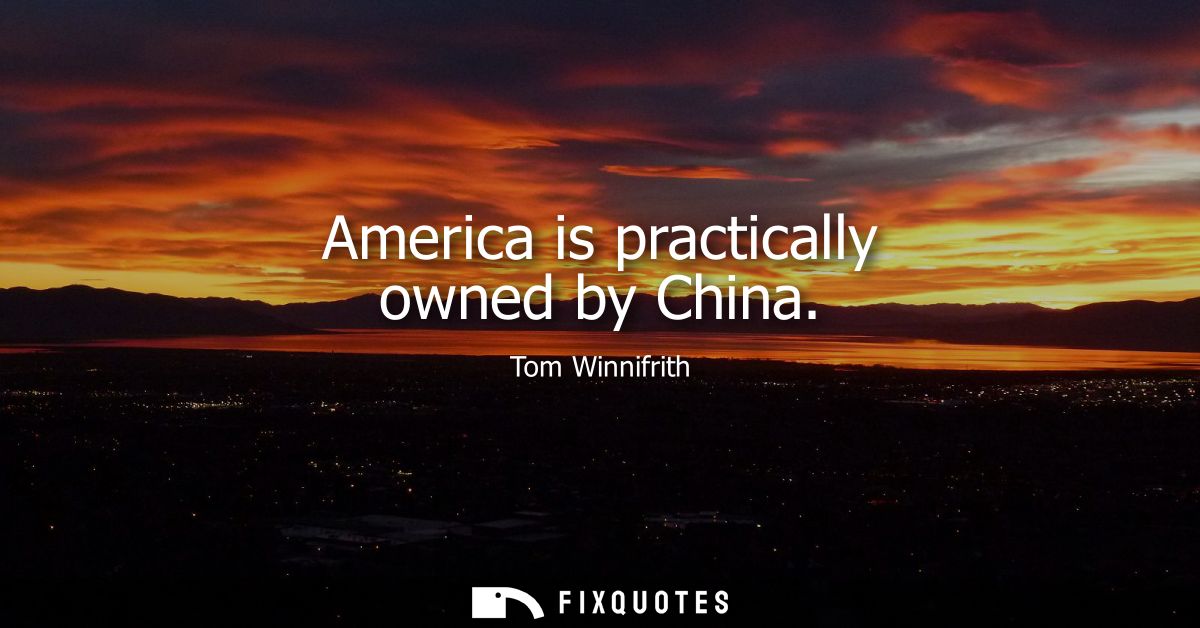
"America is practically owned by China"
About this Quote
“America is practically owned by China” is the kind of provocation journalists deploy when they want to drag a complicated web of trade, debt, and dependence into one blunt moral image: ownership. The intent isn’t literal legal control; it’s to frame an economic relationship as a power imbalance so stark it feels humiliating. “Practically” does a lot of work here, giving the writer plausible deniability while still landing the punch. It signals: I know you’ll object on technical grounds; I’m talking about outcomes.
The subtext is grievance dressed as realism. “Owned” isn’t neutral economics; it’s the language of domination, and it taps a familiar American anxiety about decline - the fear that the country’s sovereignty is being quietly auctioned off through supply chains, manufacturing offshoring, and financial interdependence. It also invites a certain kind of readerly satisfaction: the clarity of a villain and the simplicity of a scorecard. Complexities like mutual dependence, corporate choices, and domestic policy failures get compressed into a single external actor.
Context matters because this line only works in an era when geopolitics has been reframed as a zero-sum contest and “China” functions as shorthand for everything from cheap consumer goods to national security risk. It’s rhetorical leverage, not a spreadsheet claim. The point is to make complicity feel visceral: if America is “owned,” then someone sold it - and the accusation shifts from Beijing’s strategy to Washington’s negligence and Wall Street’s incentives. That’s why the line sticks: it weaponizes economics as identity.
The subtext is grievance dressed as realism. “Owned” isn’t neutral economics; it’s the language of domination, and it taps a familiar American anxiety about decline - the fear that the country’s sovereignty is being quietly auctioned off through supply chains, manufacturing offshoring, and financial interdependence. It also invites a certain kind of readerly satisfaction: the clarity of a villain and the simplicity of a scorecard. Complexities like mutual dependence, corporate choices, and domestic policy failures get compressed into a single external actor.
Context matters because this line only works in an era when geopolitics has been reframed as a zero-sum contest and “China” functions as shorthand for everything from cheap consumer goods to national security risk. It’s rhetorical leverage, not a spreadsheet claim. The point is to make complicity feel visceral: if America is “owned,” then someone sold it - and the accusation shifts from Beijing’s strategy to Washington’s negligence and Wall Street’s incentives. That’s why the line sticks: it weaponizes economics as identity.
Quote Details
| Topic | Freedom |
|---|---|
| Source | Help us find the source |
| Cite |
Citation Formats
APA Style (7th ed.)
Winnifrith, Tom. (2026, January 16). America is practically owned by China. FixQuotes. https://fixquotes.com/quotes/america-is-practically-owned-by-china-107691/
Chicago Style
Winnifrith, Tom. "America is practically owned by China." FixQuotes. January 16, 2026. https://fixquotes.com/quotes/america-is-practically-owned-by-china-107691/.
MLA Style (9th ed.)
"America is practically owned by China." FixQuotes, 16 Jan. 2026, https://fixquotes.com/quotes/america-is-practically-owned-by-china-107691/. Accessed 28 Mar. 2026.
More Quotes by Tom
Add to List