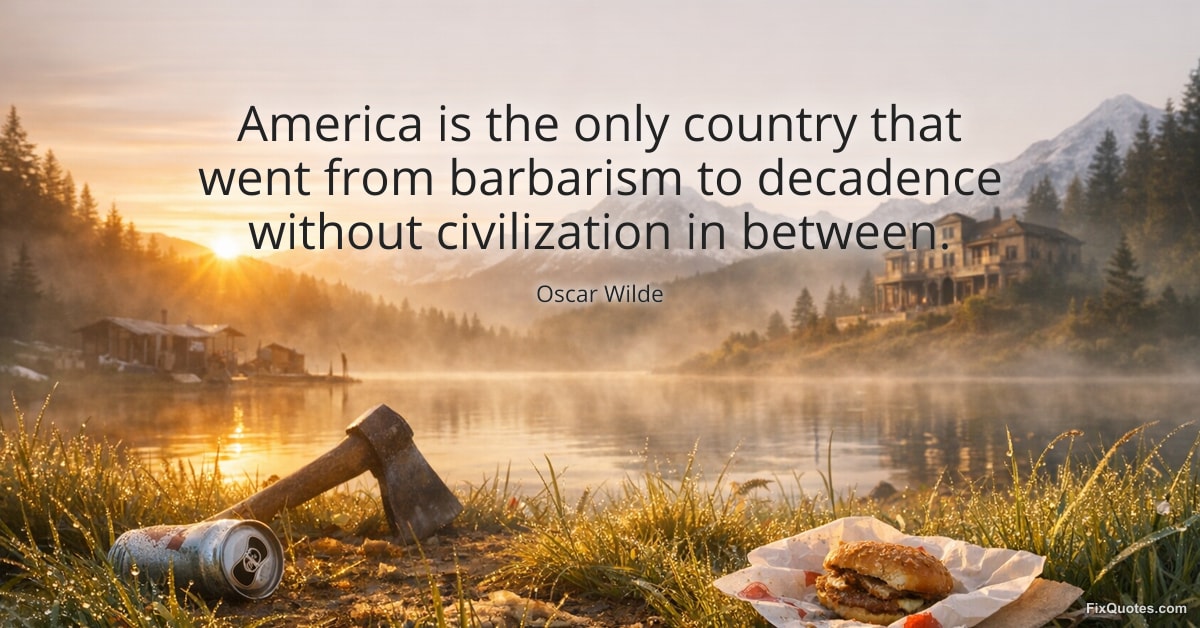
"America is the only country that went from barbarism to decadence without civilization in between"
About this Quote
The specific intent is twofold. First, it flatters Wilde’s own posture as the connoisseur who can diagnose cultural sickness at a glance. Second, it punctures America’s late-19th-century self-myth: a society that saw itself as industrious, moral, and modern. Wilde’s insinuation is that the country’s material dynamism has produced a shiny, overconfident decadence (money, spectacle, appetite) without the tempering institutions of “civilization” as Wilde understood it: old-world art, cultivated leisure, inherited manners, and a shared canon.
The subtext is less “Americans are uncultured” than “America is new money.” Decadence here isn’t just vice; it’s consumption without refinement, pleasure without apprenticeship. Wilde is also slyly defending decadence itself: in his aesthetic worldview, decadence can be high art when it’s conscious, ironic, and disciplined. America’s alleged failure is that it’s decadent in the bluntest way - loud, literal, and certain it has nothing to learn.
Context sharpens the bite. Wilde toured the United States in 1882, encountering a booming, commercial, publicity-driven culture that treated celebrities as commodities and culture as entertainment. The line reads as his revenge and his souvenir: a quip that turns culture shock into social theory, with a smirk.
Quote Details
| Topic | Sarcastic |
|---|---|
| Source | Later attribution: Hating America (Barry M. Rubin, Judith Colp Rubin, 2004) modern compilation
Evidence: ... Oscar Wilde, who would agree with Clemenceau on little else, declared, “America is the only country that went from barbarism to decadence without civilization in between.” Decades later the British writer George Bernard Shaw jeered: “An ... Other candidates (2) Oscar Wilde (Oscar Wilde) compilation37.5% ild intellect and the sham epigram which he wrote to thrill the very tamest part of our tame civilization g k chesterton The Happy Prince: And Other Tales (Oscar Wilde, George Percy Jacomb Hood, 1888) primary33.9% atchman and they wandered out into the rain then he flew back and told the prince what he had seen i am covered with ... |
| Cite |
Citation Formats
APA Style (7th ed.)
Wilde, Oscar. (2026, February 7). America is the only country that went from barbarism to decadence without civilization in between. FixQuotes. https://fixquotes.com/quotes/america-is-the-only-country-that-went-from-13743/
Chicago Style
Wilde, Oscar. "America is the only country that went from barbarism to decadence without civilization in between." FixQuotes. February 7, 2026. https://fixquotes.com/quotes/america-is-the-only-country-that-went-from-13743/.
MLA Style (9th ed.)
"America is the only country that went from barbarism to decadence without civilization in between." FixQuotes, 7 Feb. 2026, https://fixquotes.com/quotes/america-is-the-only-country-that-went-from-13743/. Accessed 30 Mar. 2026.