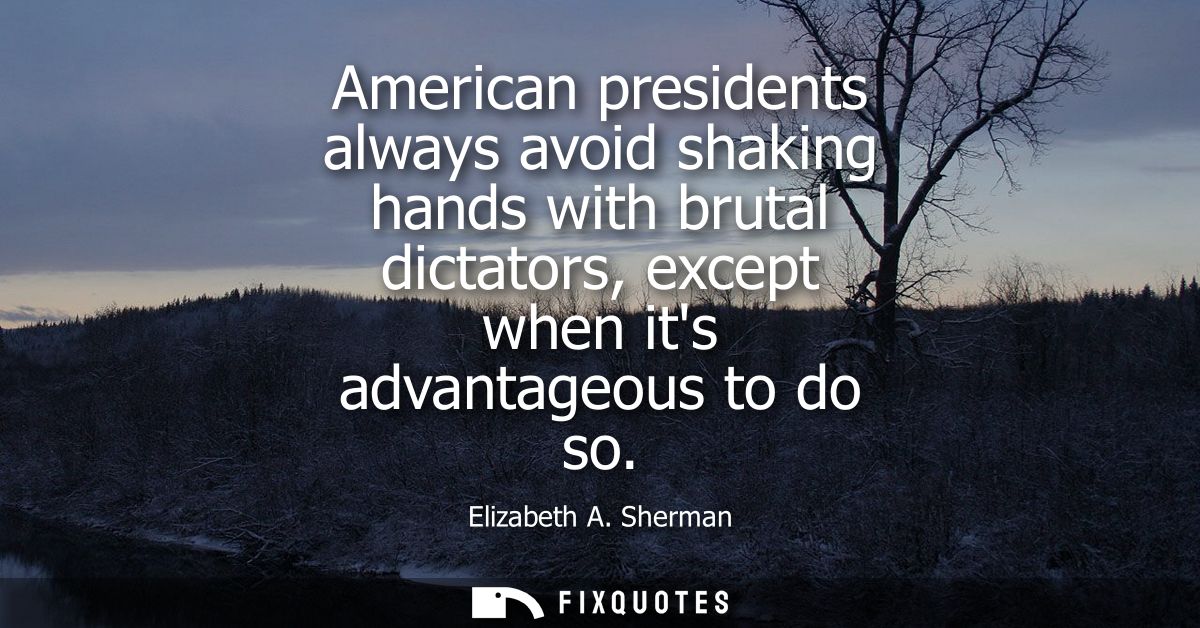
"American presidents always avoid shaking hands with brutal dictators, except when it's advantageous to do so"
About this Quote
The handshake is a small, almost banal gesture, which is why it’s such a sharp symbol. It’s public, photographic, and instantly legible; it’s also deniable. Leaders can sell it as “diplomacy,” “opening channels,” or “realism,” while critics read it as validation. Sherman’s point is that the debate is usually staged: the real decision isn’t whether a dictator is brutal (everyone knows), but whether the brutality is currently inconvenient to acknowledge.
There’s an educator’s clarity in the construction: “always” sets up an official myth of American restraint, and the exception reveals the curriculum’s missing chapter. The subtext is a familiar pattern in U.S. foreign policy: condemnation for adversaries, accommodation for strategic partners, and photo ops that launder relationships through the language of peace-making. It’s a sentence aimed at media cycles and history textbooks alike, asking who gets labeled untouchable, who gets rehabilitated, and what “advantageous” quietly includes: bases, oil, intelligence, trade, leverage.
Quote Details
| Topic | Sarcastic |
|---|---|
| Source | Help us find the source |
| Cite |
Citation Formats
APA Style (7th ed.)
Sherman, Elizabeth A. (2026, January 15). American presidents always avoid shaking hands with brutal dictators, except when it's advantageous to do so. FixQuotes. https://fixquotes.com/quotes/american-presidents-always-avoid-shaking-hands-148006/
Chicago Style
Sherman, Elizabeth A. "American presidents always avoid shaking hands with brutal dictators, except when it's advantageous to do so." FixQuotes. January 15, 2026. https://fixquotes.com/quotes/american-presidents-always-avoid-shaking-hands-148006/.
MLA Style (9th ed.)
"American presidents always avoid shaking hands with brutal dictators, except when it's advantageous to do so." FixQuotes, 15 Jan. 2026, https://fixquotes.com/quotes/american-presidents-always-avoid-shaking-hands-148006/. Accessed 29 Mar. 2026.