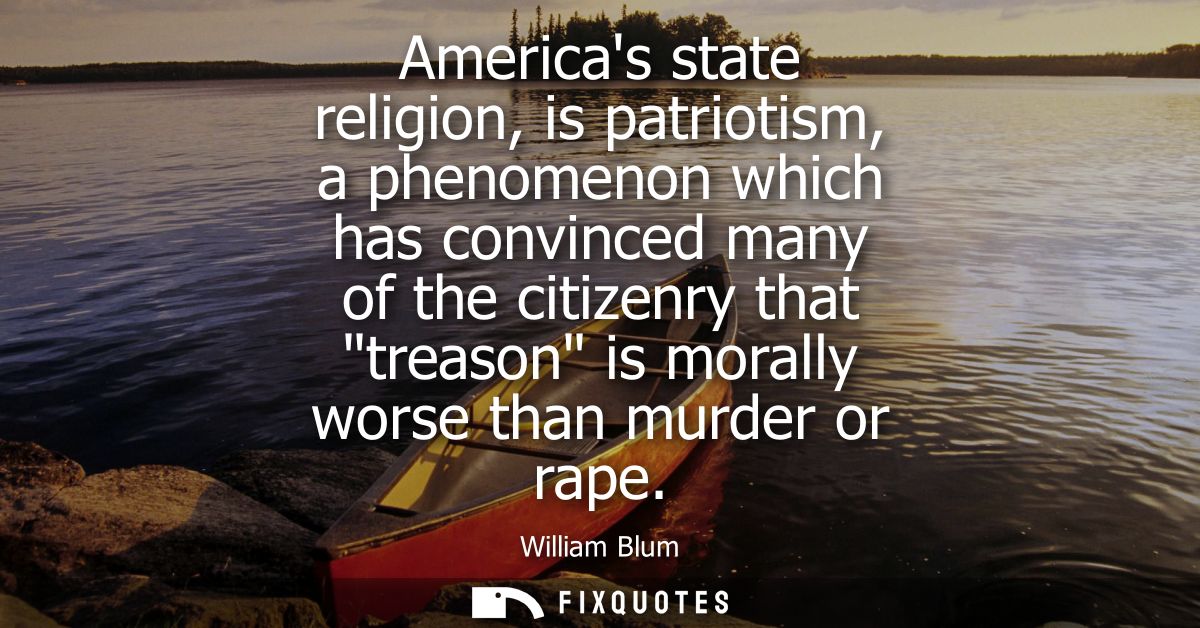
"America's state religion, is patriotism, a phenomenon which has convinced many of the citizenry that "treason" is morally worse than murder or rape"
About this Quote
The sting is in his moral comparison. Treason versus “murder or rape” is not a casual escalation; it forces the reader to notice how national-security discourse reorders ethics. Violent crimes harm bodies; “treason” harms the state’s story about itself. Blum’s subtext is that the U.S. political culture often treats the latter as the unforgivable sin because it threatens legitimacy, power, and cohesion. That’s why whistleblowers, dissenters, and defectors can be painted as monsters more readily than perpetrators of interpersonal violence, particularly when the accused is linked to foreign enemies. The quote isn’t arguing that murder is excusable; it’s arguing that the state’s outrage is selective, and selection reveals priorities.
Context matters: Blum built a career cataloging U.S. covert operations and interventions, and he wrote from the long shadow of the Cold War, when “un-American” functioned as a civic excommunication. Post-9/11 politics made his framing newly legible: security language expands, loyalty tests proliferate, and “patriotism” becomes a shortcut to end debate. The intent is to unmask that shortcut as a moral shortcut, too.
Quote Details
| Topic | Ethics & Morality |
|---|---|
| Source | Help us find the source |
| Cite |
Citation Formats
APA Style (7th ed.)
Blum, William. (2026, January 16). America's state religion, is patriotism, a phenomenon which has convinced many of the citizenry that "treason" is morally worse than murder or rape. FixQuotes. https://fixquotes.com/quotes/americas-state-religion-is-patriotism-a-90864/
Chicago Style
Blum, William. "America's state religion, is patriotism, a phenomenon which has convinced many of the citizenry that "treason" is morally worse than murder or rape." FixQuotes. January 16, 2026. https://fixquotes.com/quotes/americas-state-religion-is-patriotism-a-90864/.
MLA Style (9th ed.)
"America's state religion, is patriotism, a phenomenon which has convinced many of the citizenry that "treason" is morally worse than murder or rape." FixQuotes, 16 Jan. 2026, https://fixquotes.com/quotes/americas-state-religion-is-patriotism-a-90864/. Accessed 12 Feb. 2026.