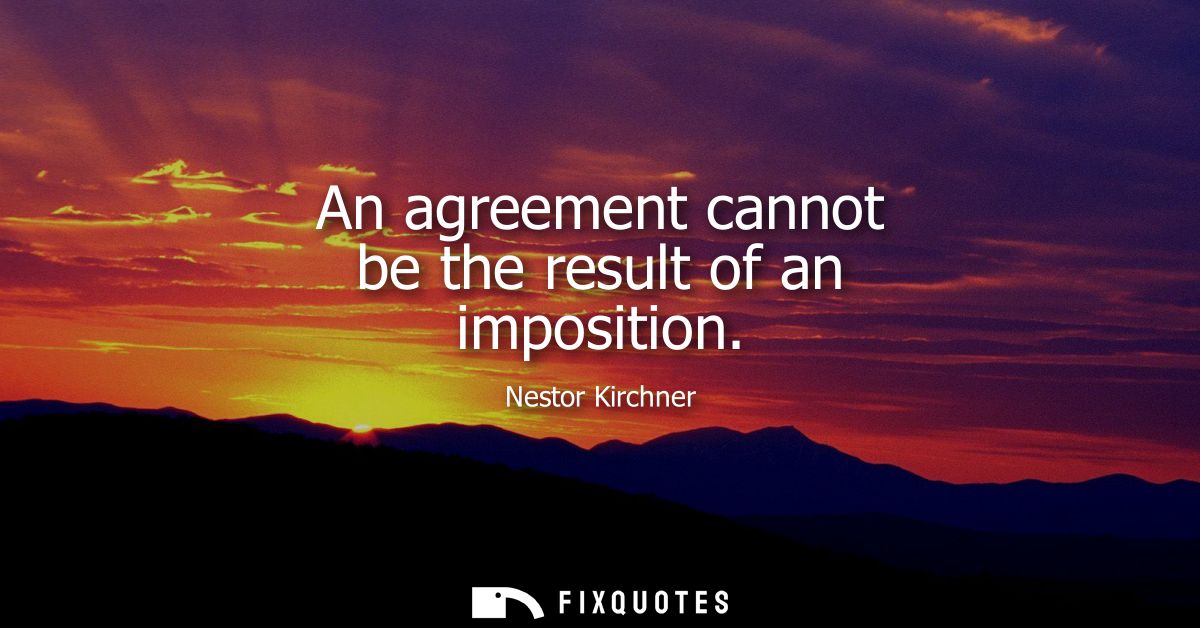
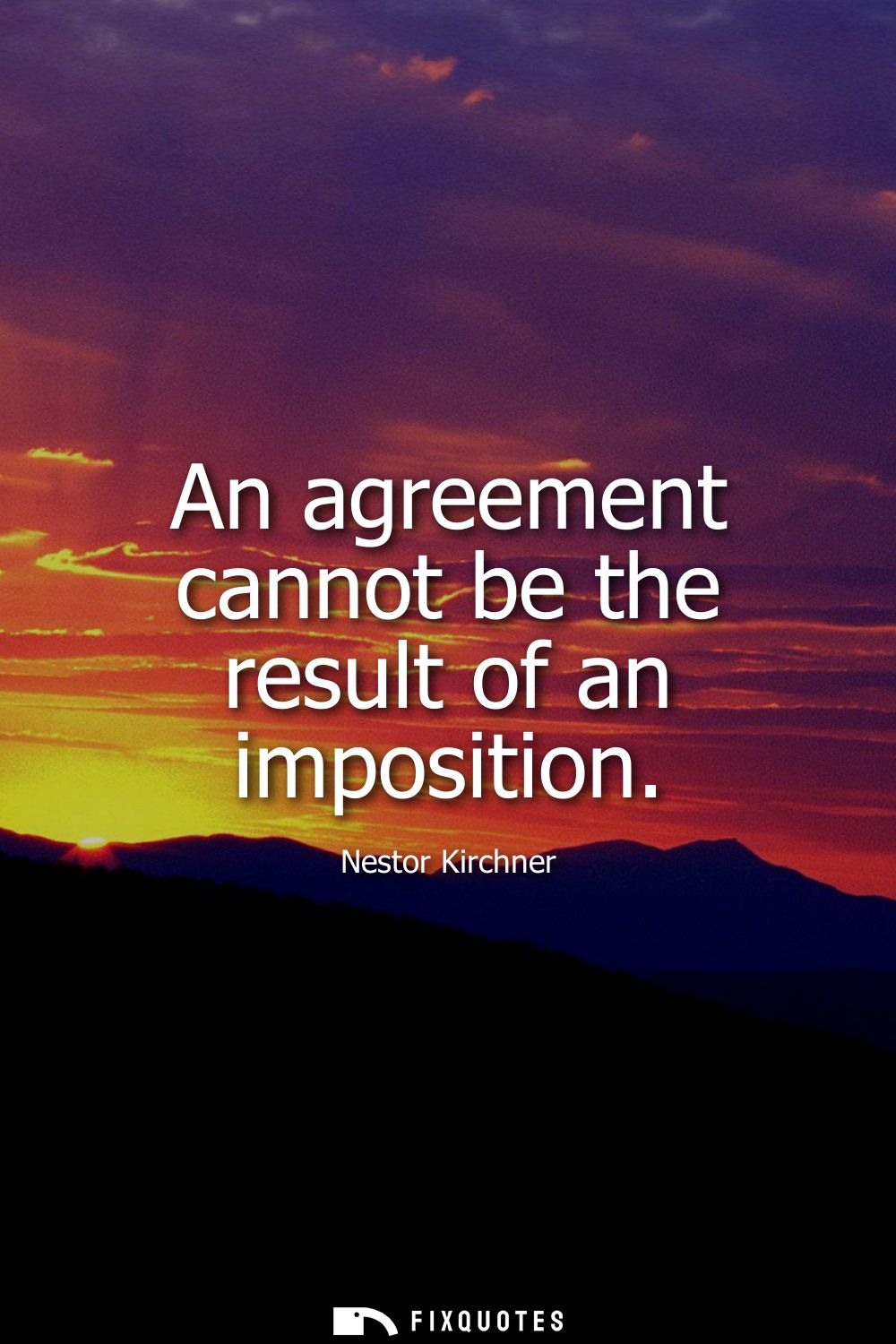
"An agreement cannot be the result of an imposition"
About this Quote
Kirchner’s line reads like a civics lesson, but it’s really a power move dressed up as principle. “An agreement cannot be the result of an imposition” draws a bright line between negotiation and coercion, then dares the other side to deny it. The phrasing is almost legalistic: “cannot,” not “should not.” He’s not offering a preference; he’s asserting that a deal produced under pressure is a category error, illegitimate by definition. That’s rhetorical judo, because it shifts the burden: if you push, you’re not just being tough, you’re disqualifying the very outcome you claim to want.
The intent is defensive and strategic at once. As an Argentine president shaped by the post-2001 collapse, Kirchner governed in the long shadow of IMF conditionality, debt restructuring, and a public newly allergic to “austerity” as a foreign mandate. The subtext is national sovereignty: consent has to look like consent, not compliance. At home, the quote flatters a bruised electorate by framing resistance as dignity rather than stubbornness. Abroad, it signals to creditors and multilateral institutions that Argentina will bargain, but not be seen as taking orders.
What makes it work is its moral asymmetry. “Imposition” is a loaded word; it implies humiliation, not just leverage. By moralizing the process, Kirchner elevates procedure into substance, turning the legitimacy of the negotiation into the central battleground. It’s a reminder that in politics, especially in unequal negotiations, the optics of agency can be as consequential as the terms on paper.
The intent is defensive and strategic at once. As an Argentine president shaped by the post-2001 collapse, Kirchner governed in the long shadow of IMF conditionality, debt restructuring, and a public newly allergic to “austerity” as a foreign mandate. The subtext is national sovereignty: consent has to look like consent, not compliance. At home, the quote flatters a bruised electorate by framing resistance as dignity rather than stubbornness. Abroad, it signals to creditors and multilateral institutions that Argentina will bargain, but not be seen as taking orders.
What makes it work is its moral asymmetry. “Imposition” is a loaded word; it implies humiliation, not just leverage. By moralizing the process, Kirchner elevates procedure into substance, turning the legitimacy of the negotiation into the central battleground. It’s a reminder that in politics, especially in unequal negotiations, the optics of agency can be as consequential as the terms on paper.
Quote Details
| Topic | Freedom |
|---|---|
| Source | Help us find the source |
| Cite |
Citation Formats
APA Style (7th ed.)
Kirchner, Nestor. (2026, January 16). An agreement cannot be the result of an imposition. FixQuotes. https://fixquotes.com/quotes/an-agreement-cannot-be-the-result-of-an-imposition-120621/
Chicago Style
Kirchner, Nestor. "An agreement cannot be the result of an imposition." FixQuotes. January 16, 2026. https://fixquotes.com/quotes/an-agreement-cannot-be-the-result-of-an-imposition-120621/.
MLA Style (9th ed.)
"An agreement cannot be the result of an imposition." FixQuotes, 16 Jan. 2026, https://fixquotes.com/quotes/an-agreement-cannot-be-the-result-of-an-imposition-120621/. Accessed 31 Mar. 2026.
More Quotes by Nestor
Add to List