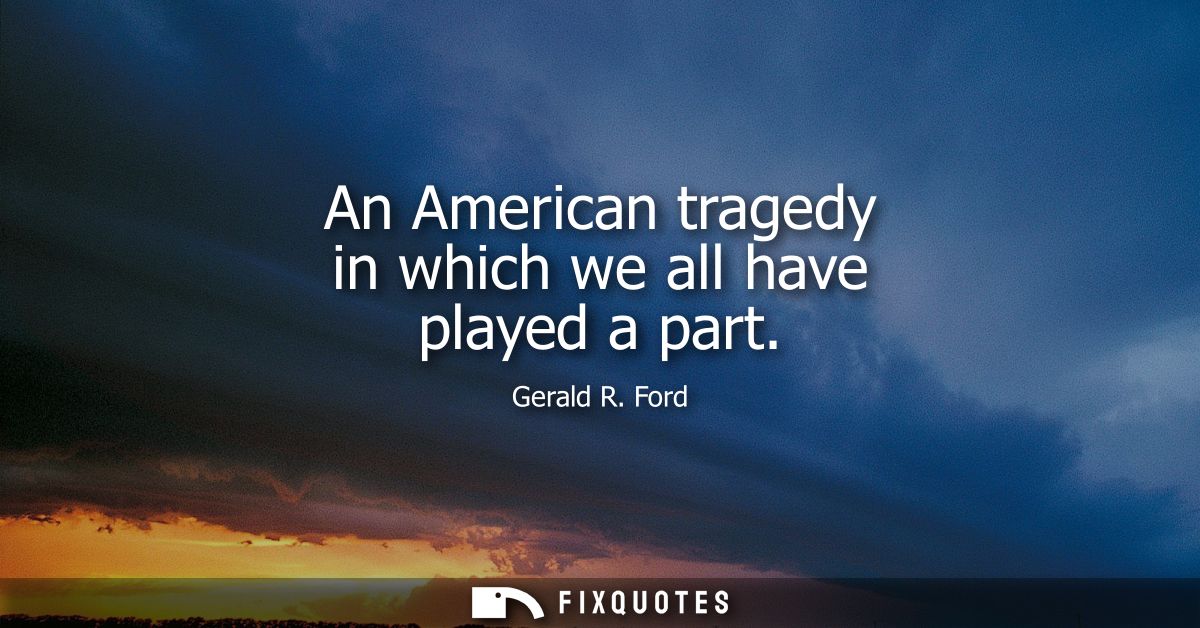
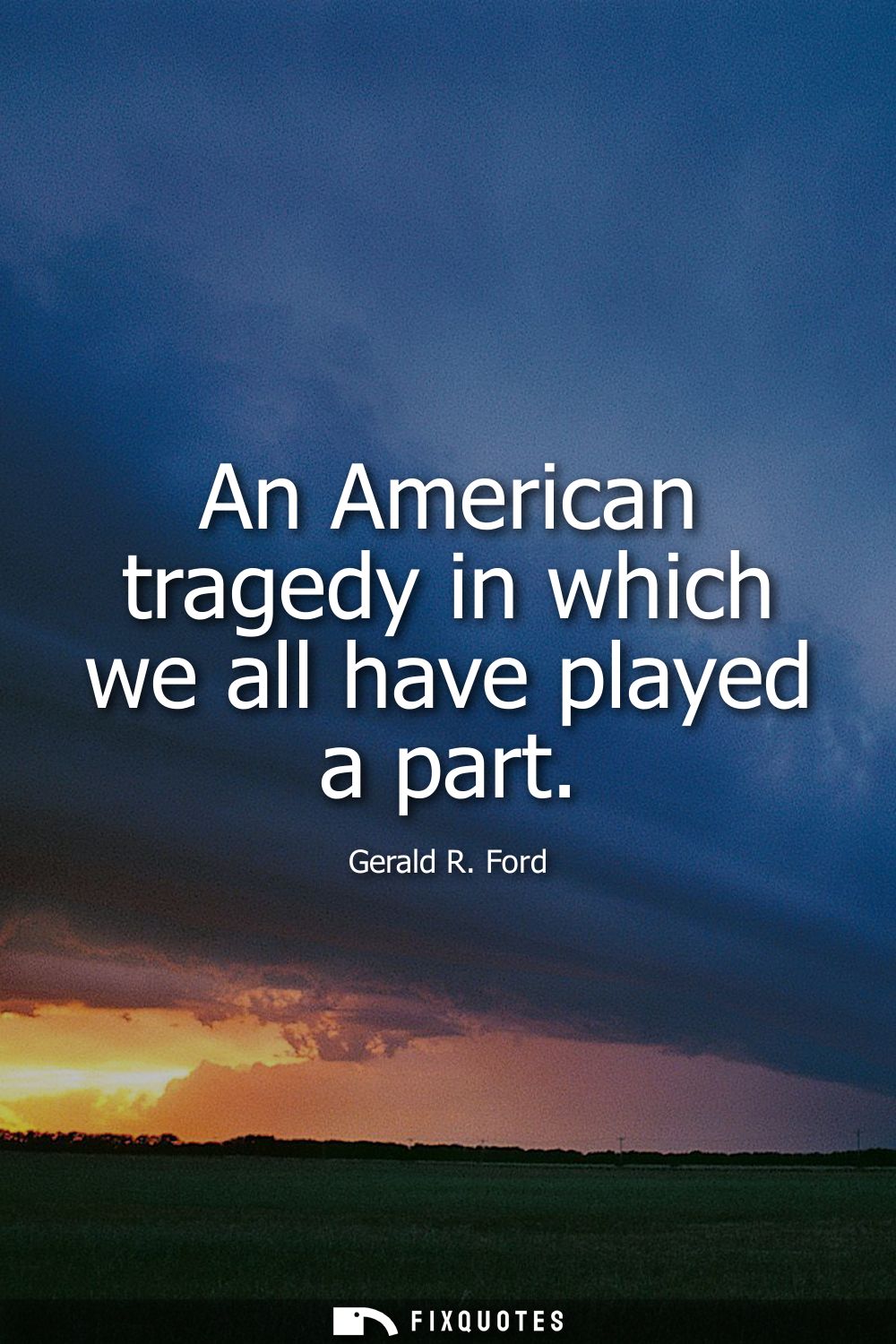
"An American tragedy in which we all have played a part"
About this Quote
Ford’s line lands with the quiet force of a man trying to drain a national fever without pretending it never happened. “An American tragedy” frames Watergate not as lurid gossip or partisan sport, but as a civic calamity: a breakdown in trust, procedure, and the basic expectation that power has limits. Calling it a tragedy also dodges the easier language of villainy. Tragedies aren’t just about bad people; they’re about systems buckling, flaws compounding, and consequences rippling outward.
The knife is in the second clause: “in which we all have played a part.” It’s an appeal and an accusation, delivered in the same breath. Ford is spreading responsibility beyond Nixon and his inner circle, suggesting that a scandal of that scale requires enabling ecosystems: ambitious staffers, compliant institutions, cynical media habits, voters who reward winning over integrity, opponents who sometimes prefer spectacle to repair. It’s also self-protective. Ford inherited the mess and then chose the most controversial cleanup tactic imaginable - the Nixon pardon. This sentence pre-argues for that decision by recasting Watergate as a shared wound that can’t heal if the country stays locked in trial-mode.
As presidential rhetoric, it’s classic Ford: restrained, moralizing without fireworks, built to lower the temperature. He’s not asking the nation to forget; he’s asking it to accept complicity, which is a harder, more political kind of accountability. The subtext is reconciliation with conditions: unity, yes, but unity purchased by everyone admitting they helped make the crisis possible.
The knife is in the second clause: “in which we all have played a part.” It’s an appeal and an accusation, delivered in the same breath. Ford is spreading responsibility beyond Nixon and his inner circle, suggesting that a scandal of that scale requires enabling ecosystems: ambitious staffers, compliant institutions, cynical media habits, voters who reward winning over integrity, opponents who sometimes prefer spectacle to repair. It’s also self-protective. Ford inherited the mess and then chose the most controversial cleanup tactic imaginable - the Nixon pardon. This sentence pre-argues for that decision by recasting Watergate as a shared wound that can’t heal if the country stays locked in trial-mode.
As presidential rhetoric, it’s classic Ford: restrained, moralizing without fireworks, built to lower the temperature. He’s not asking the nation to forget; he’s asking it to accept complicity, which is a harder, more political kind of accountability. The subtext is reconciliation with conditions: unity, yes, but unity purchased by everyone admitting they helped make the crisis possible.
Quote Details
| Topic | Ethics & Morality |
|---|---|
| Source | Help us find the source |
| Cite |
Citation Formats
APA Style (7th ed.)
Ford, Gerald R. (2026, January 17). An American tragedy in which we all have played a part. FixQuotes. https://fixquotes.com/quotes/an-american-tragedy-in-which-we-all-have-played-a-53653/
Chicago Style
Ford, Gerald R. "An American tragedy in which we all have played a part." FixQuotes. January 17, 2026. https://fixquotes.com/quotes/an-american-tragedy-in-which-we-all-have-played-a-53653/.
MLA Style (9th ed.)
"An American tragedy in which we all have played a part." FixQuotes, 17 Jan. 2026, https://fixquotes.com/quotes/an-american-tragedy-in-which-we-all-have-played-a-53653/. Accessed 13 Feb. 2026.
More Quotes by Gerald
Add to List