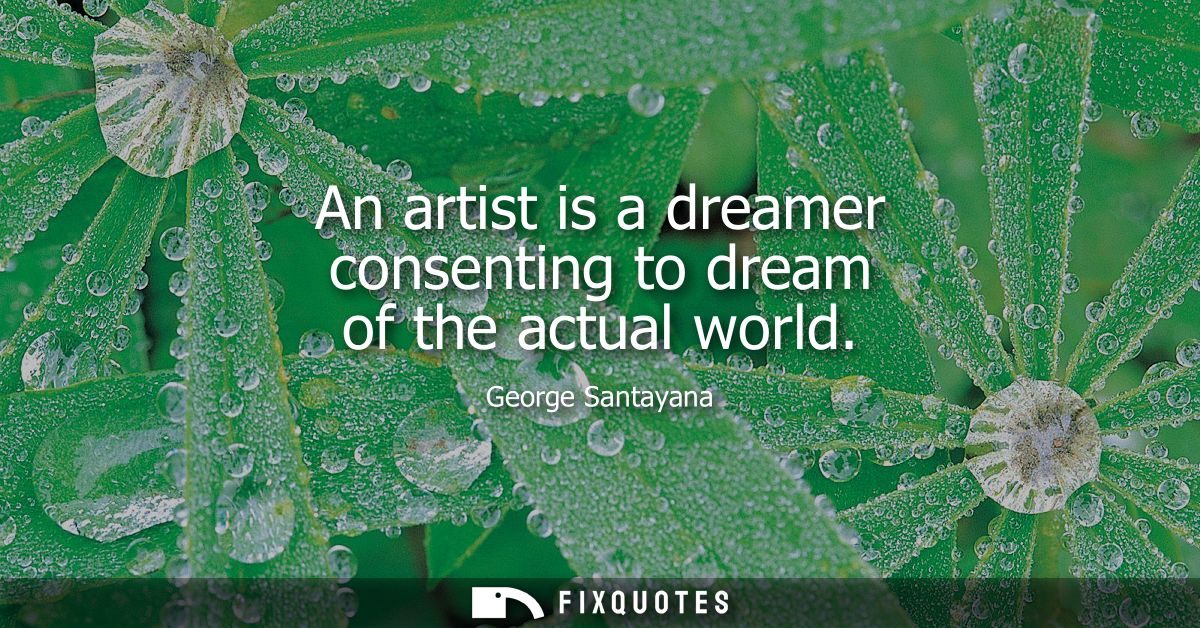
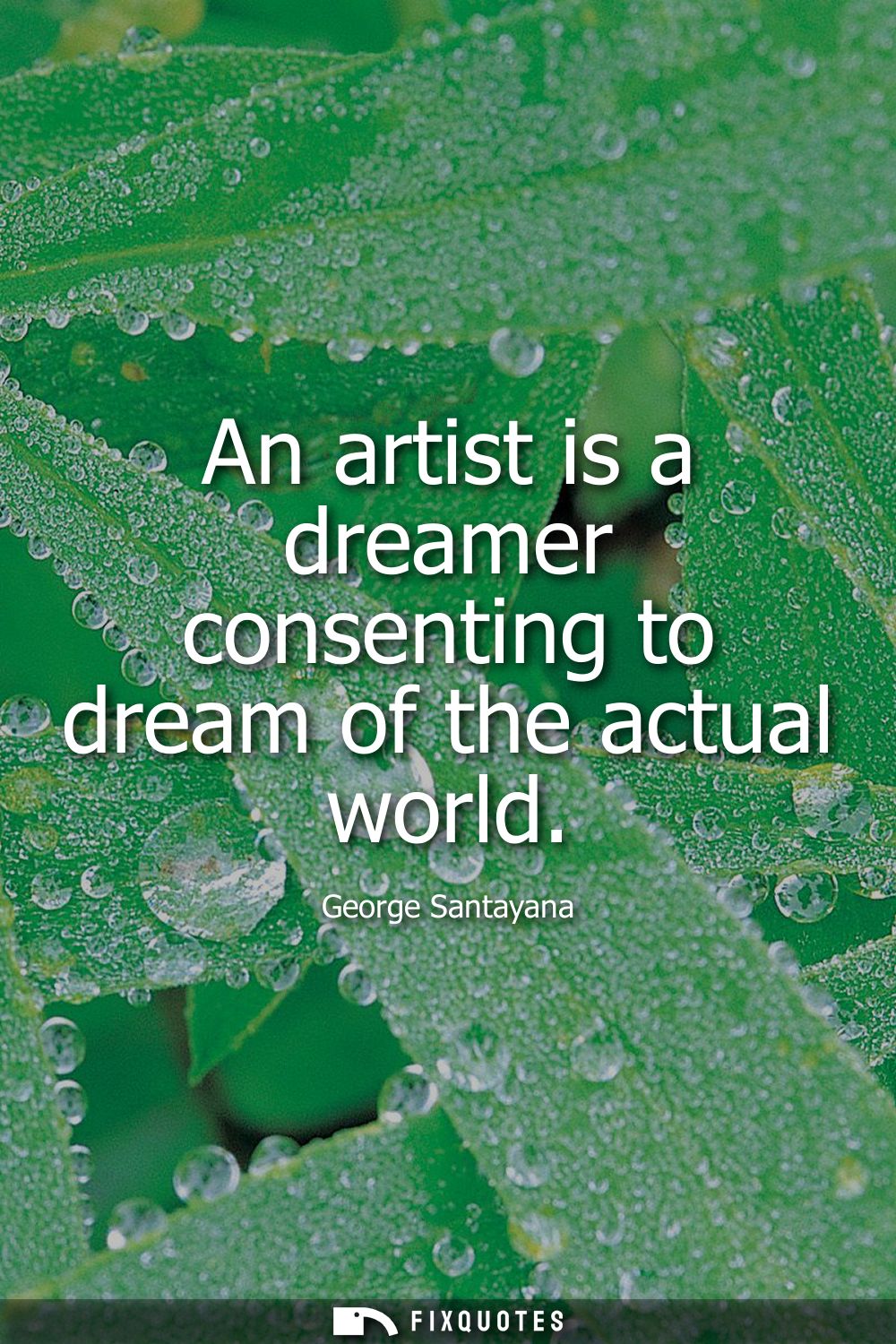
"An artist is a dreamer consenting to dream of the actual world"
About this Quote
Santayana slips a quiet provocation into a sentence that sounds almost consoling: the artist isn’t a fugitive from reality, but someone who agrees to meet it on different terms. “Dreamer” carries the romantic charge of imagination, but “consenting” is the hinge. It suggests choice, discipline, even a kind of contract. The artist’s gift isn’t merely to fantasize; it’s to accept the burden of attention, to let the actual world into the dream without disinfecting it or turning away.
That verb also hints at resistance. The “actual world” is not automatically inspiring; it’s often banal, brutal, politically compromised. To consent to dream of it is to refuse two easy exits: dry reportage on one side, escapist reverie on the other. Santayana, a philosopher who distrusted both naive realism and sentimental idealism, frames art as an ethical posture: staying porous to experience while reshaping it into form. The subtext is that imagination is not a lie; it’s a method for making reality intelligible, bearable, or newly strange.
Placed in Santayana’s era - industrial modernity, mass culture, the rise of scientific authority - the line reads like a defense of art’s cognitive legitimacy. Art doesn’t compete with facts; it metabolizes them. The “dream” is not sleep but a heightened mode of perception, where the real is allowed to carry symbolic weight. In that sense, the artist is less an escape artist than a translator, turning the world’s raw data into felt meaning.
That verb also hints at resistance. The “actual world” is not automatically inspiring; it’s often banal, brutal, politically compromised. To consent to dream of it is to refuse two easy exits: dry reportage on one side, escapist reverie on the other. Santayana, a philosopher who distrusted both naive realism and sentimental idealism, frames art as an ethical posture: staying porous to experience while reshaping it into form. The subtext is that imagination is not a lie; it’s a method for making reality intelligible, bearable, or newly strange.
Placed in Santayana’s era - industrial modernity, mass culture, the rise of scientific authority - the line reads like a defense of art’s cognitive legitimacy. Art doesn’t compete with facts; it metabolizes them. The “dream” is not sleep but a heightened mode of perception, where the real is allowed to carry symbolic weight. In that sense, the artist is less an escape artist than a translator, turning the world’s raw data into felt meaning.
Quote Details
| Topic | Art |
|---|---|
| Source | Help us find the source |
| Cite |
Citation Formats
APA Style (7th ed.)
Santayana, George. (2026, January 15). An artist is a dreamer consenting to dream of the actual world. FixQuotes. https://fixquotes.com/quotes/an-artist-is-a-dreamer-consenting-to-dream-of-the-24685/
Chicago Style
Santayana, George. "An artist is a dreamer consenting to dream of the actual world." FixQuotes. January 15, 2026. https://fixquotes.com/quotes/an-artist-is-a-dreamer-consenting-to-dream-of-the-24685/.
MLA Style (9th ed.)
"An artist is a dreamer consenting to dream of the actual world." FixQuotes, 15 Jan. 2026, https://fixquotes.com/quotes/an-artist-is-a-dreamer-consenting-to-dream-of-the-24685/. Accessed 3 Apr. 2026.
More Quotes by George
Add to List