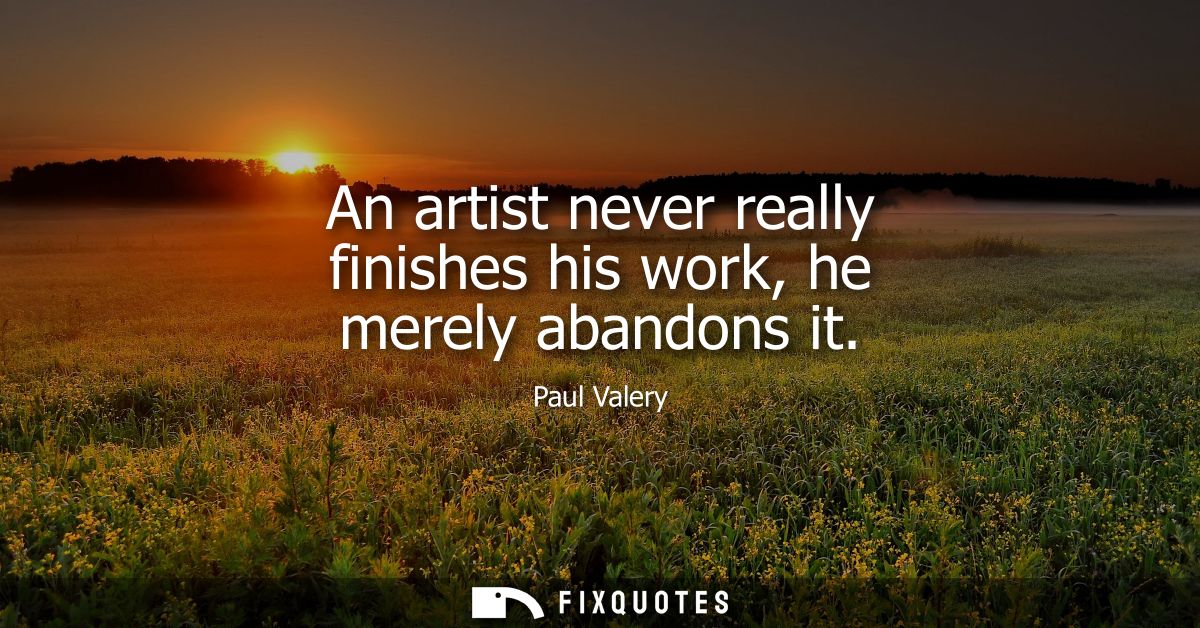
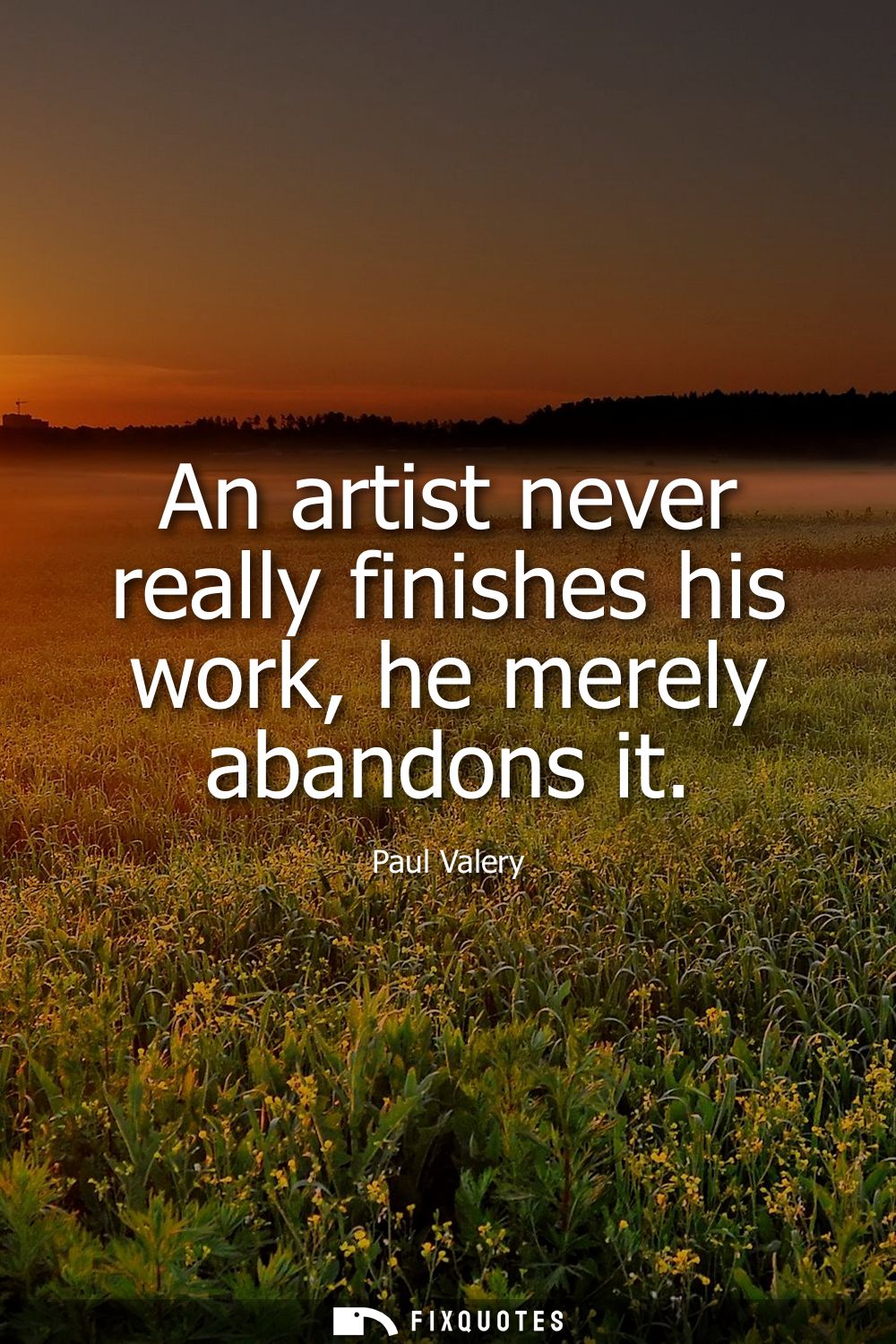
"An artist never really finishes his work, he merely abandons it"
About this Quote
Perfectionism has a stylish alibi: you did not fail to finish, you chose to leave. Valery frames the artist's relationship to work as a long negotiation with the impossible. The verb "abandons" is the knife twist. It suggests not a triumphant completion but a reluctant departure, as if the work remains alive, still asking for revision, still capable of becoming something else. Ending, in this view, is less a creative act than an act of self-defense.
Valery, a poet and obsessive reviser, knew the modernist condition: art made under the pressure of infinite possibility. Once you can always re-cut a line, re-balance an image, re-think a structure, the notion of "finished" starts to look like a polite fiction. The quote is a quiet indictment of the romantic myth of inspiration-as-closure. What replaces it is labor, doubt, and the awareness that any final version is just one snapshot in an endless sequence of could-have-beens.
The subtext is practical and psychological. Practically, artists stop because deadlines, money, exhaustion, and mortality intervene. Psychologically, they stop because endless revision can become a way to avoid the risk of judgment. "Abandons" admits the guilt and the relief: you walk away while the work is still imperfect, because living inside its imperfections has become its own trap.
Culturally, the line lands as a modern mantra for anyone making things in public, where drafts never die and audiences demand constant iteration. Valery offers a bracing truth: art ends when the artist runs out of reasons to keep going, not when the work runs out of flaws.
Valery, a poet and obsessive reviser, knew the modernist condition: art made under the pressure of infinite possibility. Once you can always re-cut a line, re-balance an image, re-think a structure, the notion of "finished" starts to look like a polite fiction. The quote is a quiet indictment of the romantic myth of inspiration-as-closure. What replaces it is labor, doubt, and the awareness that any final version is just one snapshot in an endless sequence of could-have-beens.
The subtext is practical and psychological. Practically, artists stop because deadlines, money, exhaustion, and mortality intervene. Psychologically, they stop because endless revision can become a way to avoid the risk of judgment. "Abandons" admits the guilt and the relief: you walk away while the work is still imperfect, because living inside its imperfections has become its own trap.
Culturally, the line lands as a modern mantra for anyone making things in public, where drafts never die and audiences demand constant iteration. Valery offers a bracing truth: art ends when the artist runs out of reasons to keep going, not when the work runs out of flaws.
Quote Details
| Topic | Art |
|---|---|
| Source | Help us find the source |
| Cite |
Citation Formats
APA Style (7th ed.)
Valery, Paul. (2026, January 15). An artist never really finishes his work, he merely abandons it. FixQuotes. https://fixquotes.com/quotes/an-artist-never-really-finishes-his-work-he-125771/
Chicago Style
Valery, Paul. "An artist never really finishes his work, he merely abandons it." FixQuotes. January 15, 2026. https://fixquotes.com/quotes/an-artist-never-really-finishes-his-work-he-125771/.
MLA Style (9th ed.)
"An artist never really finishes his work, he merely abandons it." FixQuotes, 15 Jan. 2026, https://fixquotes.com/quotes/an-artist-never-really-finishes-his-work-he-125771/. Accessed 7 Apr. 2026.
More Quotes by Paul
Add to List