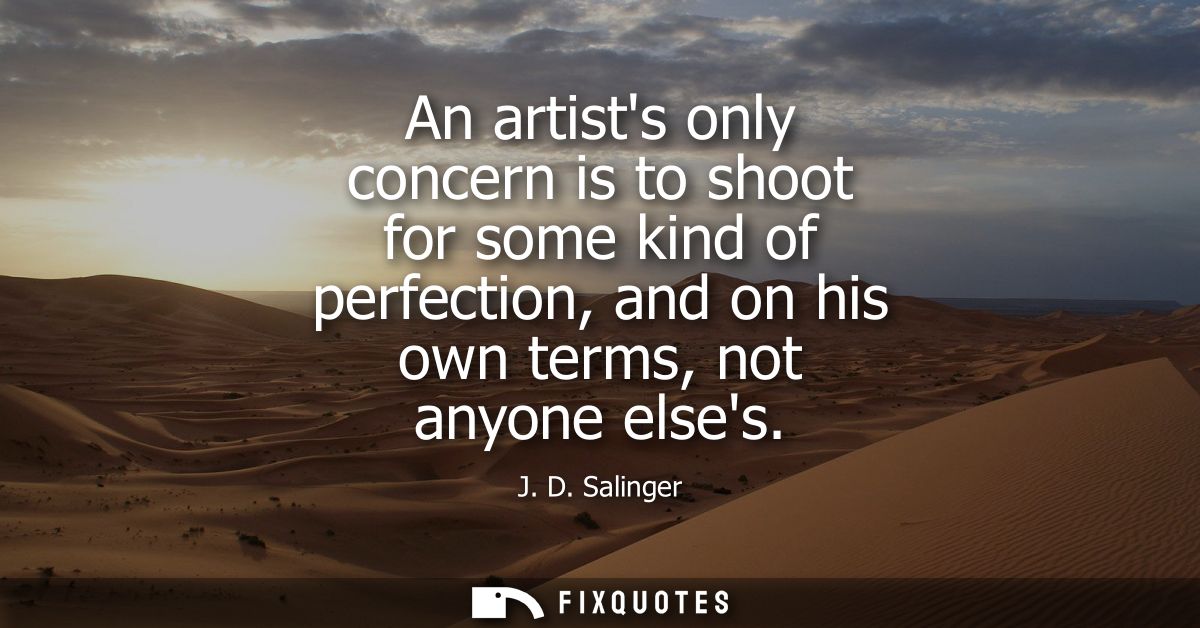
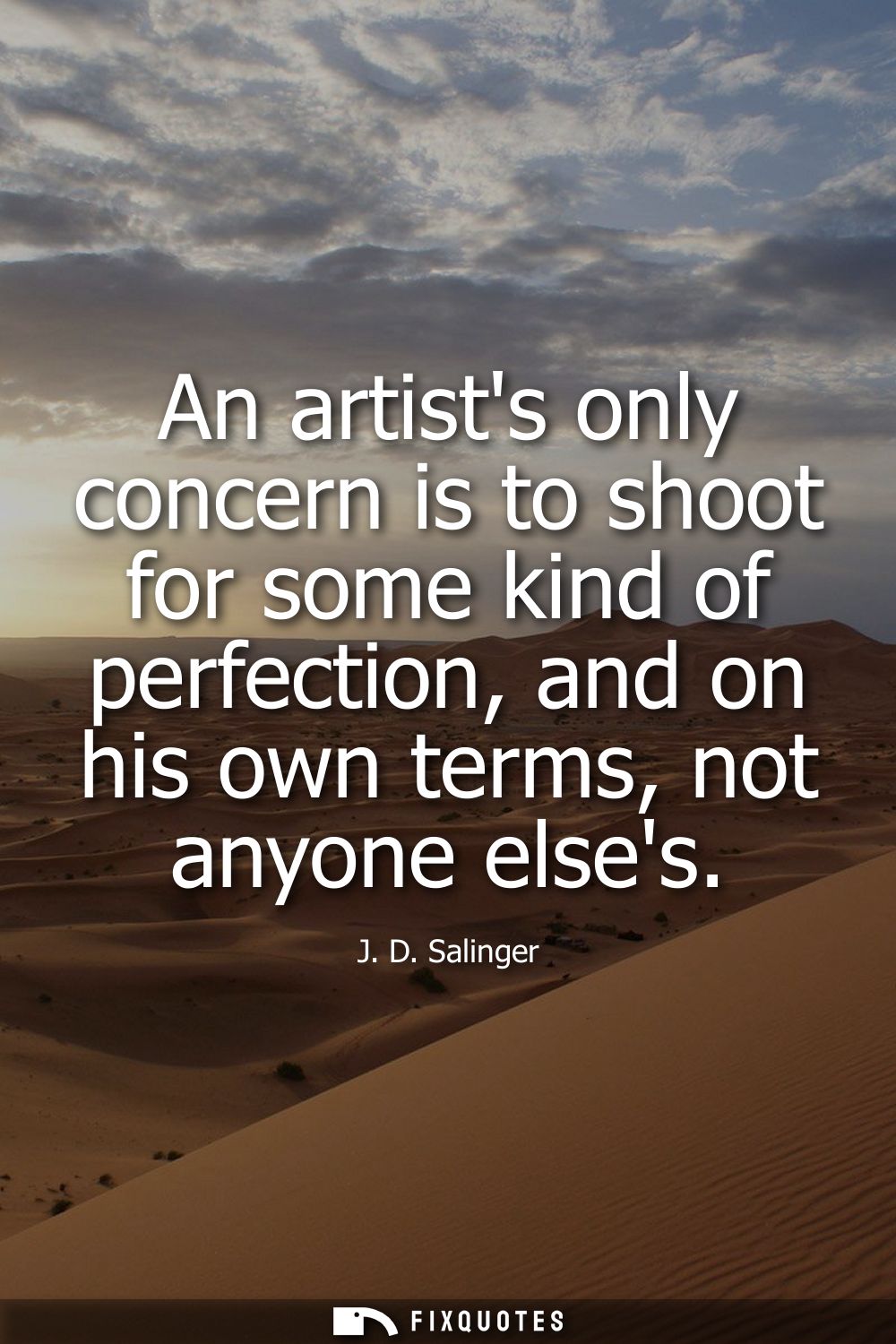
"An artist's only concern is to shoot for some kind of perfection, and on his own terms, not anyone else's"
About this Quote
Perfection is the bait word here: seductive, impossible, and useful precisely because it can never be fully cashed out. Salinger frames it as an artist's "only concern", a deliberately narrowing credo that reads less like motivational advice than a defensive perimeter. In one stroke, he sanctifies obsession and shuts the door on the crowd.
The key clause is "on his own terms". Salinger isn't praising some abstract purity of craft; he's staking out sovereignty. It’s a rejection of the marketplace's soft coercions: reviews that grade you on someone else's rubric, publishers nudging you toward what "lands", readers demanding the sequel to the version of you they liked best. "Perfection" becomes a private standard that can’t be audited. That’s the subtext: if the goal is self-defined, no one else gets to declare you finished, failed, or sellable.
Context makes it sharper. Salinger is the novelist who famously withdrew, turning privacy into a kind of aesthetic policy. Read through that biography, the quote sounds like both principle and alibi. It dignifies retreat as discipline. It also hints at the dark side of perfectionism: the way "only concern" can justify silence, delay, disappearance.
What makes the line work is its moral absolutism. It flatters the artist's integrity while smuggling in a critique of cultural consumption: art judged publicly is art bent into a public shape. Salinger’s perfection isn’t a finish line; it’s a refusal to be managed.
The key clause is "on his own terms". Salinger isn't praising some abstract purity of craft; he's staking out sovereignty. It’s a rejection of the marketplace's soft coercions: reviews that grade you on someone else's rubric, publishers nudging you toward what "lands", readers demanding the sequel to the version of you they liked best. "Perfection" becomes a private standard that can’t be audited. That’s the subtext: if the goal is self-defined, no one else gets to declare you finished, failed, or sellable.
Context makes it sharper. Salinger is the novelist who famously withdrew, turning privacy into a kind of aesthetic policy. Read through that biography, the quote sounds like both principle and alibi. It dignifies retreat as discipline. It also hints at the dark side of perfectionism: the way "only concern" can justify silence, delay, disappearance.
What makes the line work is its moral absolutism. It flatters the artist's integrity while smuggling in a critique of cultural consumption: art judged publicly is art bent into a public shape. Salinger’s perfection isn’t a finish line; it’s a refusal to be managed.
Quote Details
| Topic | Art |
|---|---|
| Source | Help us find the source |
More Quotes by Salinger
Add to List