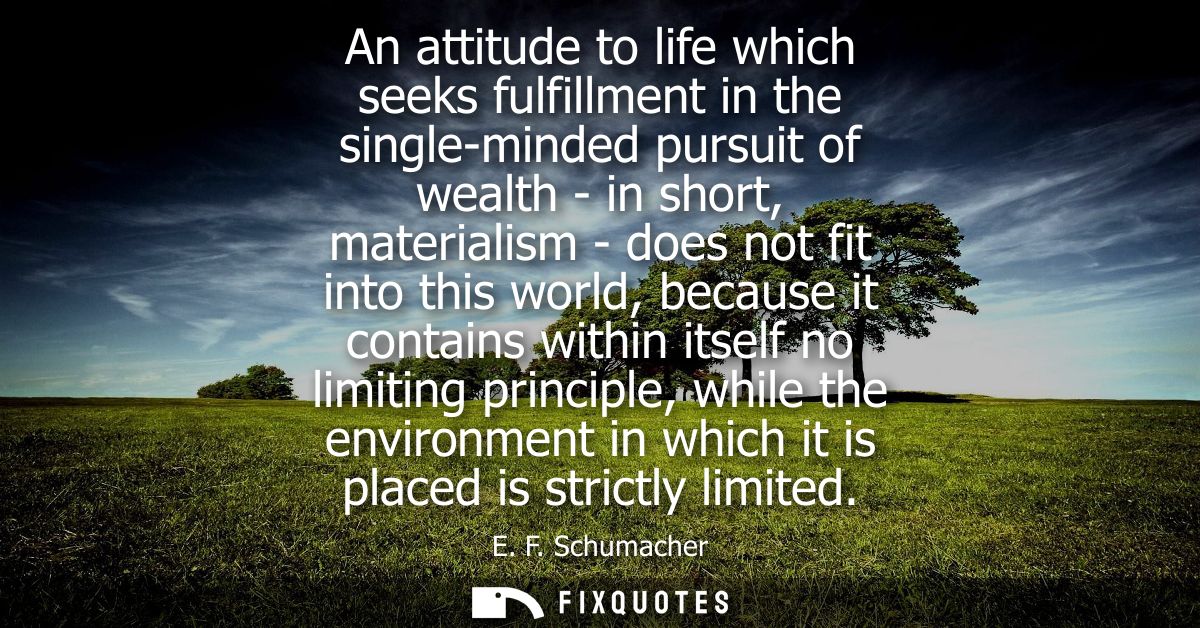
"An attitude to life which seeks fulfillment in the single-minded pursuit of wealth - in short, materialism - does not fit into this world, because it contains within itself no limiting principle, while the environment in which it is placed is strictly limited"
About this Quote
The punch lands because Schumacher forces a collision between two kinds of limits: the self’s boundlessness and the planet’s borders. He doesn’t romanticize nature; he treats “environment” with the cold clarity of a balance sheet. “Strictly limited” reads like a budget line, a hard cap. In that sense, he’s calling materialism irrational on its own terms: it’s an economic strategy that ignores the most basic scarcity.
Context matters. Schumacher wrote in the afterglow of postwar industrial confidence, when GDP growth was sold as proof of social progress and consumer affluence was treated as democratic destiny. His broader project (later canonized in Small Is Beautiful) was to argue for “enoughness” - scale, restraint, human-centered economics. This quote is a warning shot at a civilization that mistakes acceleration for direction, and treats the absence of limits as freedom rather than a design flaw.
Quote Details
| Topic | Wealth |
|---|---|
| Source | Help us find the source |
| Cite |
Citation Formats
APA Style (7th ed.)
Schumacher, E. F. (2026, January 18). An attitude to life which seeks fulfillment in the single-minded pursuit of wealth - in short, materialism - does not fit into this world, because it contains within itself no limiting principle, while the environment in which it is placed is strictly limited. FixQuotes. https://fixquotes.com/quotes/an-attitude-to-life-which-seeks-fulfillment-in-8157/
Chicago Style
Schumacher, E. F. "An attitude to life which seeks fulfillment in the single-minded pursuit of wealth - in short, materialism - does not fit into this world, because it contains within itself no limiting principle, while the environment in which it is placed is strictly limited." FixQuotes. January 18, 2026. https://fixquotes.com/quotes/an-attitude-to-life-which-seeks-fulfillment-in-8157/.
MLA Style (9th ed.)
"An attitude to life which seeks fulfillment in the single-minded pursuit of wealth - in short, materialism - does not fit into this world, because it contains within itself no limiting principle, while the environment in which it is placed is strictly limited." FixQuotes, 18 Jan. 2026, https://fixquotes.com/quotes/an-attitude-to-life-which-seeks-fulfillment-in-8157/. Accessed 29 Mar. 2026.