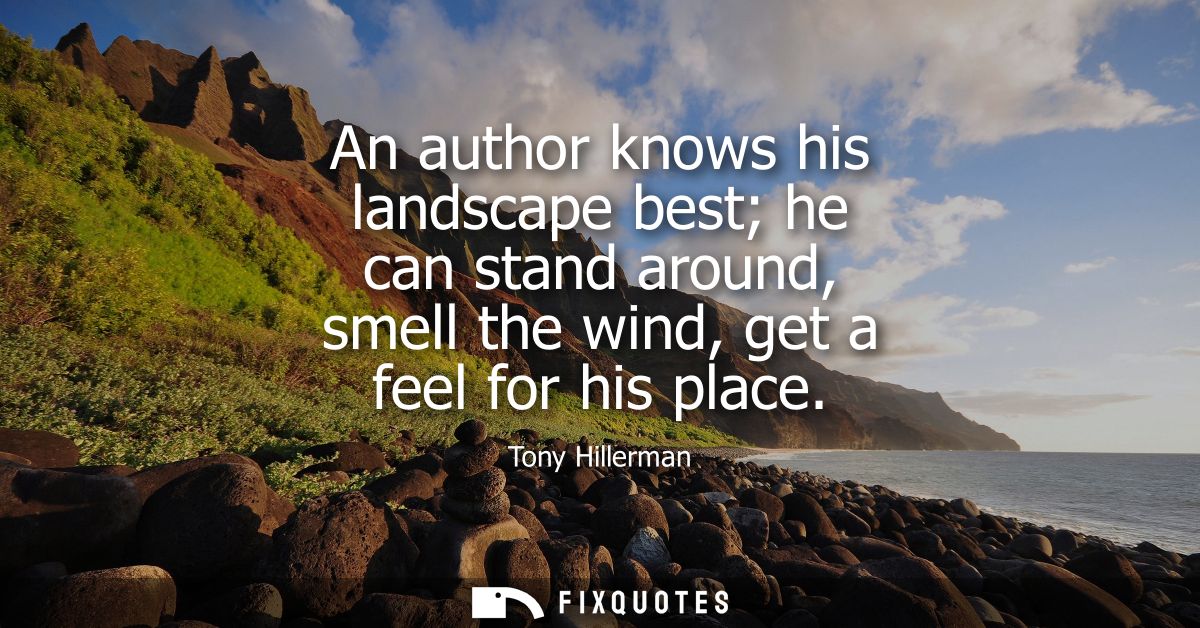
"An author knows his landscape best; he can stand around, smell the wind, get a feel for his place"
About this Quote
The subtext is about authority and humility at the same time. Hillerman built a career writing the American Southwest, especially Navajo country, as more than scenic backdrop. In his hands, land becomes plot, ethics, and pressure system. This quote signals his method: place isn’t decoration; it’s an active intelligence. The writer’s job is to tune in until the setting starts making decisions - how people move, what they fear, what they notice, what they can’t escape.
Context matters here. Hillerman arrived at this landscape as an outsider and spent decades observing it. “Smell the wind” reads like a corrective to armchair regionalism and tourism-era “local color,” where geography is flattened into vibes. He’s arguing for a kind of earned intimacy: the right detail isn’t the exotic one, it’s the true one, the one you only get by lingering until the land stops performing and starts being.
Quote Details
| Topic | Writing |
|---|---|
| Source | Help us find the source |
| Cite |
Citation Formats
APA Style (7th ed.)
Hillerman, Tony. (2026, January 16). An author knows his landscape best; he can stand around, smell the wind, get a feel for his place. FixQuotes. https://fixquotes.com/quotes/an-author-knows-his-landscape-best-he-can-stand-104170/
Chicago Style
Hillerman, Tony. "An author knows his landscape best; he can stand around, smell the wind, get a feel for his place." FixQuotes. January 16, 2026. https://fixquotes.com/quotes/an-author-knows-his-landscape-best-he-can-stand-104170/.
MLA Style (9th ed.)
"An author knows his landscape best; he can stand around, smell the wind, get a feel for his place." FixQuotes, 16 Jan. 2026, https://fixquotes.com/quotes/an-author-knows-his-landscape-best-he-can-stand-104170/. Accessed 12 Feb. 2026.