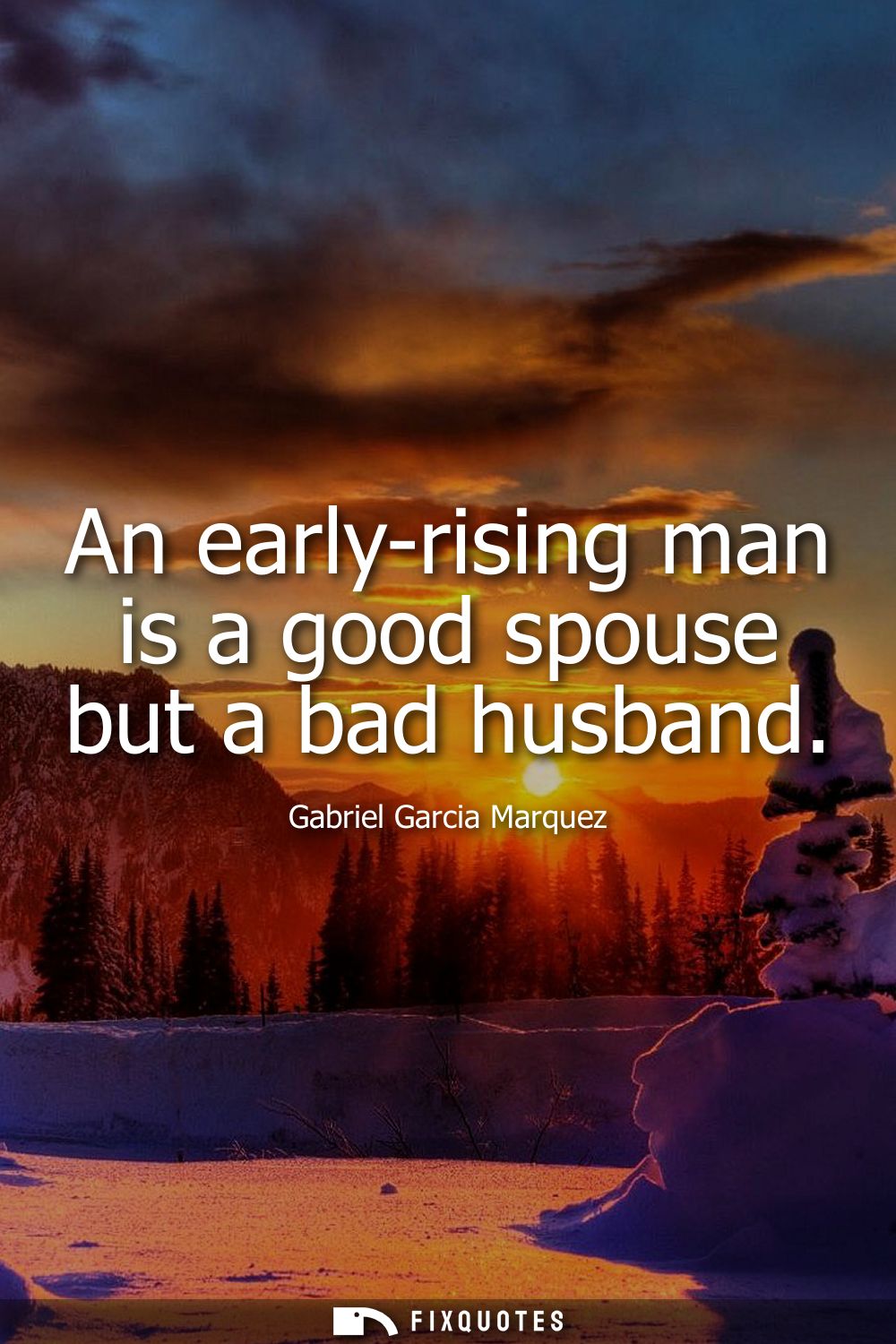
"An early-rising man is a good spouse but a bad husband"
About this Quote
Marquez twists a piece of bourgeois self-help - wake up early, win at life - into a marital paradox that feels like a miniature of his larger project: puncturing “common sense” with lived complexity. The line flatters and mocks the early riser at the same time. “Good spouse” reads like a social performance, the kind that looks great from the outside: responsible, punctual, productive, up before the world. But “bad husband” exposes the private cost of that performance. A spouse is a role you can fulfill; a husband is a relationship you have to inhabit.
The intent is less about sleep schedules than about intimacy. Rising early can be a form of disciplined withdrawal: leaving the bed, leaving the room, leaving the messy negotiation of shared time. It suggests a person married to routine, not necessarily to the other person. In that sense, the joke lands because it understands marriage as two parallel economies: the public ledger of virtue (work ethic, reliability) and the private currency of attention (lingering, listening, being available when nothing is “getting done”).
Context matters because Marquez writes from a Latin American tradition where family and domestic life are dense with expectations, and where modernity often arrives as a sermon about efficiency. The line resists that sermon. It implies that what society rewards in a man - industriousness, self-control - can erode what a partner experiences as love: presence, softness, unhurried morning closeness. The wit is gentle, but the critique is sharp: productivity can make you legible as “good,” while making you absent where it counts.
The intent is less about sleep schedules than about intimacy. Rising early can be a form of disciplined withdrawal: leaving the bed, leaving the room, leaving the messy negotiation of shared time. It suggests a person married to routine, not necessarily to the other person. In that sense, the joke lands because it understands marriage as two parallel economies: the public ledger of virtue (work ethic, reliability) and the private currency of attention (lingering, listening, being available when nothing is “getting done”).
Context matters because Marquez writes from a Latin American tradition where family and domestic life are dense with expectations, and where modernity often arrives as a sermon about efficiency. The line resists that sermon. It implies that what society rewards in a man - industriousness, self-control - can erode what a partner experiences as love: presence, softness, unhurried morning closeness. The wit is gentle, but the critique is sharp: productivity can make you legible as “good,” while making you absent where it counts.
Quote Details
| Topic | Husband & Wife |
|---|---|
| Source | Help us find the source |
| Cite |
Citation Formats
APA Style (7th ed.)
Marquez, Gabriel Garcia. (2026, January 15). An early-rising man is a good spouse but a bad husband. FixQuotes. https://fixquotes.com/quotes/an-early-rising-man-is-a-good-spouse-but-a-bad-158288/
Chicago Style
Marquez, Gabriel Garcia. "An early-rising man is a good spouse but a bad husband." FixQuotes. January 15, 2026. https://fixquotes.com/quotes/an-early-rising-man-is-a-good-spouse-but-a-bad-158288/.
MLA Style (9th ed.)
"An early-rising man is a good spouse but a bad husband." FixQuotes, 15 Jan. 2026, https://fixquotes.com/quotes/an-early-rising-man-is-a-good-spouse-but-a-bad-158288/. Accessed 12 Feb. 2026.
More Quotes by Gabriel
Add to List