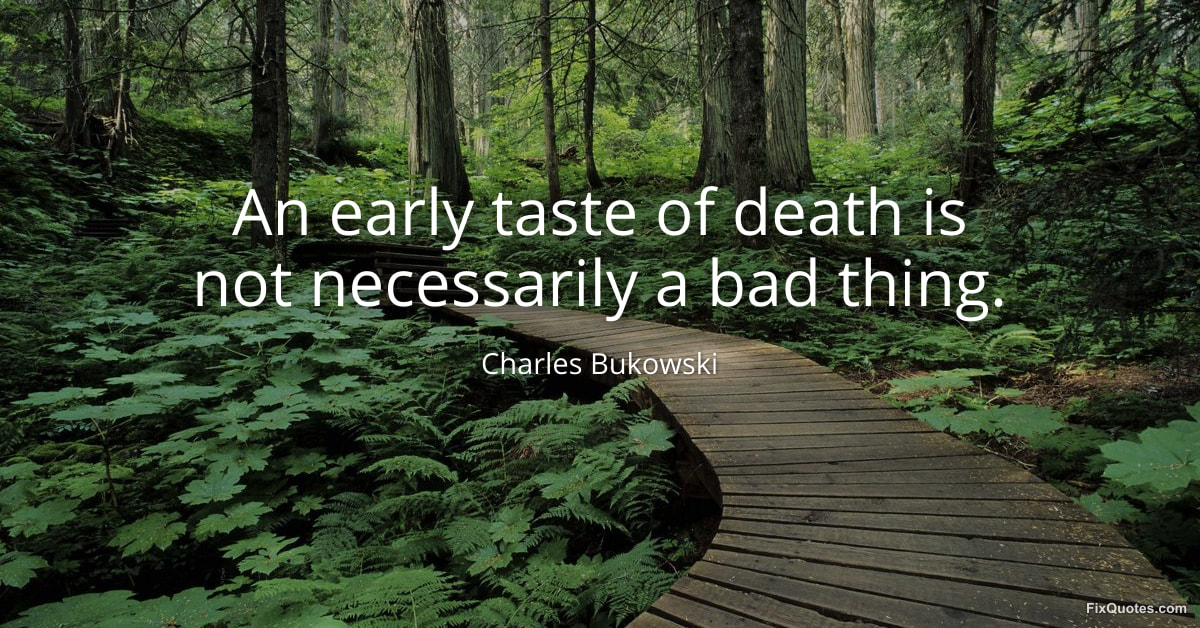
"An early taste of death is not necessarily a bad thing"
About this Quote
Bukowski’s line lands like a cigarette burn: small, casual, and hard to ignore. “An early taste of death” isn’t just morbidity for shock value; it’s his blunt shorthand for premature contact with the limits of life - violence, poverty, illness, addiction, breakdown, the kind of bad luck that teaches faster than school ever will. He’s not romanticizing trauma so much as refusing the cultural script that says hardship must only deform you. In his world, it can also strip you down to something usable.
The phrasing matters. “Taste” is intimate, bodily, immediate. Not “knowledge” of death, not “awareness”, but a sensory sample - enough to change your appetite. And “not necessarily” is classic Bukowski hedging: a barroom qualifier that keeps the statement from turning into self-help. He’s allergic to moral lessons, so he smuggles one in under a shrug.
The subtext is survivalist. Getting close to death early can puncture youthful fantasies, flatten ego, and make you stop treating time like it’s infinite. That can sharpen desire, reorder priorities, and even give a person permission to live without performing for respectable society. It’s a backhanded argument for clarity: when you’ve seen the cliff edge, you waste less breath pretending the path is safe.
Contextually, it fits the Bukowski persona: working-class fatalism, anti-bourgeois disgust, and a lifelong insistence that beauty and meaning show up not after you’re “fixed”, but while you’re still bleeding. It’s grim, yes - but it’s also a credo for staying awake.
The phrasing matters. “Taste” is intimate, bodily, immediate. Not “knowledge” of death, not “awareness”, but a sensory sample - enough to change your appetite. And “not necessarily” is classic Bukowski hedging: a barroom qualifier that keeps the statement from turning into self-help. He’s allergic to moral lessons, so he smuggles one in under a shrug.
The subtext is survivalist. Getting close to death early can puncture youthful fantasies, flatten ego, and make you stop treating time like it’s infinite. That can sharpen desire, reorder priorities, and even give a person permission to live without performing for respectable society. It’s a backhanded argument for clarity: when you’ve seen the cliff edge, you waste less breath pretending the path is safe.
Contextually, it fits the Bukowski persona: working-class fatalism, anti-bourgeois disgust, and a lifelong insistence that beauty and meaning show up not after you’re “fixed”, but while you’re still bleeding. It’s grim, yes - but it’s also a credo for staying awake.
Quote Details
| Topic | Mortality |
|---|---|
| Source | Help us find the source |
| Cite |
Citation Formats
APA Style (7th ed.)
Bukowski, Charles. (2026, February 10). An early taste of death is not necessarily a bad thing. FixQuotes. https://fixquotes.com/quotes/an-early-taste-of-death-is-not-necessarily-a-bad-185211/
Chicago Style
Bukowski, Charles. "An early taste of death is not necessarily a bad thing." FixQuotes. February 10, 2026. https://fixquotes.com/quotes/an-early-taste-of-death-is-not-necessarily-a-bad-185211/.
MLA Style (9th ed.)
"An early taste of death is not necessarily a bad thing." FixQuotes, 10 Feb. 2026, https://fixquotes.com/quotes/an-early-taste-of-death-is-not-necessarily-a-bad-185211/. Accessed 30 Mar. 2026.
More Quotes by Charles
Add to List