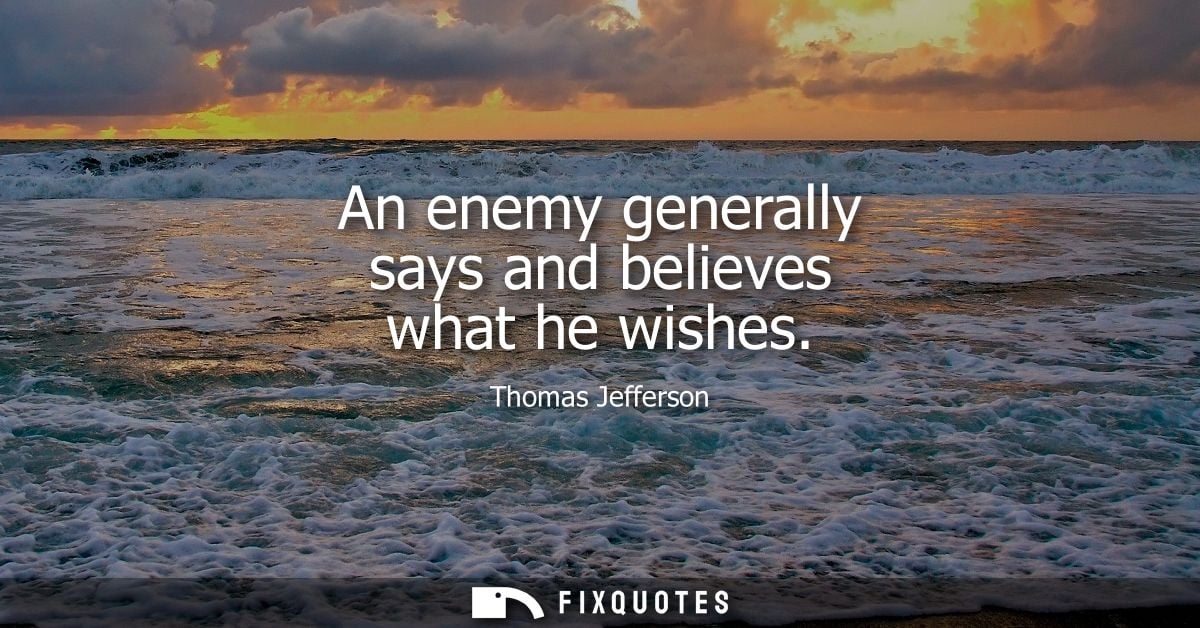
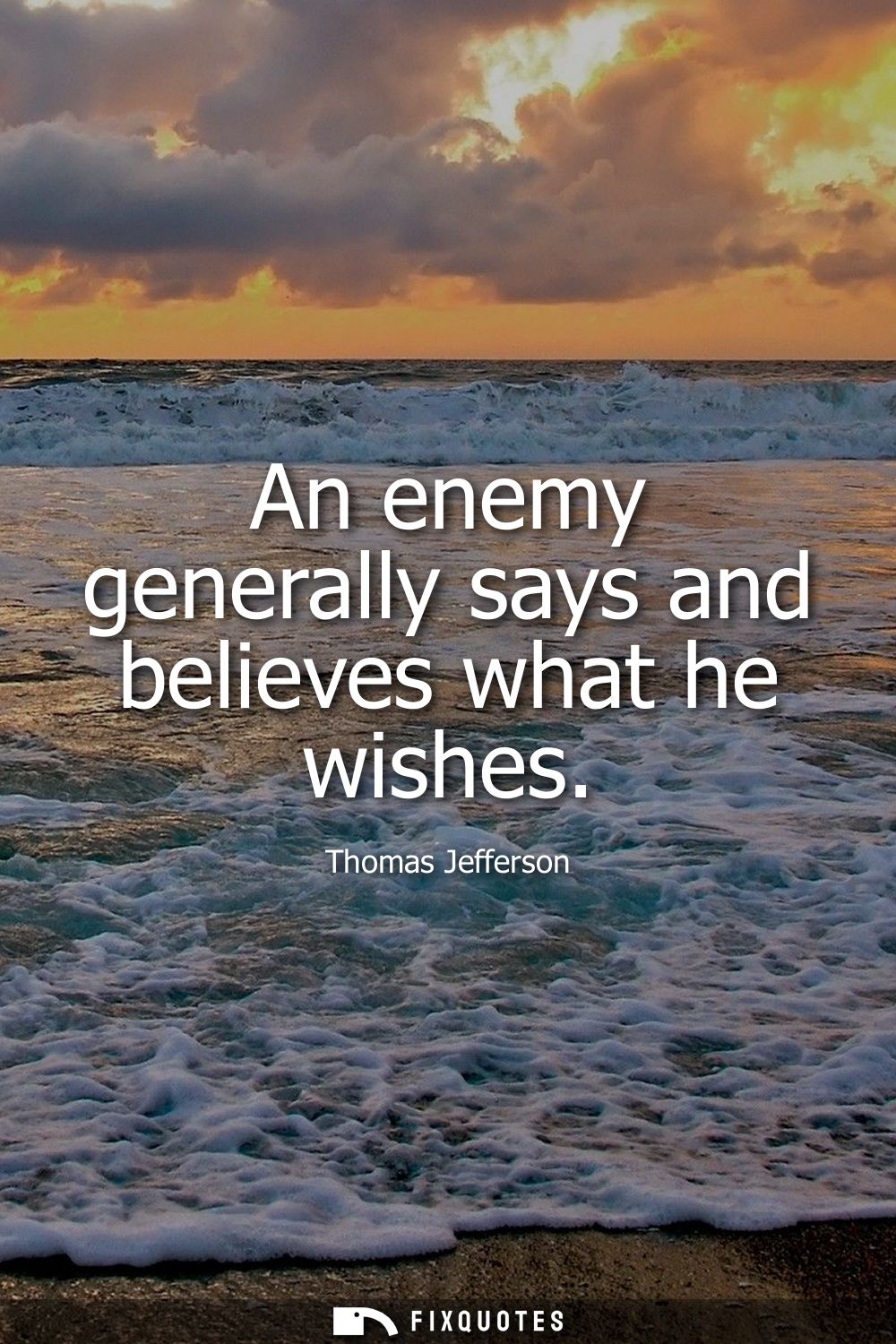
"An enemy generally says and believes what he wishes"
About this Quote
Jefferson’s line lands with the cool pragmatism of someone who spent a lifetime watching politics turn personal. “An enemy generally says and believes what he wishes” isn’t just a complaint about slander; it’s a diagnosis of motivated reasoning before the term existed. The enemy, in Jefferson’s telling, isn’t primarily a liar. He’s a person whose desires edit reality into something usable. That’s the sharper insult: not that opponents fabricate, but that they willingly live inside their preferred version of events, and then broadcast it as truth.
The intent is defensive and strategic. Jefferson wrote in an era when reputations were the currency of power and newspapers were partisan weapons. During the bruising battles between Federalists and Democratic-Republicans, charges of atheism, treason, and foreign loyalty were routine. To call an adversary someone who “believes what he wishes” is to reframe attacks as predictable outputs of faction, not evidence requiring rebuttal. It’s inoculation: if critics are wish-driven, their claims can be dismissed as psychological projection rather than factual dispute.
The subtext is more unsettling. Jefferson implies that enmity doesn’t merely distort speech; it colonizes belief. Once politics becomes tribal, people don’t just say what helps their side, they start to experience it as sincerely true. That insight still reads modern because it anticipates the way media ecosystems harden identity into certainty. It’s also a quiet warning to allies: today’s enemy is tomorrow’s you, if desire becomes your editor.
The intent is defensive and strategic. Jefferson wrote in an era when reputations were the currency of power and newspapers were partisan weapons. During the bruising battles between Federalists and Democratic-Republicans, charges of atheism, treason, and foreign loyalty were routine. To call an adversary someone who “believes what he wishes” is to reframe attacks as predictable outputs of faction, not evidence requiring rebuttal. It’s inoculation: if critics are wish-driven, their claims can be dismissed as psychological projection rather than factual dispute.
The subtext is more unsettling. Jefferson implies that enmity doesn’t merely distort speech; it colonizes belief. Once politics becomes tribal, people don’t just say what helps their side, they start to experience it as sincerely true. That insight still reads modern because it anticipates the way media ecosystems harden identity into certainty. It’s also a quiet warning to allies: today’s enemy is tomorrow’s you, if desire becomes your editor.
Quote Details
| Topic | Truth |
|---|---|
| Source | Help us find the source |
| Cite |
Citation Formats
APA Style (7th ed.)
Jefferson, Thomas. (2026, January 17). An enemy generally says and believes what he wishes. FixQuotes. https://fixquotes.com/quotes/an-enemy-generally-says-and-believes-what-he-25012/
Chicago Style
Jefferson, Thomas. "An enemy generally says and believes what he wishes." FixQuotes. January 17, 2026. https://fixquotes.com/quotes/an-enemy-generally-says-and-believes-what-he-25012/.
MLA Style (9th ed.)
"An enemy generally says and believes what he wishes." FixQuotes, 17 Jan. 2026, https://fixquotes.com/quotes/an-enemy-generally-says-and-believes-what-he-25012/. Accessed 9 Mar. 2026.
More Quotes by Thomas
Add to List