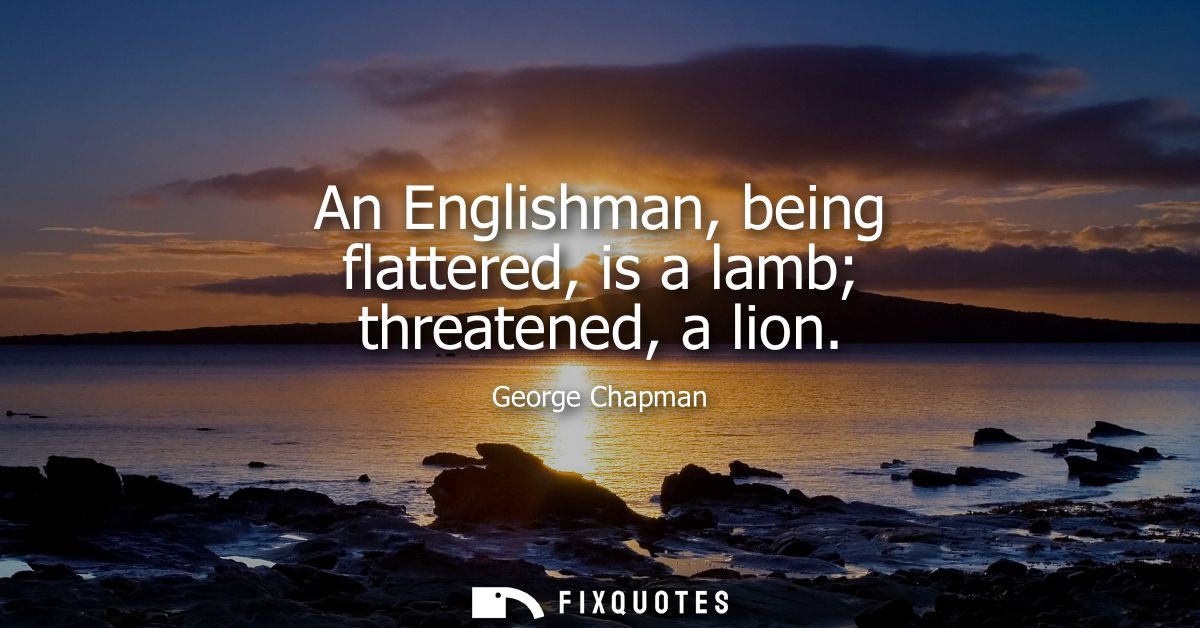
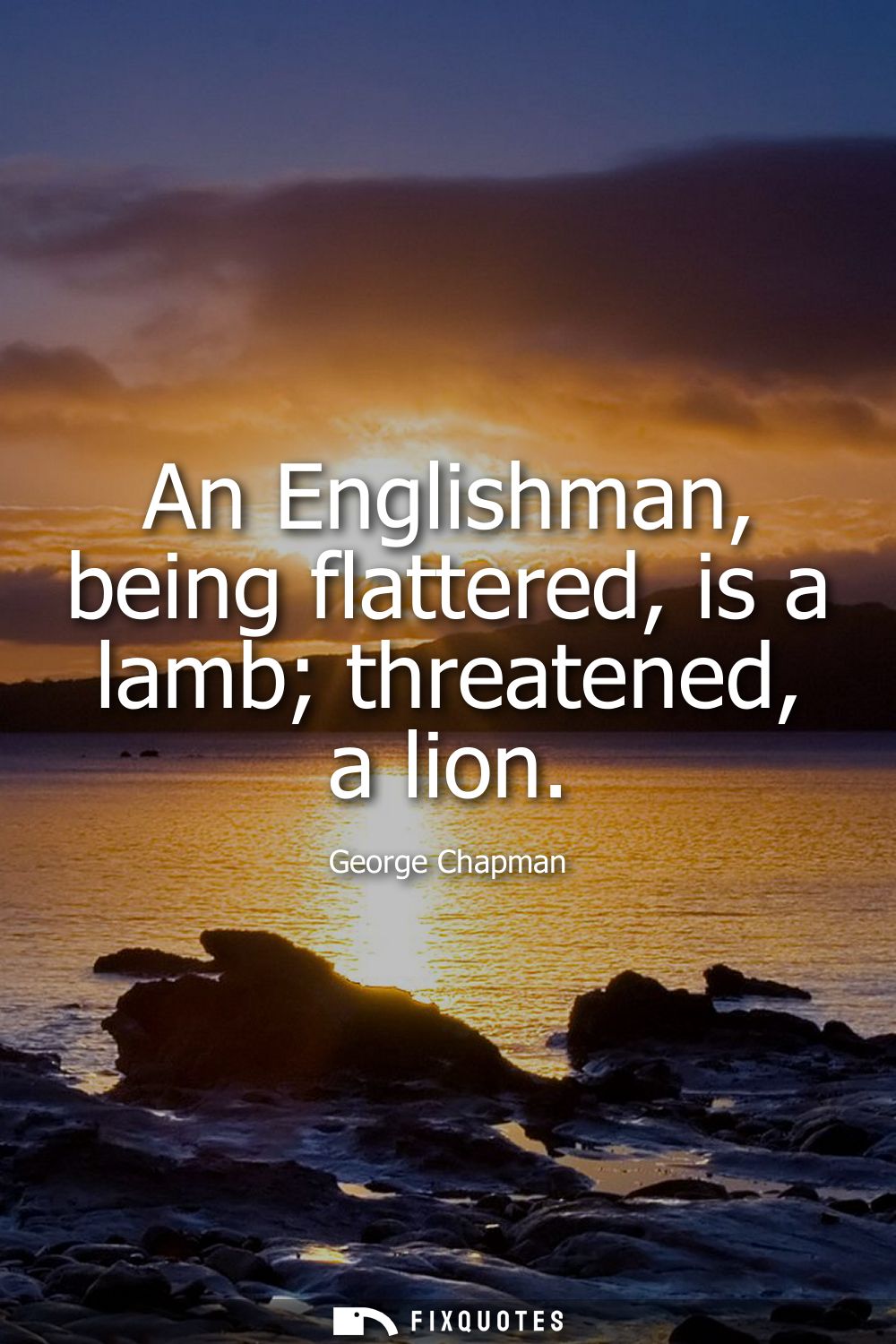
"An Englishman, being flattered, is a lamb; threatened, a lion"
About this Quote
Chapman’s line is a neat little pressure test of national character: touch the English ego gently and you get compliance; apply force and you get ferocity. It works because it’s built like a proverb, but it’s really a warning disguised as an observation. “Flattered” and “threatened” aren’t just moods; they’re political tactics. Chapman is sketching an Englishman as someone governable through vanity, but ungovernable through intimidation. That’s not a compliment so much as a strategic read.
The animal swap is doing the heavy lifting. A lamb is not merely “kind”; it’s domesticated, herd-minded, easy to lead. A lion is not merely “brave”; it’s solitary, territorial, dangerous when cornered. Chapman compresses a whole theory of persuasion into two images and a semicolon, implying that English loyalty is conditional and performative: praise makes people feel chosen; threats make them feel conquered. The subtext is that power depends on knowing which button you’re pressing.
Contextually, Chapman is writing into an England anxious about sovereignty and status, with national identity hardening through war, court intrigue, and the theater’s obsession with rulers and crowds. The quote carries the Renaissance sense that publics are volatile creatures, and that the state’s relationship to them is always partly theatrical. Flattery is a script the Englishman is willing to play along with; coercion breaks the spell and summons the lion. It’s cynicism with a poet’s economy: the nation as an audience that cheers when praised, and claws when bullied.
The animal swap is doing the heavy lifting. A lamb is not merely “kind”; it’s domesticated, herd-minded, easy to lead. A lion is not merely “brave”; it’s solitary, territorial, dangerous when cornered. Chapman compresses a whole theory of persuasion into two images and a semicolon, implying that English loyalty is conditional and performative: praise makes people feel chosen; threats make them feel conquered. The subtext is that power depends on knowing which button you’re pressing.
Contextually, Chapman is writing into an England anxious about sovereignty and status, with national identity hardening through war, court intrigue, and the theater’s obsession with rulers and crowds. The quote carries the Renaissance sense that publics are volatile creatures, and that the state’s relationship to them is always partly theatrical. Flattery is a script the Englishman is willing to play along with; coercion breaks the spell and summons the lion. It’s cynicism with a poet’s economy: the nation as an audience that cheers when praised, and claws when bullied.
Quote Details
| Topic | Witty One-Liners |
|---|---|
| Source | Help us find the source |
| Cite |
Citation Formats
APA Style (7th ed.)
Chapman, George. (2026, January 16). An Englishman, being flattered, is a lamb; threatened, a lion. FixQuotes. https://fixquotes.com/quotes/an-englishman-being-flattered-is-a-lamb-112167/
Chicago Style
Chapman, George. "An Englishman, being flattered, is a lamb; threatened, a lion." FixQuotes. January 16, 2026. https://fixquotes.com/quotes/an-englishman-being-flattered-is-a-lamb-112167/.
MLA Style (9th ed.)
"An Englishman, being flattered, is a lamb; threatened, a lion." FixQuotes, 16 Jan. 2026, https://fixquotes.com/quotes/an-englishman-being-flattered-is-a-lamb-112167/. Accessed 16 Mar. 2026.
More Quotes by George
Add to List