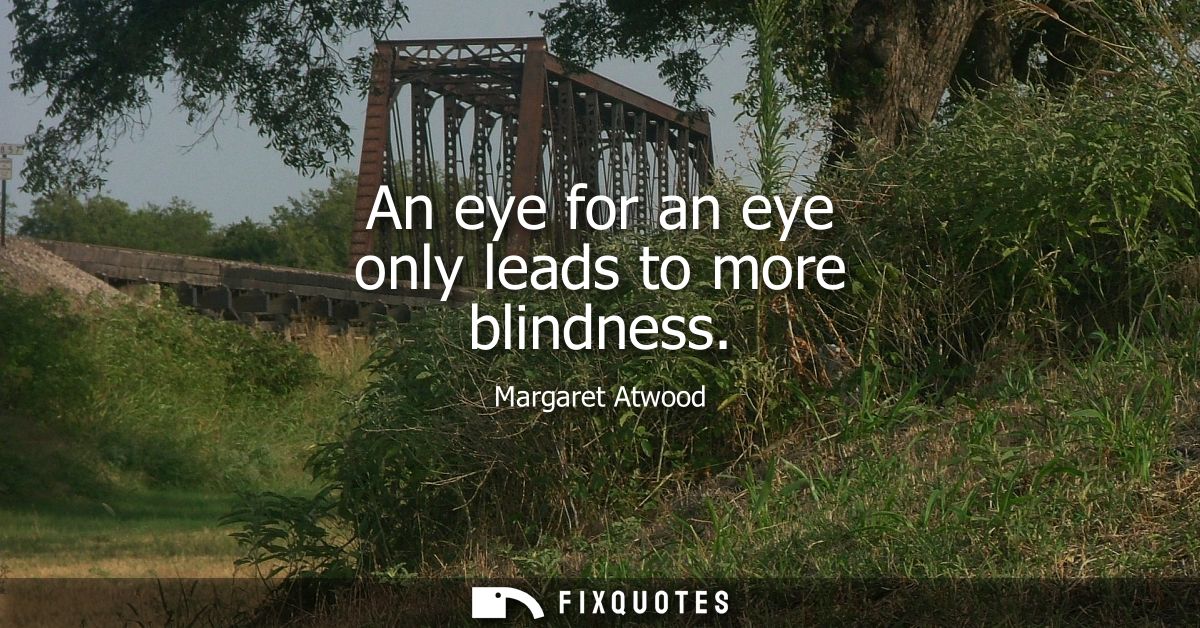
"An eye for an eye only leads to more blindness"
About this Quote
Atwood’s line takes a proverb that’s often misremembered as moral clarity and flips it into a diagnosis of social decay. “An eye for an eye” is the old promise of proportional justice: harm answered with equal harm, vengeance dressed up as order. Atwood’s tweak - “only leads to more blindness” - doesn’t just condemn retaliation; it exposes how the logic of payback quietly destroys the very faculties a society needs to call itself civilized: perception, judgment, moral sight.
The brilliance is in the word “only.” It strips revenge of its usual justifications (closure, deterrence, balance) and insists on a single outcome: escalation. Blindness functions on two levels. Literally, violence compounds, bodies accumulate damage. Figuratively, each retaliatory act narrows empathy and imagination. People stop seeing the other person as a person and start seeing a symbol, a debt, a target. In that sense, blindness is contagious: institutions harden, language simplifies into “deserving” and “not,” and cruelty starts to feel like procedure.
Context matters with Atwood because her fiction is obsessed with systems that normalize brutality while claiming righteousness. Whether she’s writing about gendered power, authoritarian control, or collective panic, her recurring question is how ordinary people come to accept the unacceptable. This quote is a pocket version of that warning: vengeance isn’t a temporary lapse; it’s an engine that trains you to stop noticing what you’re becoming. It’s not pacifism so much as realism about feedback loops - the moral kind and the political kind.
The brilliance is in the word “only.” It strips revenge of its usual justifications (closure, deterrence, balance) and insists on a single outcome: escalation. Blindness functions on two levels. Literally, violence compounds, bodies accumulate damage. Figuratively, each retaliatory act narrows empathy and imagination. People stop seeing the other person as a person and start seeing a symbol, a debt, a target. In that sense, blindness is contagious: institutions harden, language simplifies into “deserving” and “not,” and cruelty starts to feel like procedure.
Context matters with Atwood because her fiction is obsessed with systems that normalize brutality while claiming righteousness. Whether she’s writing about gendered power, authoritarian control, or collective panic, her recurring question is how ordinary people come to accept the unacceptable. This quote is a pocket version of that warning: vengeance isn’t a temporary lapse; it’s an engine that trains you to stop noticing what you’re becoming. It’s not pacifism so much as realism about feedback loops - the moral kind and the political kind.
Quote Details
| Topic | Peace |
|---|---|
| Source | Help us find the source |
| Cite |
Citation Formats
APA Style (7th ed.)
Atwood, Margaret. (2026, January 15). An eye for an eye only leads to more blindness. FixQuotes. https://fixquotes.com/quotes/an-eye-for-an-eye-only-leads-to-more-blindness-156728/
Chicago Style
Atwood, Margaret. "An eye for an eye only leads to more blindness." FixQuotes. January 15, 2026. https://fixquotes.com/quotes/an-eye-for-an-eye-only-leads-to-more-blindness-156728/.
MLA Style (9th ed.)
"An eye for an eye only leads to more blindness." FixQuotes, 15 Jan. 2026, https://fixquotes.com/quotes/an-eye-for-an-eye-only-leads-to-more-blindness-156728/. Accessed 6 Feb. 2026.
More Quotes by Margaret
Add to List