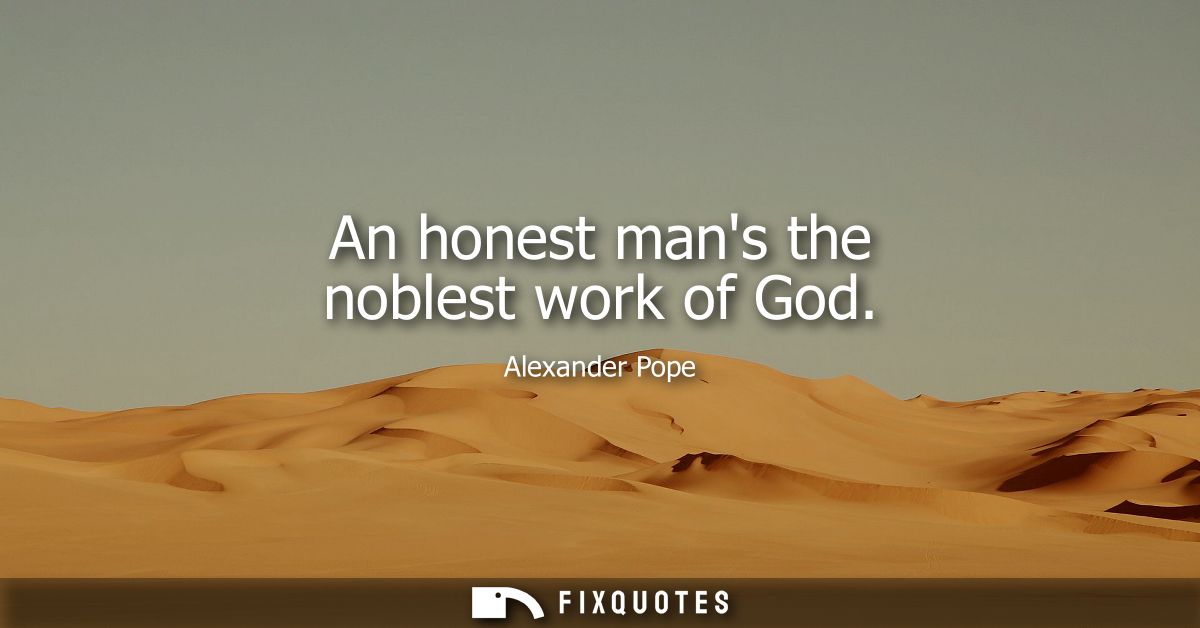
"An honest man's the noblest work of God"
About this Quote
Pope flatters the moral life with the swagger of a craftsman praising his finest product. In an age obsessed with pedigree, patronage, and the careful theater of “virtue,” he yanks nobility down from the bloodline and plants it in character. The line’s brilliance is its bait-and-switch: it sounds like pious uplift, but it’s also an indictment. If the “noblest work of God” is merely an honest man, then a lot of titled men, courtiers, and respectable sinners are implicitly downgraded to shoddy workmanship.
The phrasing does extra work. “Work” frames God not as a distant monarch but as an artisan, inviting a secular standard of quality: honesty becomes measurable, almost engineered, not a misty spiritual state. The superlative “noblest” is deliberately provocative in a culture that treated nobility as an inherited fact. Pope’s couplet-ready compression turns ethics into a social weapon: it praises one kind of man while quietly humiliating the kind that claims moral authority by rank.
Context sharpens the edge. Pope, a Catholic in Protestant England and an outsider to the official power structure, had reason to distrust institutions that conferred legitimacy. His satirical bent often targets hypocrisy dressed as refinement. Here, “honest” isn’t just personal sincerity; it signals integrity against corruption, plain dealing against fashionable deceit. The line works because it offers a devotional-sounding compliment that doubles as class critique: God’s best creation might be the person your society least rewards.
The phrasing does extra work. “Work” frames God not as a distant monarch but as an artisan, inviting a secular standard of quality: honesty becomes measurable, almost engineered, not a misty spiritual state. The superlative “noblest” is deliberately provocative in a culture that treated nobility as an inherited fact. Pope’s couplet-ready compression turns ethics into a social weapon: it praises one kind of man while quietly humiliating the kind that claims moral authority by rank.
Context sharpens the edge. Pope, a Catholic in Protestant England and an outsider to the official power structure, had reason to distrust institutions that conferred legitimacy. His satirical bent often targets hypocrisy dressed as refinement. Here, “honest” isn’t just personal sincerity; it signals integrity against corruption, plain dealing against fashionable deceit. The line works because it offers a devotional-sounding compliment that doubles as class critique: God’s best creation might be the person your society least rewards.
Quote Details
| Topic | Honesty & Integrity |
|---|---|
| Source | Alexander Pope, An Essay on Man (Epistle II), 1733–1734. |
| Cite |
Citation Formats
APA Style (7th ed.)
Pope, Alexander. (2026, January 17). An honest man's the noblest work of God. FixQuotes. https://fixquotes.com/quotes/an-honest-mans-the-noblest-work-of-god-29705/
Chicago Style
Pope, Alexander. "An honest man's the noblest work of God." FixQuotes. January 17, 2026. https://fixquotes.com/quotes/an-honest-mans-the-noblest-work-of-god-29705/.
MLA Style (9th ed.)
"An honest man's the noblest work of God." FixQuotes, 17 Jan. 2026, https://fixquotes.com/quotes/an-honest-mans-the-noblest-work-of-god-29705/. Accessed 31 Mar. 2026.
More Quotes by Alexander
Add to List