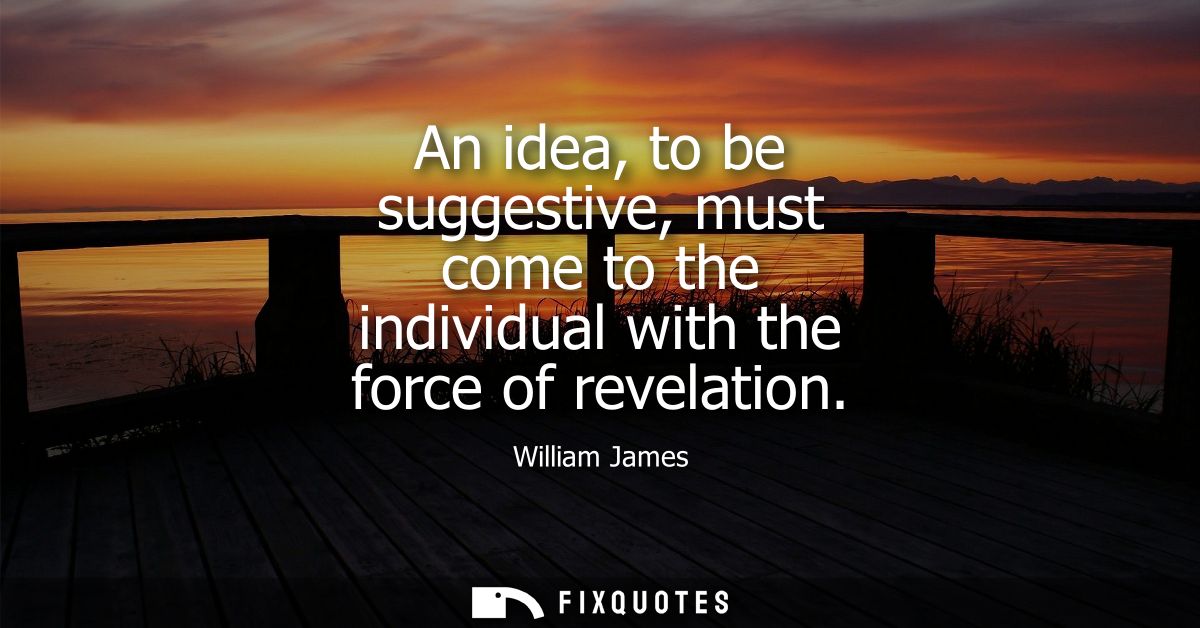
"An idea, to be suggestive, must come to the individual with the force of revelation"
About this Quote
That’s classic William James: the pragmatist who distrusts armchair certainty and cares about how beliefs actually land in a person. The subtext is anti-authoritarian in a subtle, American way. Knowledge can’t simply be handed down from the lectern; it has to be owned, metabolized, made vivid. Revelation here doesn’t mean supernatural truth so much as psychological undeniability - an idea becomes generative when it changes what you can notice and therefore what you can do. Suggestiveness is a test of fertility, not pedigree.
Context matters: James is writing in an era when scientific prestige is rising, religion is being re-litigated, and modern psychology is being born. He’s trying to reconcile rigor with lived experience. By making revelation the entry point, he’s also warning against the seductions of system-building: an idea that never strikes anyone as revelatory may be internally consistent and still culturally inert. He’s asking for philosophy that behaves less like a courthouse brief and more like a door you didn’t realize could open.
Quote Details
| Topic | Wisdom |
|---|---|
| Source | Help us find the source |
| Cite |
Citation Formats
APA Style (7th ed.)
James, William. (2026, January 18). An idea, to be suggestive, must come to the individual with the force of revelation. FixQuotes. https://fixquotes.com/quotes/an-idea-to-be-suggestive-must-come-to-the-22118/
Chicago Style
James, William. "An idea, to be suggestive, must come to the individual with the force of revelation." FixQuotes. January 18, 2026. https://fixquotes.com/quotes/an-idea-to-be-suggestive-must-come-to-the-22118/.
MLA Style (9th ed.)
"An idea, to be suggestive, must come to the individual with the force of revelation." FixQuotes, 18 Jan. 2026, https://fixquotes.com/quotes/an-idea-to-be-suggestive-must-come-to-the-22118/. Accessed 11 Mar. 2026.