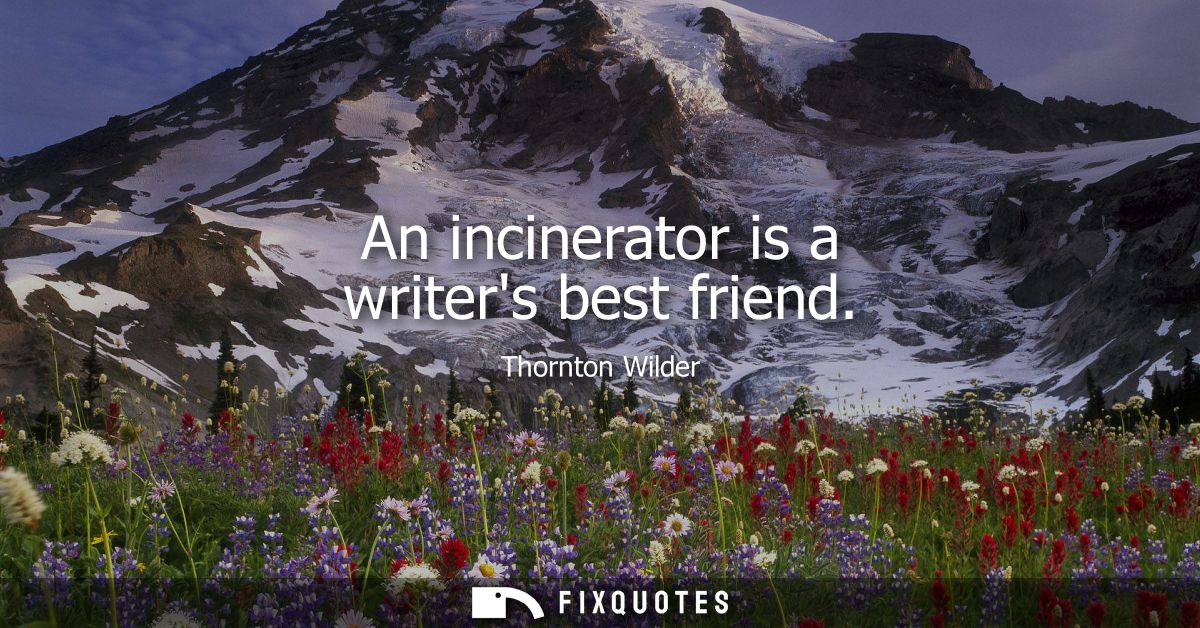
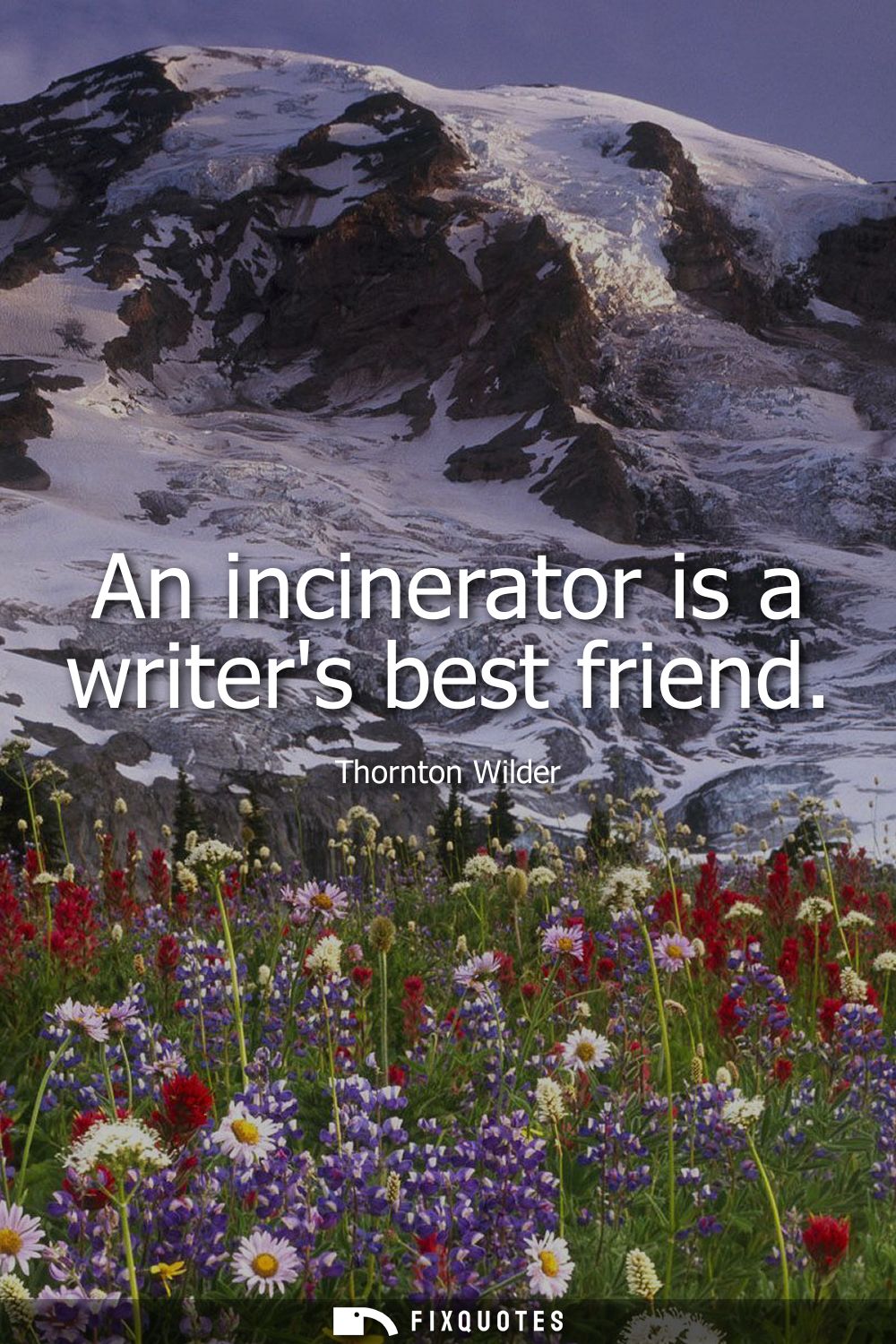
"An incinerator is a writer's best friend"
About this Quote
The line lands like a polite arson joke, which is exactly Wilder’s point: the serious business of writing often demands the ruthless pleasure of destruction. An incinerator isn’t just a disposal method; it’s a mindset. It implies heat, finality, no resurrection from the trash bin. For a novelist and playwright obsessed with craft and architecture, that finality is liberating. You can’t negotiate with ash.
Wilder’s intent reads as practical advice disguised as gallows humor. Writers mythologize inspiration, but revision is where the work either earns its keep or gets executed. Calling the incinerator a “best friend” turns self-critique into companionship, as if the only ally you can fully trust is the one that helps you delete your own vanity. The subtext is a warning against sentimentality: don’t confuse effort with value; don’t keep a scene because you suffered for it; don’t hoard paragraphs like heirlooms.
Contextually, Wilder wrote across forms and eras, from early 20th-century modernist discipline to midcentury American theatrical polish. He lived in a time when drafts were literal paper stacks, not infinitely recoverable digital versions. The joke carries a material truth: bad pages take up space, literally and mentally. Today, when every version is archived and “deleted” is reversible, Wilder’s incinerator reads almost radical. He’s advocating for the rare writerly courage to make choices permanent, to burn the scaffolding so the building can actually stand.
Wilder’s intent reads as practical advice disguised as gallows humor. Writers mythologize inspiration, but revision is where the work either earns its keep or gets executed. Calling the incinerator a “best friend” turns self-critique into companionship, as if the only ally you can fully trust is the one that helps you delete your own vanity. The subtext is a warning against sentimentality: don’t confuse effort with value; don’t keep a scene because you suffered for it; don’t hoard paragraphs like heirlooms.
Contextually, Wilder wrote across forms and eras, from early 20th-century modernist discipline to midcentury American theatrical polish. He lived in a time when drafts were literal paper stacks, not infinitely recoverable digital versions. The joke carries a material truth: bad pages take up space, literally and mentally. Today, when every version is archived and “deleted” is reversible, Wilder’s incinerator reads almost radical. He’s advocating for the rare writerly courage to make choices permanent, to burn the scaffolding so the building can actually stand.
Quote Details
| Topic | Writing |
|---|---|
| Source | Help us find the source |
| Cite |
Citation Formats
APA Style (7th ed.)
Wilder, Thornton. (2026, January 17). An incinerator is a writer's best friend. FixQuotes. https://fixquotes.com/quotes/an-incinerator-is-a-writers-best-friend-36588/
Chicago Style
Wilder, Thornton. "An incinerator is a writer's best friend." FixQuotes. January 17, 2026. https://fixquotes.com/quotes/an-incinerator-is-a-writers-best-friend-36588/.
MLA Style (9th ed.)
"An incinerator is a writer's best friend." FixQuotes, 17 Jan. 2026, https://fixquotes.com/quotes/an-incinerator-is-a-writers-best-friend-36588/. Accessed 31 Mar. 2026.
More Quotes by Thornton
Add to List