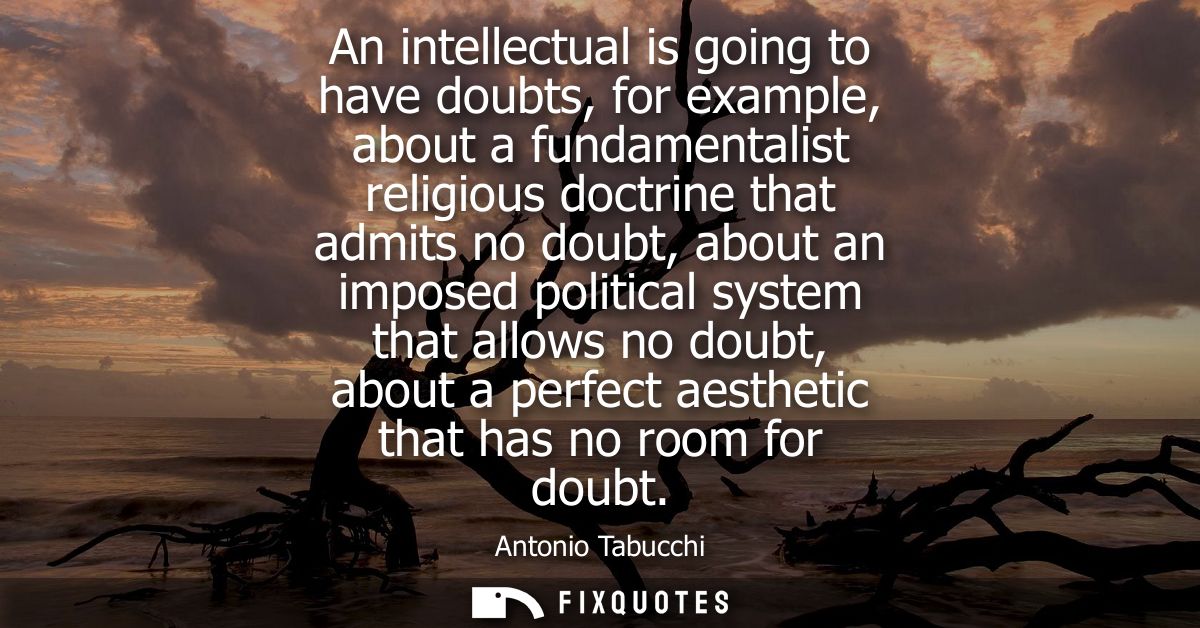
"An intellectual is going to have doubts, for example, about a fundamentalist religious doctrine that admits no doubt, about an imposed political system that allows no doubt, about a perfect aesthetic that has no room for doubt"
About this Quote
The intent is quietly polemical. Tabucchi isn't congratulating intellectuals for being skeptical by temperament; he's defining them by their friction with closed worlds. The repetition of "doubt" is deliberate monotony, a drumbeat that makes absolutism feel claustrophobic. He also widens the target. It's easy to condemn fundamentalism and authoritarianism; it's more uncomfortable to implicate "a perfect aesthetic" - the seductive cultural version of the same impulse, where taste becomes law and art becomes a purity test. That's the subtext: intolerance doesn't only arrive with uniforms and sermons. It can arrive as prestige.
Context matters. Tabucchi, an Italian novelist deeply engaged with Portugal's Salazar-era shadow and European twentieth-century authoritarian hangovers, writes with the memory of regimes that demanded unanimity and punished nuance. His line reads like a defense of pluralism, but also as a warning about the pleasure of certainty. The intellectual's doubt isn't nihilism; it's a refusal to let any institution - sacred, civic, or cultural - declare itself finished.
Quote Details
| Topic | Reason & Logic |
|---|---|
| Source | Help us find the source |
| Cite |
Citation Formats
APA Style (7th ed.)
Tabucchi, Antonio. (2026, January 18). An intellectual is going to have doubts, for example, about a fundamentalist religious doctrine that admits no doubt, about an imposed political system that allows no doubt, about a perfect aesthetic that has no room for doubt. FixQuotes. https://fixquotes.com/quotes/an-intellectual-is-going-to-have-doubts-for-9277/
Chicago Style
Tabucchi, Antonio. "An intellectual is going to have doubts, for example, about a fundamentalist religious doctrine that admits no doubt, about an imposed political system that allows no doubt, about a perfect aesthetic that has no room for doubt." FixQuotes. January 18, 2026. https://fixquotes.com/quotes/an-intellectual-is-going-to-have-doubts-for-9277/.
MLA Style (9th ed.)
"An intellectual is going to have doubts, for example, about a fundamentalist religious doctrine that admits no doubt, about an imposed political system that allows no doubt, about a perfect aesthetic that has no room for doubt." FixQuotes, 18 Jan. 2026, https://fixquotes.com/quotes/an-intellectual-is-going-to-have-doubts-for-9277/. Accessed 5 Apr. 2026.