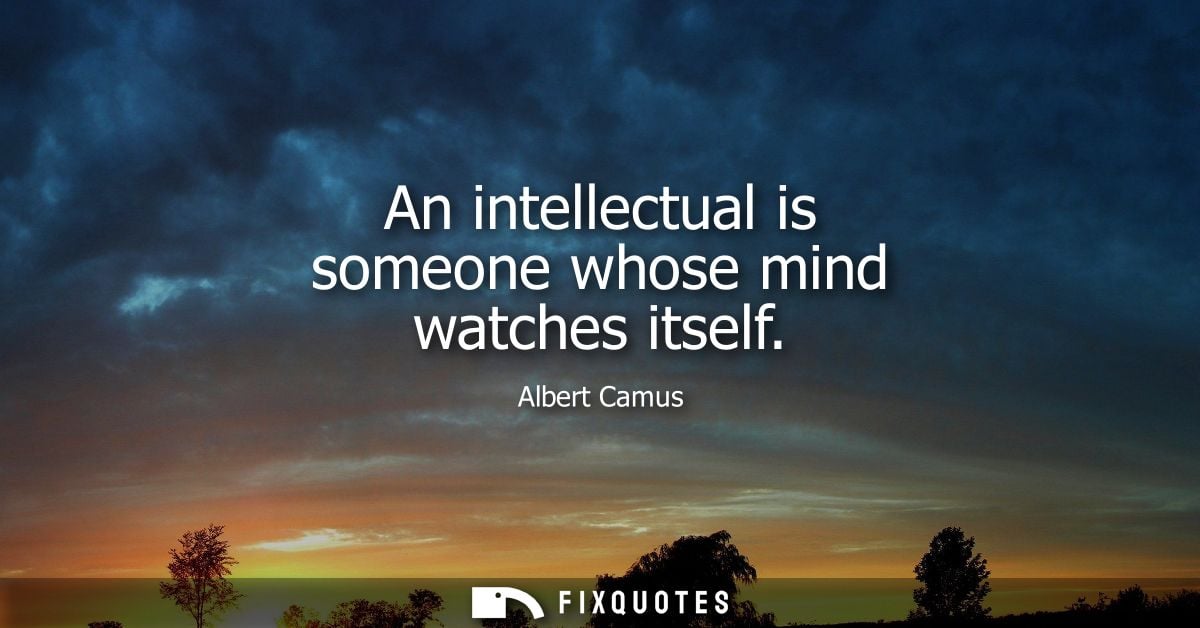
"An intellectual is someone whose mind watches itself"
About this Quote
Camus’s line turns the intellectual into a spectator of their own thinking, and it lands with the cool sting of a diagnosis. “Watches itself” isn’t the triumph of self-knowledge; it’s the image of consciousness split in two, mind as both actor and surveillance camera. That double-vision is Camus in miniature: lucid, allergic to consolation, suspicious of any story that pretends the world is more coherent than it is.
The intent is partly definitional, partly corrective. Camus isn’t praising the intellectual as a keeper of facts; he’s narrowing the category to a practice: reflexivity under pressure. The subtext is that intelligence alone is cheap. What matters is the ability to observe your own motives, the seductions of ideology, the little lies that make life feel tidy. The mind watching itself is an internal check against fanaticism - and, just as importantly for Camus, against the melodramatic fantasy that suffering can be redeemed by some grand historical plan.
Context matters. Writing in the shadow of World War II and the ideological fistfights of mid-century France, Camus watched brilliant people recruit their brains into moral alibis. His break with Sartre over Soviet apologetics hangs in the background: the “intellectual” who doesn’t watch himself becomes a technician of justifications, polishing arguments that excuse cruelty for a promised future.
There’s irony, too. A mind that watches itself can tip into paralysis, forever analyzing, never living. Camus’s real challenge is implied: keep the self-scrutiny, lose the self-importance. The intellectual’s job isn’t to float above the world; it’s to stay awake inside it.
The intent is partly definitional, partly corrective. Camus isn’t praising the intellectual as a keeper of facts; he’s narrowing the category to a practice: reflexivity under pressure. The subtext is that intelligence alone is cheap. What matters is the ability to observe your own motives, the seductions of ideology, the little lies that make life feel tidy. The mind watching itself is an internal check against fanaticism - and, just as importantly for Camus, against the melodramatic fantasy that suffering can be redeemed by some grand historical plan.
Context matters. Writing in the shadow of World War II and the ideological fistfights of mid-century France, Camus watched brilliant people recruit their brains into moral alibis. His break with Sartre over Soviet apologetics hangs in the background: the “intellectual” who doesn’t watch himself becomes a technician of justifications, polishing arguments that excuse cruelty for a promised future.
There’s irony, too. A mind that watches itself can tip into paralysis, forever analyzing, never living. Camus’s real challenge is implied: keep the self-scrutiny, lose the self-importance. The intellectual’s job isn’t to float above the world; it’s to stay awake inside it.
Quote Details
| Topic | Wisdom |
|---|---|
| Source | Verified source: Notebooks 1935–1942 (Albert Camus, 1963)
Evidence: “An intellectual is someone whose mind watches itself. I like this, because I am happy to be both halves, the watcher and the watched. ‘Can they be brought together?’ This is a practical question. We must get down to it. ‘I despise intelligence’ really means: ‘I cannot bear my doubts.’ I prefer to keep my eyes open.”. Primary source is Camus’s own notebook entry (written during the 1935–1942 notebook years). The first publication of the underlying French notebooks is commonly given as "Carnets" (Gallimard) in 1962, posthumous; the first English publication of that volume is "Notebooks 1935–1942" (Philip Thody, trans.; Knopf) reported contemporaneously as appearing in the U.S. in 1963. I was able to verify the exact wording of the English passage via a 1964 New Yorker review quoting the line while describing the Knopf translation, but I could not, within this search session, open a scan of the Knopf book itself to extract a page number or reproduce the original French sentence exactly. So: source identification is strong, but page/chapter details remain unverified here. Other candidates (1) Humorous Wit (Djamel Ouis, 2020) compilation95.0% ... An intellectual is someone whose mind watches itself. Albert Camus The best way to increase the intel- ligence of... |
| Cite |
Citation Formats
APA Style (7th ed.)
Camus, Albert. (2026, February 27). An intellectual is someone whose mind watches itself. FixQuotes. https://fixquotes.com/quotes/an-intellectual-is-someone-whose-mind-watches-29598/
Chicago Style
Camus, Albert. "An intellectual is someone whose mind watches itself." FixQuotes. February 27, 2026. https://fixquotes.com/quotes/an-intellectual-is-someone-whose-mind-watches-29598/.
MLA Style (9th ed.)
"An intellectual is someone whose mind watches itself." FixQuotes, 27 Feb. 2026, https://fixquotes.com/quotes/an-intellectual-is-someone-whose-mind-watches-29598/. Accessed 28 Mar. 2026.
More Quotes by Albert
Add to List