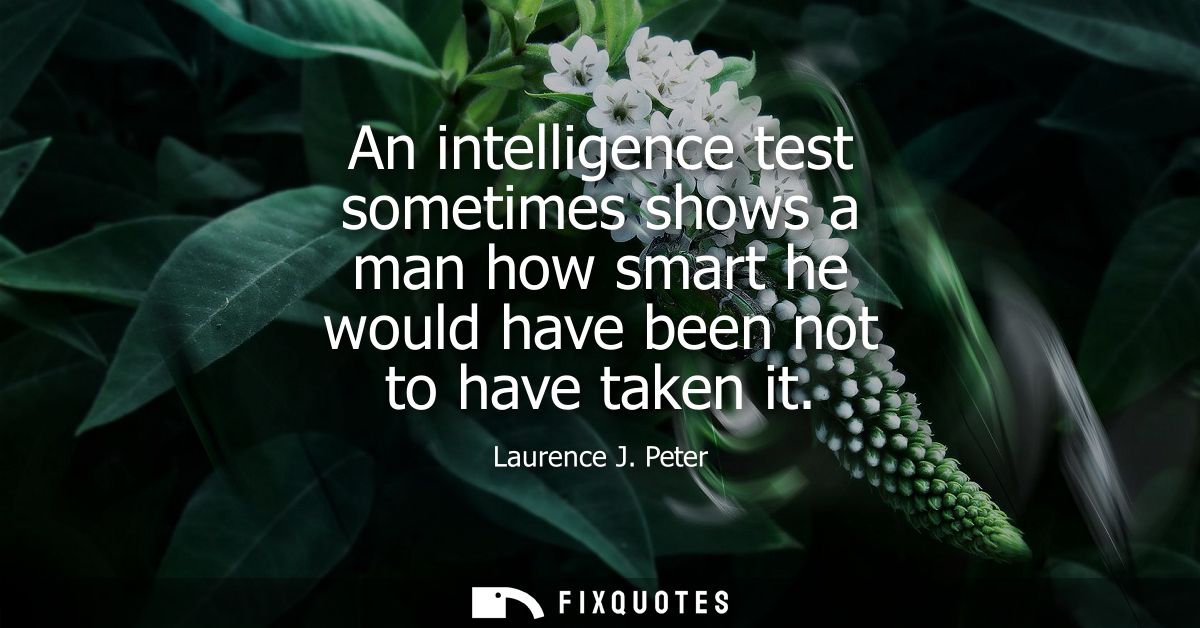
"An intelligence test sometimes shows a man how smart he would have been not to have taken it"
About this Quote
The comedy works because the “intelligence test” isn’t just a test; it’s a ritual of bureaucratic faith. You walk in hoping to be certified as exceptional, and walk out with a number that can only shrink you. Peter flips the script by implying that the truly smart move is opting out entirely. That’s not anti-intellectualism; it’s suspicion of systems that claim to quantify something as slippery as human judgment. The punchline lands on “would have been”: intelligence becomes a hypothetical, a counterfactual self you can never retrieve once you’ve let the test define the terms.
Context matters: Peter is best known for the Peter Principle, his satirical diagnosis of workplaces that promote people until they’re incompetent. This quote lives in the same universe: institutions love tidy metrics because they make decisions feel objective, even when they’re crude. The subtext is that tests often measure compliance as much as cognition - your willingness to be sorted, ranked, and managed.
It’s also a quiet critique of ego. Taking the test is a bet you’ll like the verdict. Peter’s wit is that the only guaranteed “smart” outcome is refusing the game that profits from your anxiety about where you stand.
Quote Details
| Topic | Witty One-Liners |
|---|---|
| Source | Help us find the source |
| Cite |
Citation Formats
APA Style (7th ed.)
Peter, Laurence J. (2026, January 17). An intelligence test sometimes shows a man how smart he would have been not to have taken it. FixQuotes. https://fixquotes.com/quotes/an-intelligence-test-sometimes-shows-a-man-how-80987/
Chicago Style
Peter, Laurence J. "An intelligence test sometimes shows a man how smart he would have been not to have taken it." FixQuotes. January 17, 2026. https://fixquotes.com/quotes/an-intelligence-test-sometimes-shows-a-man-how-80987/.
MLA Style (9th ed.)
"An intelligence test sometimes shows a man how smart he would have been not to have taken it." FixQuotes, 17 Jan. 2026, https://fixquotes.com/quotes/an-intelligence-test-sometimes-shows-a-man-how-80987/. Accessed 12 Feb. 2026.