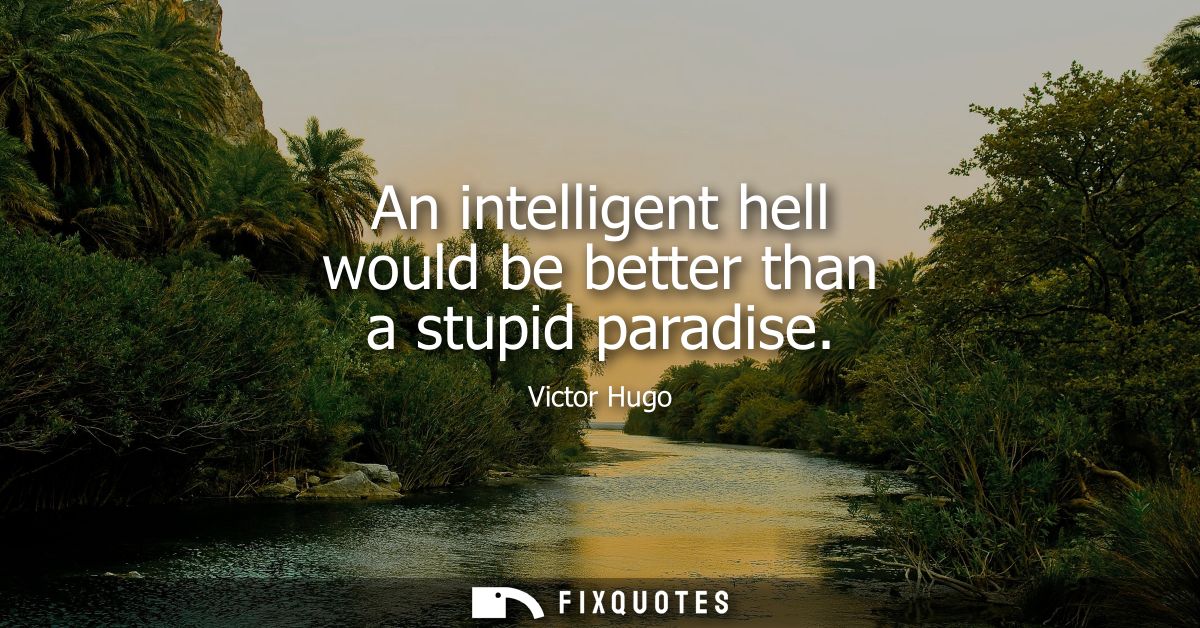
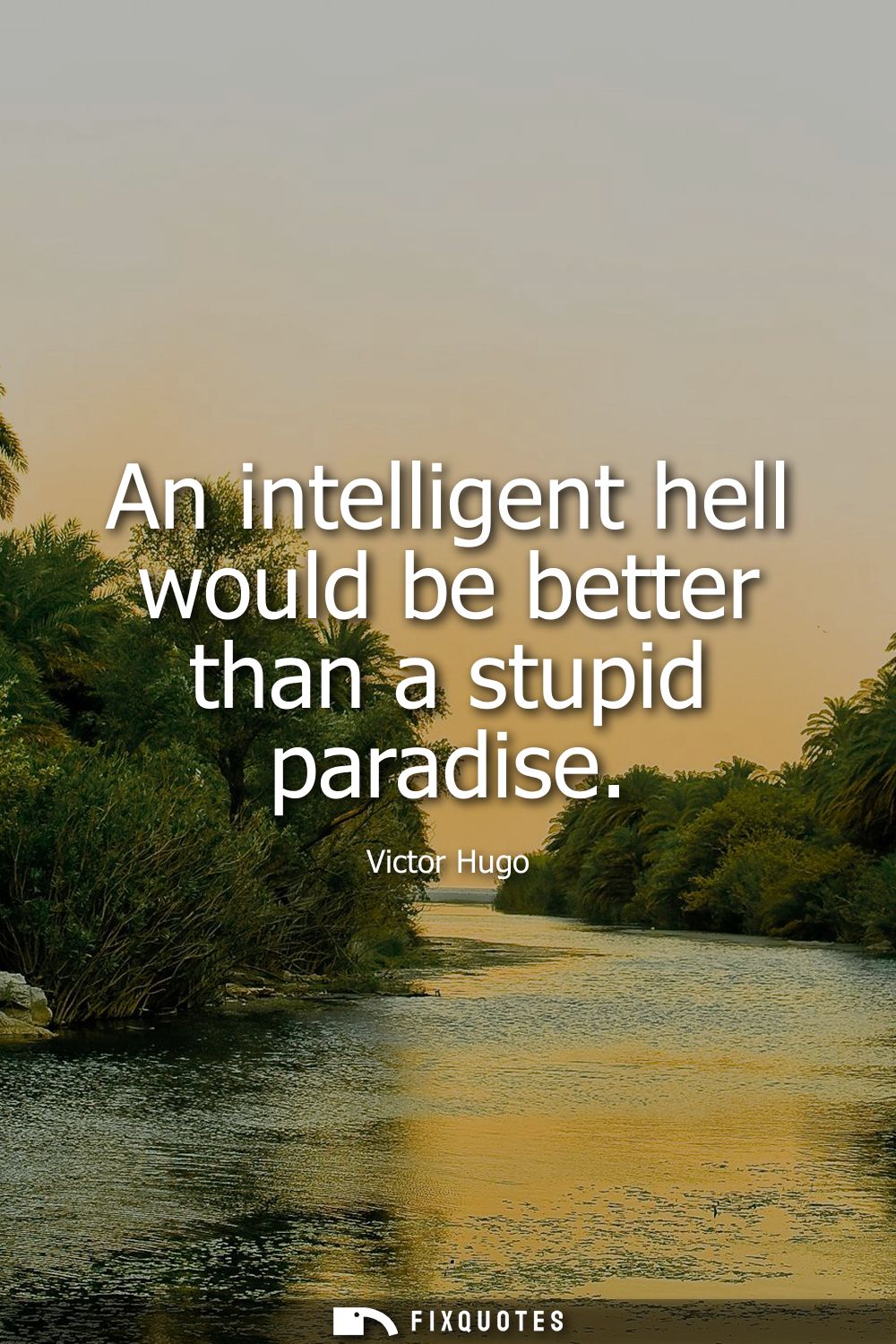
"An intelligent hell would be better than a stupid paradise"
About this Quote
“An intelligent hell would be better than a stupid paradise” is Hugo at his most deliciously combative: a moralist who refuses to flatter comfort. The line turns the usual religious calculus inside out. Heaven and hell aren’t treated as metaphysical destinations; they’re measures of mental life. “Intelligent” becomes an ethical category, not just an IQ score. A place of suffering that still permits thought, debate, and lucidity beats a blissful enclosure built on dull obedience. Hugo’s provocation is aimed less at theology than at any system that demands you trade your mind for your security.
The subtext is political. Hugo lived through regime changes, censorship, and exile; he watched “paradise” rhetoric get used as a civic anesthetic. The promise is always the same: accept the story, keep quiet, enjoy the comforts. Hugo answers with a writer’s heresy: consciousness matters more than consolation. If paradise is “stupid,” it’s also infantilizing, a place where the citizen becomes a child and the believer becomes a consumer of certainty. Hell, in this frame, resembles the hard brightness of reality - unpleasant, but awake.
The line works because it’s an insult disguised as a theological aphorism. It flatters the reader’s self-image (you, of course, prefer intelligence) while quietly accusing institutions that market happiness at the price of curiosity. Hugo isn’t romanticizing suffering; he’s warning that a painless world without thinking is its own kind of damnation.
The subtext is political. Hugo lived through regime changes, censorship, and exile; he watched “paradise” rhetoric get used as a civic anesthetic. The promise is always the same: accept the story, keep quiet, enjoy the comforts. Hugo answers with a writer’s heresy: consciousness matters more than consolation. If paradise is “stupid,” it’s also infantilizing, a place where the citizen becomes a child and the believer becomes a consumer of certainty. Hell, in this frame, resembles the hard brightness of reality - unpleasant, but awake.
The line works because it’s an insult disguised as a theological aphorism. It flatters the reader’s self-image (you, of course, prefer intelligence) while quietly accusing institutions that market happiness at the price of curiosity. Hugo isn’t romanticizing suffering; he’s warning that a painless world without thinking is its own kind of damnation.
Quote Details
| Topic | Wisdom |
|---|---|
| Source | Help us find the source |
| Cite |
Citation Formats
APA Style (7th ed.)
Hugo, Victor. (2026, January 14). An intelligent hell would be better than a stupid paradise. FixQuotes. https://fixquotes.com/quotes/an-intelligent-hell-would-be-better-than-a-stupid-22579/
Chicago Style
Hugo, Victor. "An intelligent hell would be better than a stupid paradise." FixQuotes. January 14, 2026. https://fixquotes.com/quotes/an-intelligent-hell-would-be-better-than-a-stupid-22579/.
MLA Style (9th ed.)
"An intelligent hell would be better than a stupid paradise." FixQuotes, 14 Jan. 2026, https://fixquotes.com/quotes/an-intelligent-hell-would-be-better-than-a-stupid-22579/. Accessed 12 Feb. 2026.
More Quotes by Victor
Add to List