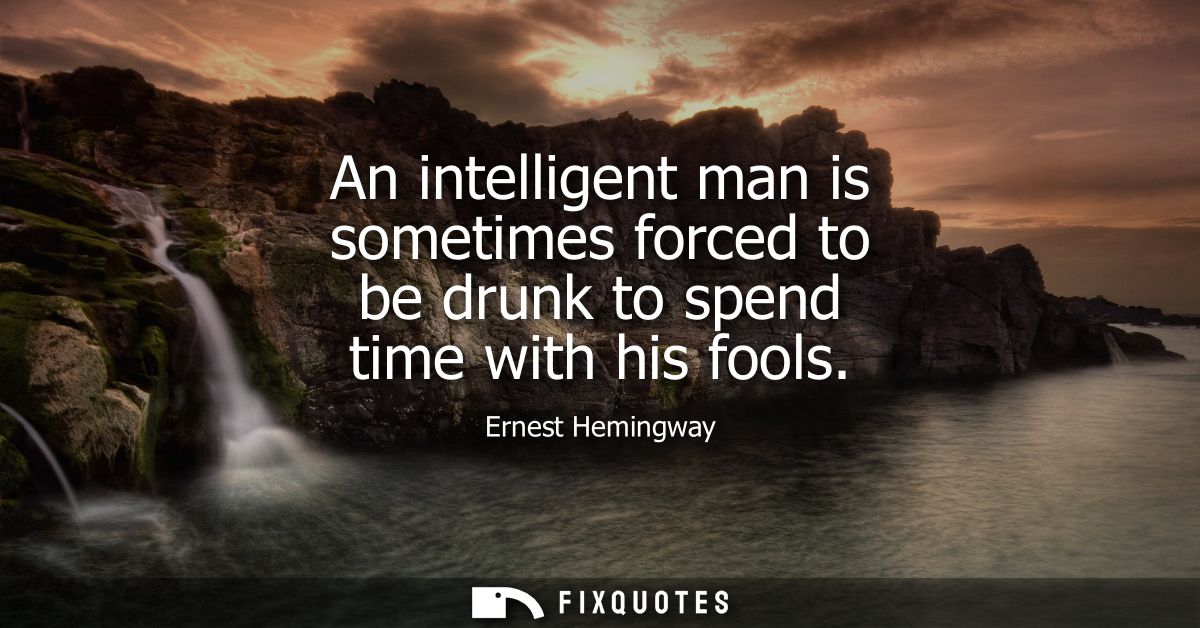
"An intelligent man is sometimes forced to be drunk to spend time with his fools"
About this Quote
The subtext is more revealing than the swagger. Calling others “fools” stages the classic Hemingway posture of the solitary witness: the man who sees too clearly and therefore can’t unsee the posturing, the small talk, the crowd’s hunger for comforting lies. Drunkenness becomes permission to participate without fully consenting. It’s a performance of belonging that keeps the self intact.
Context matters because Hemingway’s public mythology was built in taverns as much as in sentences: the expatriate cafes of Paris, the Spanish bars, the Key West watering holes. Modernism’s hangover is all over this attitude. After war and disillusionment, the old social scripts can feel like bad theater, and intoxication offers a shortcut around sincerity. There’s also an uncomfortable edge: the quote flatters the speaker’s superiority, turning impatience into insight and contempt into wit.
Why it works is its ruthless economy. “Sometimes forced” pretends necessity; “his fools” claims ownership. It’s not just a joke about drinking. It’s a defense mechanism dressed up as masculinity, elevating alienation into a lifestyle and calling the coping strategy a virtue.
Quote Details
| Topic | Sarcastic |
|---|---|
| Source | Help us find the source |
| Cite |
Citation Formats
APA Style (7th ed.)
Hemingway, Ernest. (2026, January 14). An intelligent man is sometimes forced to be drunk to spend time with his fools. FixQuotes. https://fixquotes.com/quotes/an-intelligent-man-is-sometimes-forced-to-be-31132/
Chicago Style
Hemingway, Ernest. "An intelligent man is sometimes forced to be drunk to spend time with his fools." FixQuotes. January 14, 2026. https://fixquotes.com/quotes/an-intelligent-man-is-sometimes-forced-to-be-31132/.
MLA Style (9th ed.)
"An intelligent man is sometimes forced to be drunk to spend time with his fools." FixQuotes, 14 Jan. 2026, https://fixquotes.com/quotes/an-intelligent-man-is-sometimes-forced-to-be-31132/. Accessed 2 Apr. 2026.