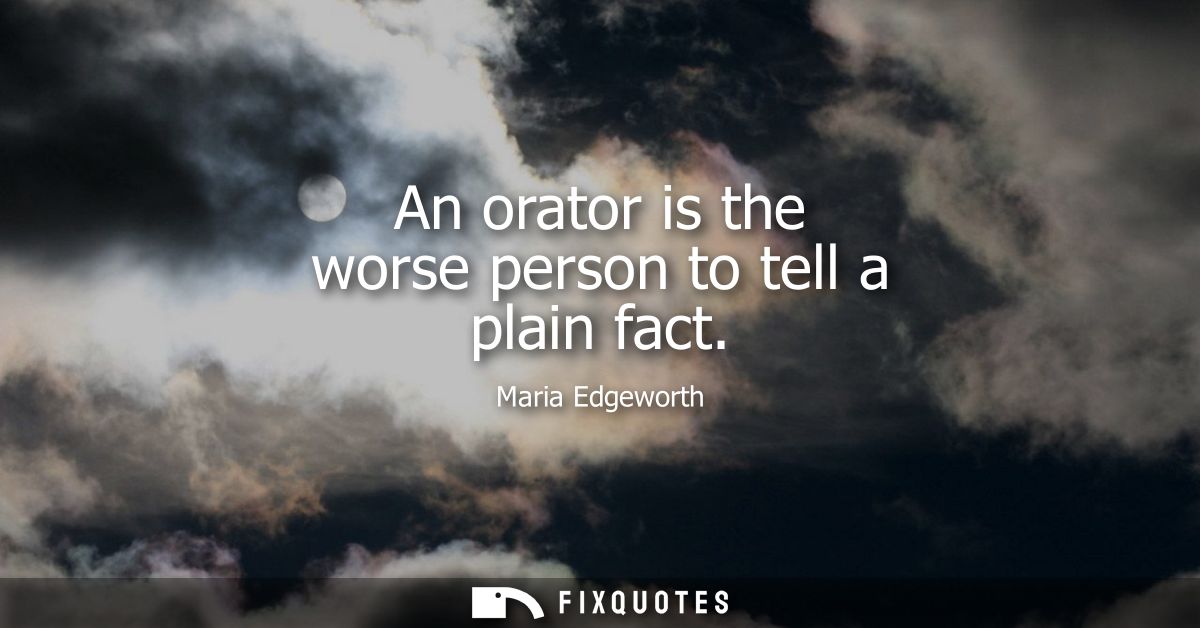
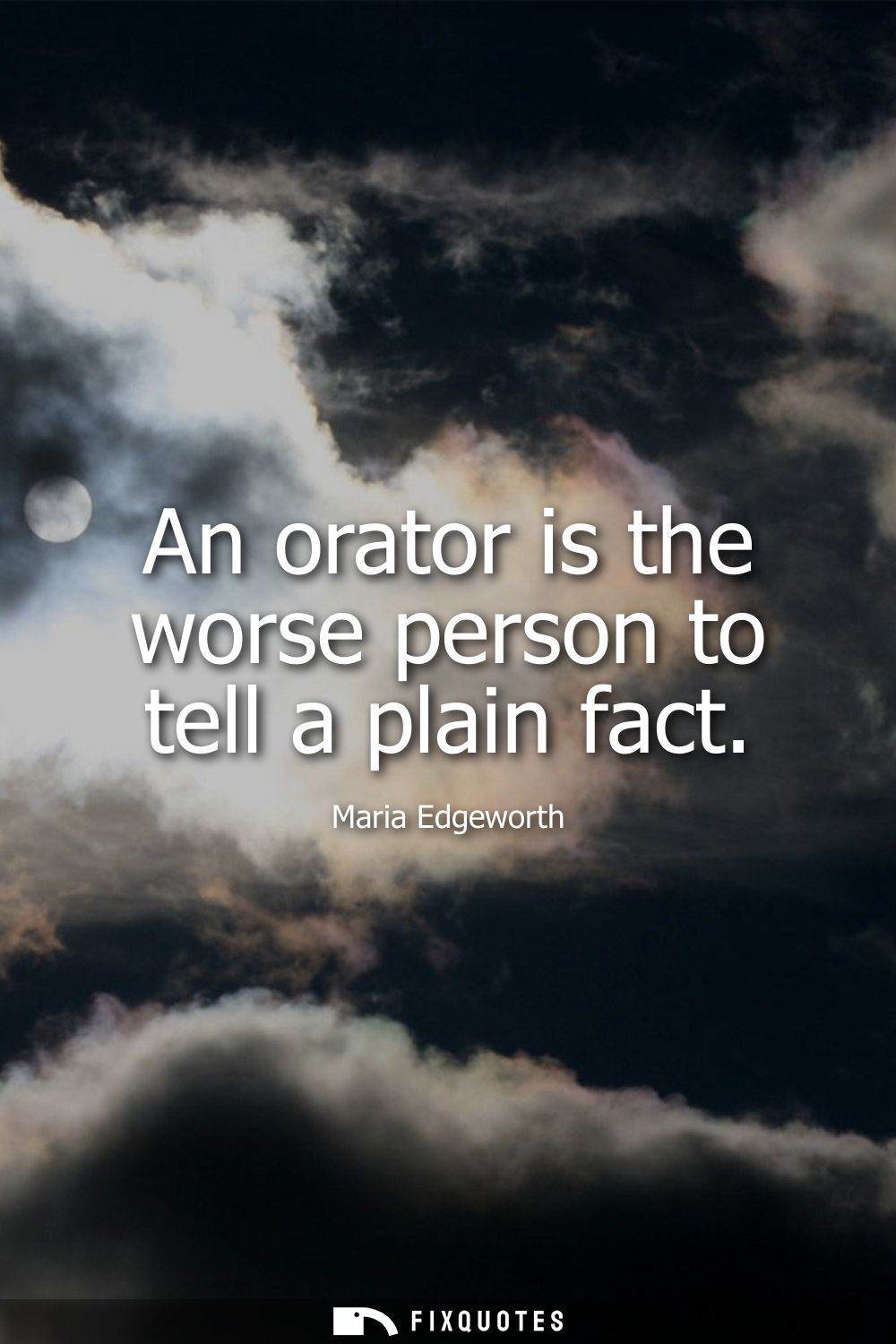
"An orator is the worse person to tell a plain fact"
About this Quote
An orator, Edgeworth implies, is professionally disqualified from plainness. The line lands like a dry Irish side-eye at a culture that rewards performance over precision: the very person trained to move a crowd is least reliable when the job is simply to report what happened. “Worse” does double duty. It’s a moral warning (the orator may shade truth to win) and a practical one (even when honest, rhetoric distorts by design).
Edgeworth was a novelist of manners and an educator as much as a storyteller, writing in a period when public speech carried real social and political leverage. Oratory wasn’t just talk; it was power, tied to parliament, the courtroom, the pulpit, and the salon. In that world, “plain fact” is a fragile thing, easily bruised by cadence, emphasis, and selective detail. The sentence exposes how persuasion works: it doesn’t necessarily lie; it curates. An orator can make a minor incident feel like a national crisis, or a scandal read as sacrifice, simply by choosing which facts get oxygen.
The subtext is less anti-speech than anti-spectacle. Edgeworth is skeptical of charisma as a substitute for evidence, and she’s alert to the way audiences collude in the process, preferring a satisfying narrative to an accurate account. Coming from a novelist, it’s also a sly admission: narrative is powerful precisely because it is not neutral. The warning isn’t “don’t listen.” It’s “don’t confuse eloquence with accuracy.”
Edgeworth was a novelist of manners and an educator as much as a storyteller, writing in a period when public speech carried real social and political leverage. Oratory wasn’t just talk; it was power, tied to parliament, the courtroom, the pulpit, and the salon. In that world, “plain fact” is a fragile thing, easily bruised by cadence, emphasis, and selective detail. The sentence exposes how persuasion works: it doesn’t necessarily lie; it curates. An orator can make a minor incident feel like a national crisis, or a scandal read as sacrifice, simply by choosing which facts get oxygen.
The subtext is less anti-speech than anti-spectacle. Edgeworth is skeptical of charisma as a substitute for evidence, and she’s alert to the way audiences collude in the process, preferring a satisfying narrative to an accurate account. Coming from a novelist, it’s also a sly admission: narrative is powerful precisely because it is not neutral. The warning isn’t “don’t listen.” It’s “don’t confuse eloquence with accuracy.”
Quote Details
| Topic | Truth |
|---|---|
| Source | Help us find the source |
| Cite |
Citation Formats
APA Style (7th ed.)
Edgeworth, Maria. (2026, January 18). An orator is the worse person to tell a plain fact. FixQuotes. https://fixquotes.com/quotes/an-orator-is-the-worse-person-to-tell-a-plain-fact-23817/
Chicago Style
Edgeworth, Maria. "An orator is the worse person to tell a plain fact." FixQuotes. January 18, 2026. https://fixquotes.com/quotes/an-orator-is-the-worse-person-to-tell-a-plain-fact-23817/.
MLA Style (9th ed.)
"An orator is the worse person to tell a plain fact." FixQuotes, 18 Jan. 2026, https://fixquotes.com/quotes/an-orator-is-the-worse-person-to-tell-a-plain-fact-23817/. Accessed 7 Feb. 2026.
More Quotes by Maria
Add to List