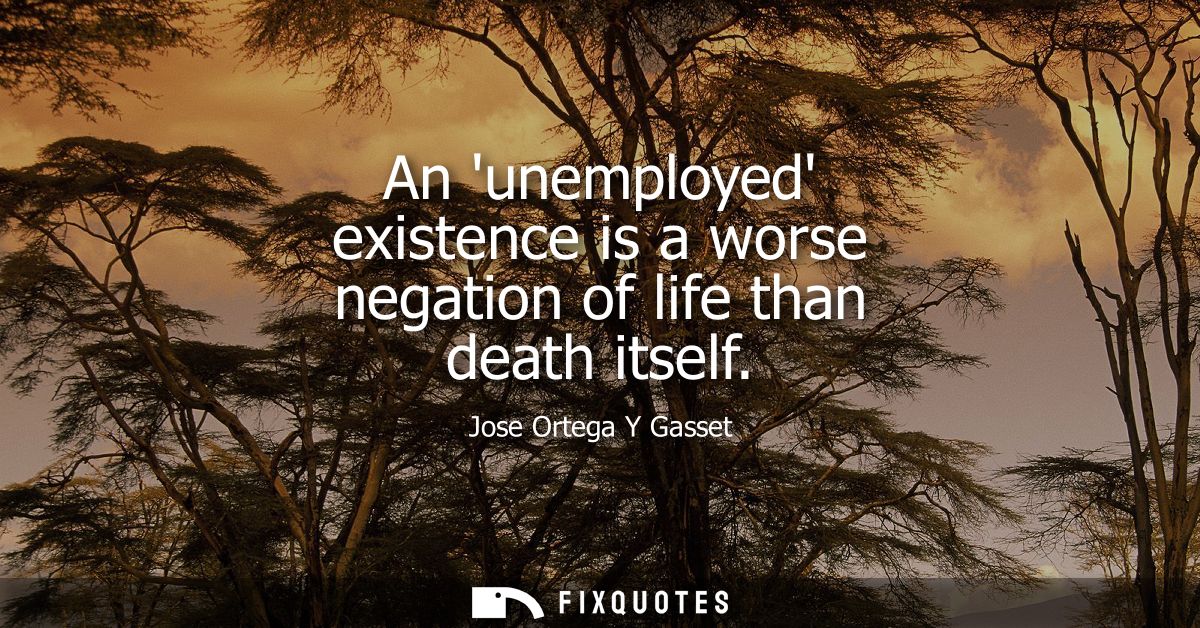
"An 'unemployed' existence is a worse negation of life than death itself"
About this Quote
The quote’s scare quotes around "unemployed" matter. They hint that Ortega is talking about more than labor-market status: a spiritual and civic vacancy. In interwar Europe, amid mass politics and the rise of what he called the "mass man", he worried about citizens drifting into a culture of entitlement, consumption, and grievance without responsibility. Work becomes shorthand for disciplined participation in reality - a daily tether to effort, competence, and social exchange. Without that tether, the self can float into a kind of living death: intact, breathing, but uncommitted.
The brutality of the comparison is the point. Death ends possibility; prolonged non-engagement corrodes it. Ortega is pressuring the reader to treat vocation, duty, and purposeful activity as moral infrastructure, not lifestyle accessories. In a society tempted to outsource meaning to the state, the crowd, or comfort, he insists the most dangerous deprivation is not material but existential: the loss of a reason to get up and answer the world.
Quote Details
| Topic | Work |
|---|---|
| Source | Help us find the source |
| Cite |
Citation Formats
APA Style (7th ed.)
Gasset, Jose Ortega Y. (2026, January 17). An 'unemployed' existence is a worse negation of life than death itself. FixQuotes. https://fixquotes.com/quotes/an-unemployed-existence-is-a-worse-negation-of-55204/
Chicago Style
Gasset, Jose Ortega Y. "An 'unemployed' existence is a worse negation of life than death itself." FixQuotes. January 17, 2026. https://fixquotes.com/quotes/an-unemployed-existence-is-a-worse-negation-of-55204/.
MLA Style (9th ed.)
"An 'unemployed' existence is a worse negation of life than death itself." FixQuotes, 17 Jan. 2026, https://fixquotes.com/quotes/an-unemployed-existence-is-a-worse-negation-of-55204/. Accessed 14 Mar. 2026.