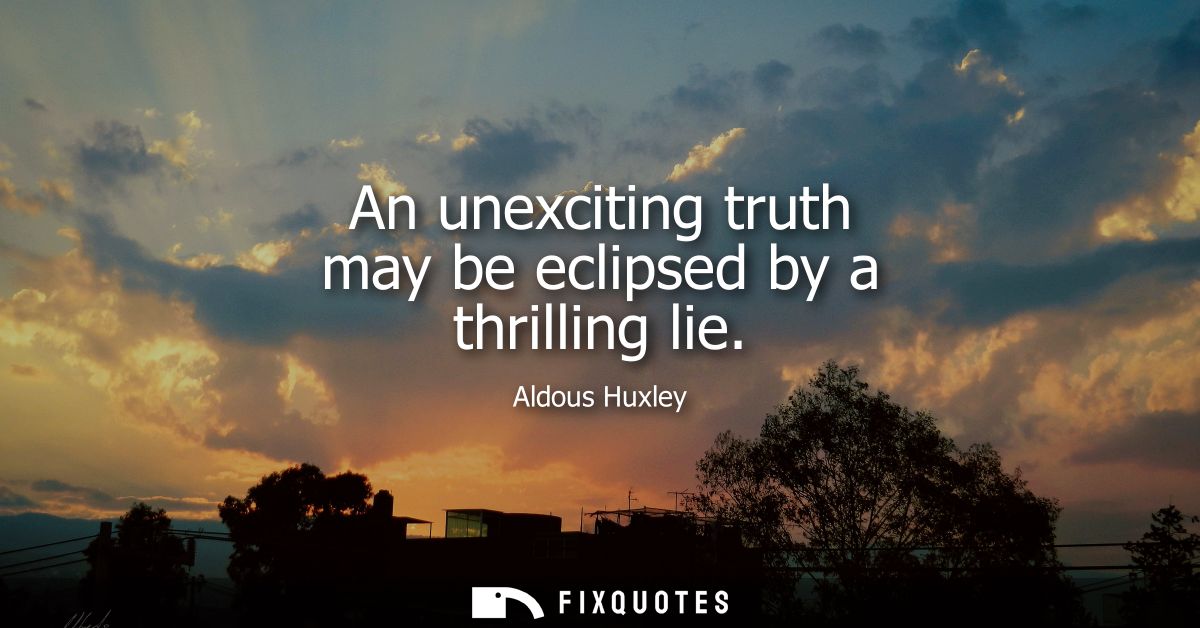
"An unexciting truth may be eclipsed by a thrilling lie"
About this Quote
Huxley is pointing at a weakness in the human operating system: we are not neutral processors of facts, we are craving machines for narrative. The “unexciting truth” isn’t refuted; it’s “eclipsed,” pushed into shadow by something brighter, more cinematic. That verb matters. He’s not describing a fair contest between evidence and misinformation but a perceptual trick: the lie wins the way a flare wins over starlight, by grabbing attention before reason has time to adjust.
The line carries Huxley’s signature cool pessimism about mass culture. Coming out of a century of propaganda, advertising, and rapidly scaling media, he understood that modern life doesn’t just distribute information; it competes for your appetite. “Thrilling” is a devastatingly accurate adjective because it admits what moralizing often ignores: falsehood can be pleasurable. It offers villain-and-hero clarity, secret knowledge, a rush of belonging, the dopamine hit of outrage. Truth, by contrast, is frequently incremental, qualified, and boring on first contact.
Subtextually, Huxley is warning that the struggle for reality is aesthetic as much as intellectual. Whoever tells the better story can colonize the public mind, even when they’re wrong. It’s a critique of audiences and institutions alike: citizens who reward spectacle, and systems that optimize for it. The sentence is also a dare to writers and educators. If truth keeps losing, maybe it’s not enough to be correct; it has to be made legible, vivid, and emotionally survivable without becoming the very “thrilling lie” it’s trying to beat.
The line carries Huxley’s signature cool pessimism about mass culture. Coming out of a century of propaganda, advertising, and rapidly scaling media, he understood that modern life doesn’t just distribute information; it competes for your appetite. “Thrilling” is a devastatingly accurate adjective because it admits what moralizing often ignores: falsehood can be pleasurable. It offers villain-and-hero clarity, secret knowledge, a rush of belonging, the dopamine hit of outrage. Truth, by contrast, is frequently incremental, qualified, and boring on first contact.
Subtextually, Huxley is warning that the struggle for reality is aesthetic as much as intellectual. Whoever tells the better story can colonize the public mind, even when they’re wrong. It’s a critique of audiences and institutions alike: citizens who reward spectacle, and systems that optimize for it. The sentence is also a dare to writers and educators. If truth keeps losing, maybe it’s not enough to be correct; it has to be made legible, vivid, and emotionally survivable without becoming the very “thrilling lie” it’s trying to beat.
Quote Details
| Topic | Truth |
|---|---|
| Source | Help us find the source |
| Cite |
Citation Formats
APA Style (7th ed.)
Huxley, Aldous. (2026, January 17). An unexciting truth may be eclipsed by a thrilling lie. FixQuotes. https://fixquotes.com/quotes/an-unexciting-truth-may-be-eclipsed-by-a-29676/
Chicago Style
Huxley, Aldous. "An unexciting truth may be eclipsed by a thrilling lie." FixQuotes. January 17, 2026. https://fixquotes.com/quotes/an-unexciting-truth-may-be-eclipsed-by-a-29676/.
MLA Style (9th ed.)
"An unexciting truth may be eclipsed by a thrilling lie." FixQuotes, 17 Jan. 2026, https://fixquotes.com/quotes/an-unexciting-truth-may-be-eclipsed-by-a-29676/. Accessed 26 Mar. 2026.
More Quotes by Aldous
Add to List