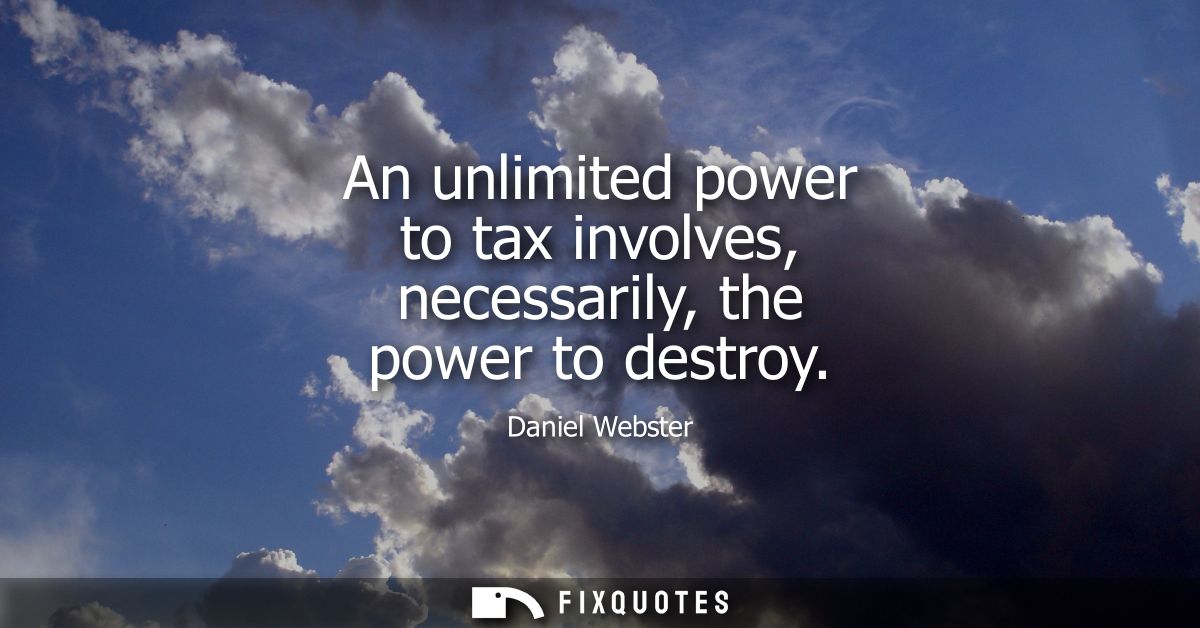
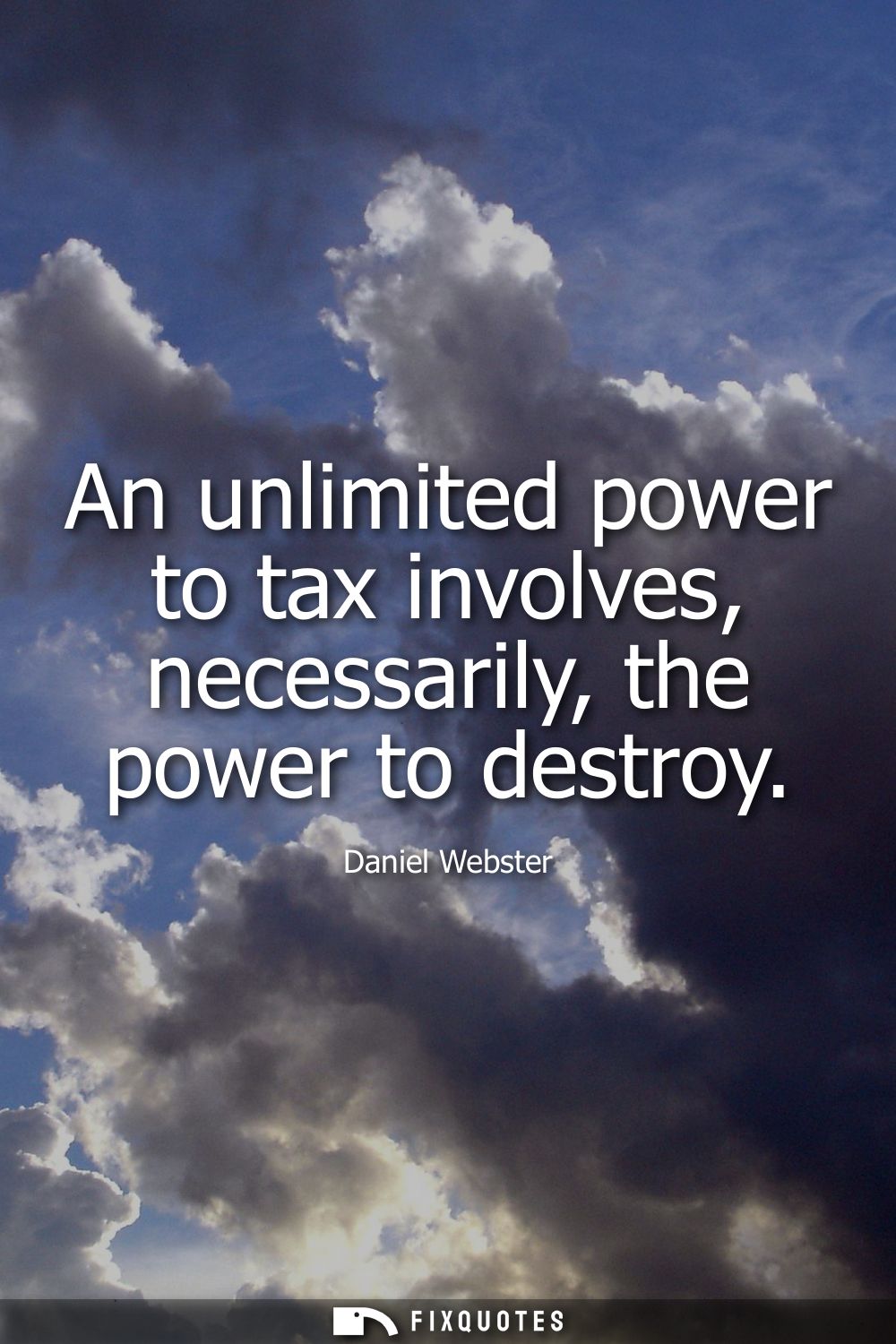
"An unlimited power to tax involves, necessarily, the power to destroy"
About this Quote
Webster’s line lands like a civics lesson delivered with a knife hidden in the grammar. “Unlimited” is the fuse: he isn’t debating tax rates, he’s warning about a system with no internal brakes. The sentence is built to feel inevitable - “involves, necessarily” - as if the logic is mechanical rather than ideological. That’s the rhetorical trick. If destruction is baked into boundless taxation, then restraint stops being a policy preference and becomes a constitutional requirement.
The intent is political pressure dressed as principle. Webster is speaking from the early American obsession with divided sovereignty: states vs. federal power, local autonomy vs. national cohesion. In a young republic still haunted by colonial taxation, “tax” carries emotional voltage. He leverages that charge to argue that whoever can tax without limit can effectively abolish the other party’s independence - not by outlawing it, but by starving it.
The subtext is about coercion. Taxes aren’t framed as collective investment or civic price-of-entry; they’re cast as a weapon that can be aimed. That framing does two things at once: it disciplines the federal government (you must be checked) and elevates the taxed entity (states, institutions, minorities of power) into a victim-in-waiting.
Context matters: Webster, a nationalist in many fights, still understood that the legitimacy of the Union depended on convincing skeptics that federal tools wouldn’t become federal shackles. The line survives because it doesn’t merely fear government; it fears unboundedness - any authority, once unlimited, stops governing and starts consuming.
The intent is political pressure dressed as principle. Webster is speaking from the early American obsession with divided sovereignty: states vs. federal power, local autonomy vs. national cohesion. In a young republic still haunted by colonial taxation, “tax” carries emotional voltage. He leverages that charge to argue that whoever can tax without limit can effectively abolish the other party’s independence - not by outlawing it, but by starving it.
The subtext is about coercion. Taxes aren’t framed as collective investment or civic price-of-entry; they’re cast as a weapon that can be aimed. That framing does two things at once: it disciplines the federal government (you must be checked) and elevates the taxed entity (states, institutions, minorities of power) into a victim-in-waiting.
Context matters: Webster, a nationalist in many fights, still understood that the legitimacy of the Union depended on convincing skeptics that federal tools wouldn’t become federal shackles. The line survives because it doesn’t merely fear government; it fears unboundedness - any authority, once unlimited, stops governing and starts consuming.
Quote Details
| Topic | Freedom |
|---|---|
| Source | Help us find the source |
| Cite |
Citation Formats
APA Style (7th ed.)
Webster, Daniel. (2026, January 18). An unlimited power to tax involves, necessarily, the power to destroy. FixQuotes. https://fixquotes.com/quotes/an-unlimited-power-to-tax-involves-necessarily-15511/
Chicago Style
Webster, Daniel. "An unlimited power to tax involves, necessarily, the power to destroy." FixQuotes. January 18, 2026. https://fixquotes.com/quotes/an-unlimited-power-to-tax-involves-necessarily-15511/.
MLA Style (9th ed.)
"An unlimited power to tax involves, necessarily, the power to destroy." FixQuotes, 18 Jan. 2026, https://fixquotes.com/quotes/an-unlimited-power-to-tax-involves-necessarily-15511/. Accessed 1 Apr. 2026.
More Quotes by Daniel
Add to List