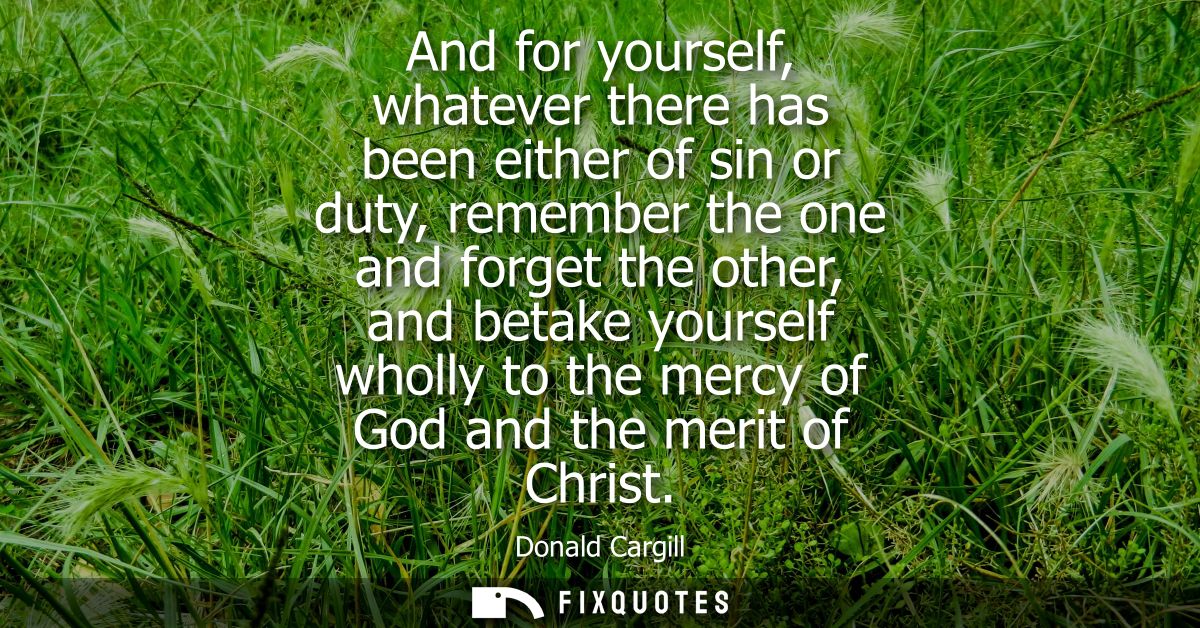
"And for yourself, whatever there has been either of sin or duty, remember the one and forget the other, and betake yourself wholly to the mercy of God and the merit of Christ"
About this Quote
That inversion is the engine of the sentence. Most moral systems tell you to remember your good deeds and try to forget your failures. Cargill flips it because he’s arguing against two temptations his audience knew well: despair under persecution and self-congratulation under resistance. “Whatever there has been either of sin or duty” levels the field: you’re not saved by the heroism of your cause, and you’re not damned by the stains of fear. Both are distractions from the only safe ground he recognizes.
The phrasing “betake yourself wholly” is totalizing, almost urgent, as if partial surrender is just another form of self-reliance. “Mercy of God” and “merit of Christ” are not decorative theology; they’re a polemic against the idea that righteousness can be earned, tallied, or proven to hostile authorities. Underneath the piety is a pointed political psychology: if the state can’t own your conscience, and you can’t even use your own virtue to own it, you’re free in the one place power can’t reach.
Quote Details
| Topic | God |
|---|---|
| Source | Help us find the source |
| Cite |
Citation Formats
APA Style (7th ed.)
Cargill, Donald. (2026, January 15). And for yourself, whatever there has been either of sin or duty, remember the one and forget the other, and betake yourself wholly to the mercy of God and the merit of Christ. FixQuotes. https://fixquotes.com/quotes/and-for-yourself-whatever-there-has-been-either-150479/
Chicago Style
Cargill, Donald. "And for yourself, whatever there has been either of sin or duty, remember the one and forget the other, and betake yourself wholly to the mercy of God and the merit of Christ." FixQuotes. January 15, 2026. https://fixquotes.com/quotes/and-for-yourself-whatever-there-has-been-either-150479/.
MLA Style (9th ed.)
"And for yourself, whatever there has been either of sin or duty, remember the one and forget the other, and betake yourself wholly to the mercy of God and the merit of Christ." FixQuotes, 15 Jan. 2026, https://fixquotes.com/quotes/and-for-yourself-whatever-there-has-been-either-150479/. Accessed 28 Mar. 2026.