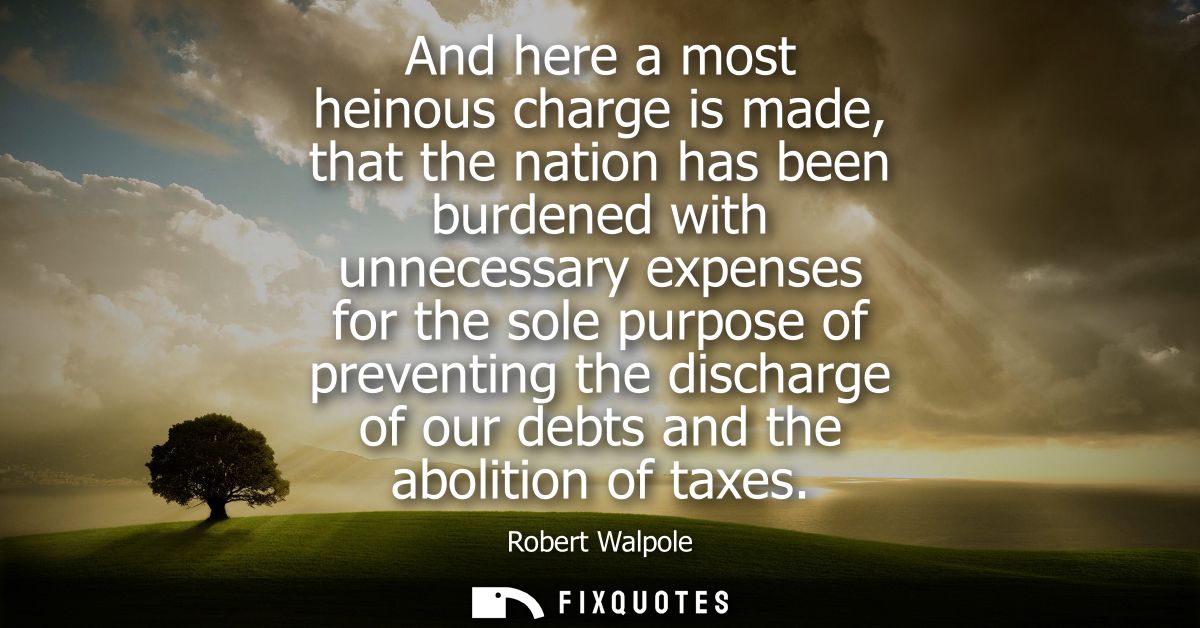
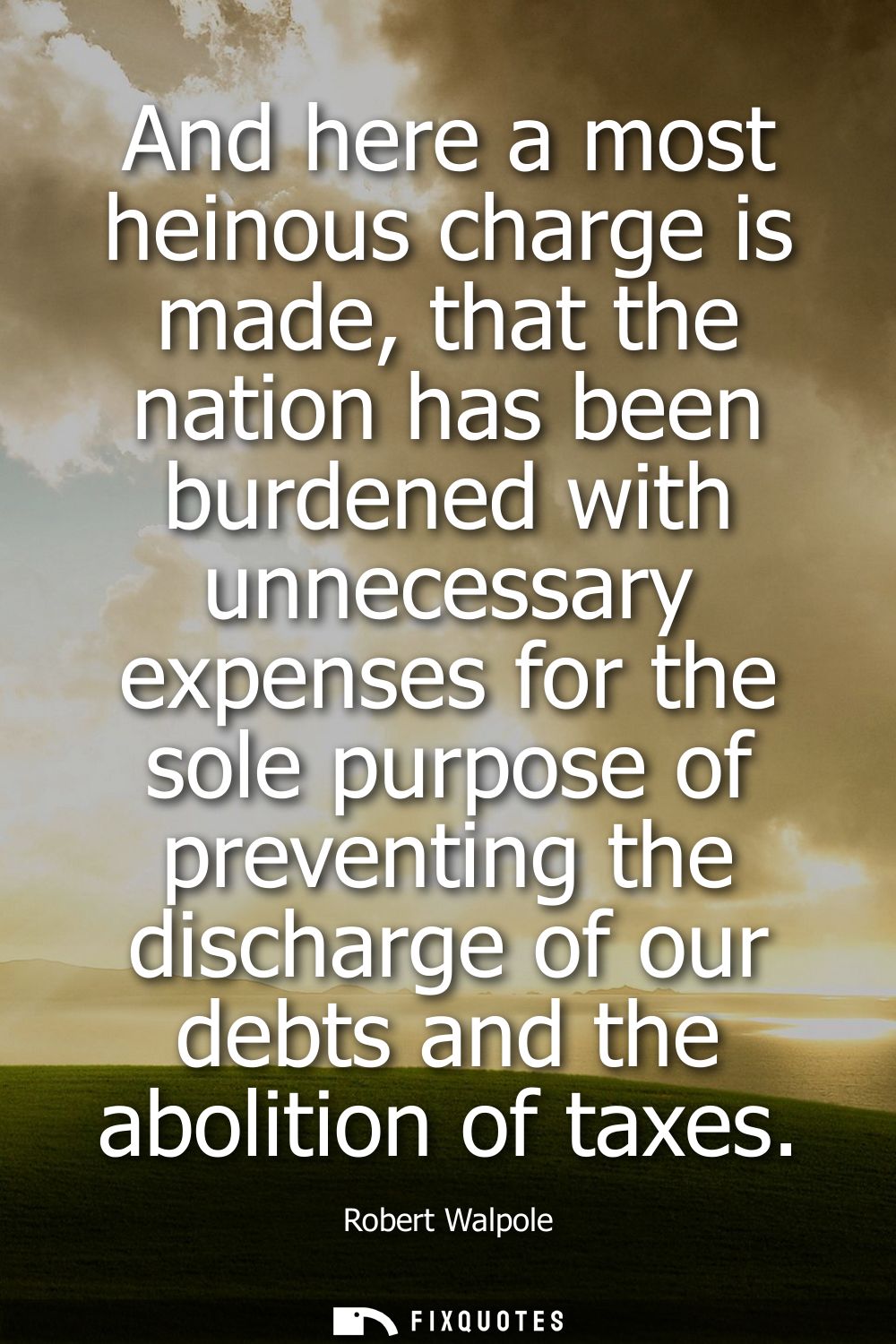
"And here a most heinous charge is made, that the nation has been burdened with unnecessary expenses for the sole purpose of preventing the discharge of our debts and the abolition of taxes"
About this Quote
Context matters: Walpole, Britain’s dominant early-18th-century minister, governed in an era when war finance, expanding credit markets, and the management of the national debt were becoming the machinery of modern state power. Debt wasn’t only a fiscal fact; it was a political instrument tying the government to creditors and to Parliament’s recurring authority to tax. Critics of Walpole’s system often saw standing fiscal structures as a self-perpetuating engine: taxes feed debt service; debt justifies taxes; expenditures keep the wheel turning.
The subtext is an early critique of what we’d now call the political economy of permanent government: that budgets can be engineered to foreclose moments of relief (debt retirement, tax cuts) because those moments would shrink patronage, weaken alliances, and reduce leverage. Walpole’s genius is rhetorical triangulation. He rejects the charge while repeating it in full, giving it oxygen, then signaling its indecency. The sentence performs containment and amplification at once: a scandal named, then declared too scandalous to be true.
Quote Details
| Topic | Money |
|---|---|
| Source | Help us find the source |
| Cite |
Citation Formats
APA Style (7th ed.)
Walpole, Robert. (2026, January 18). And here a most heinous charge is made, that the nation has been burdened with unnecessary expenses for the sole purpose of preventing the discharge of our debts and the abolition of taxes. FixQuotes. https://fixquotes.com/quotes/and-here-a-most-heinous-charge-is-made-that-the-4725/
Chicago Style
Walpole, Robert. "And here a most heinous charge is made, that the nation has been burdened with unnecessary expenses for the sole purpose of preventing the discharge of our debts and the abolition of taxes." FixQuotes. January 18, 2026. https://fixquotes.com/quotes/and-here-a-most-heinous-charge-is-made-that-the-4725/.
MLA Style (9th ed.)
"And here a most heinous charge is made, that the nation has been burdened with unnecessary expenses for the sole purpose of preventing the discharge of our debts and the abolition of taxes." FixQuotes, 18 Jan. 2026, https://fixquotes.com/quotes/and-here-a-most-heinous-charge-is-made-that-the-4725/. Accessed 8 Mar. 2026.