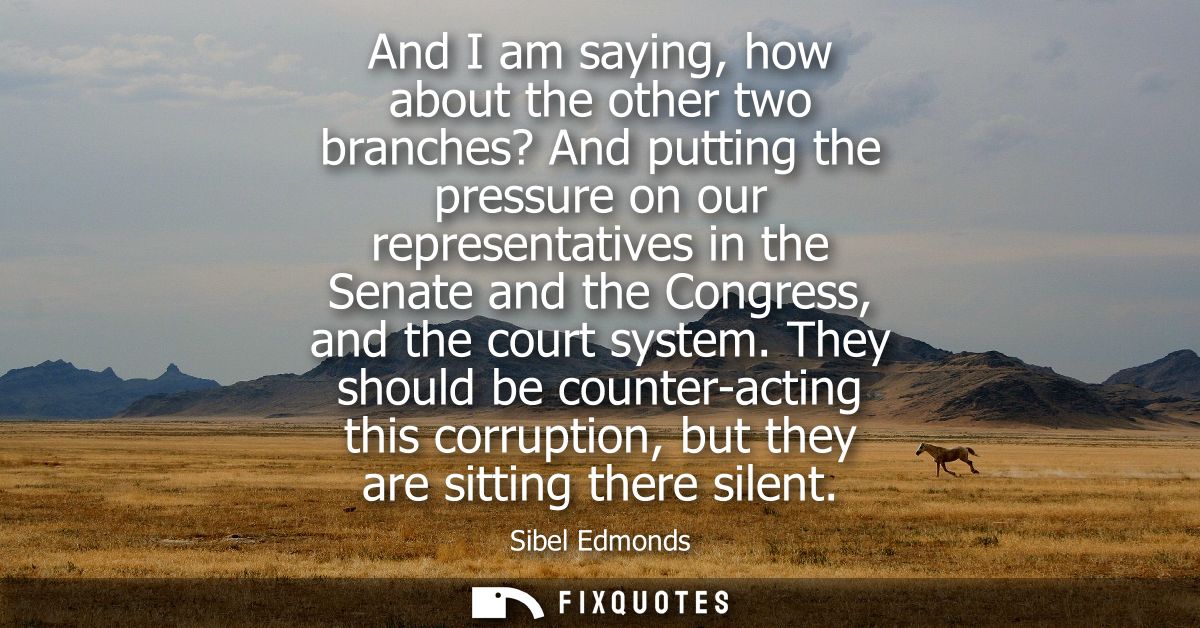
"And I am saying, how about the other two branches? And putting the pressure on our representatives in the Senate and the Congress, and the court system. They should be counteracting this corruption, but they are sitting there silent"
About this Quote
Her phrasing is pointedly colloquial (“how about,” “sitting there silent”), which matters. It’s not the language of a white paper; it’s the language of a whistleblower trying to translate insider frustration into a public demand. “Putting the pressure on our representatives” shifts the burden onto citizens, but without romanticizing activism. Pressure is not a feeling here; it’s leverage. She’s naming the mechanism by which supposedly independent branches get nudged back into motion: political cost.
The subtext is bleak: silence isn’t neutrality, it’s a form of participation. “Counter-acting” frames the legislative and judicial branches as reactive, duty-bound brakes - and their failure as a systemic breakdown, not a bad-news cycle. Contextually, Edmonds’ public persona is built on claims that institutions bury misconduct under classification, procedure, and career incentives. This quote taps that well: corruption doesn’t only happen in dark rooms; it survives in bright daylight when oversight becomes theater and everyone pretends the script is still democracy.
Quote Details
| Topic | Justice |
|---|---|
| Source | Help us find the source |
| Cite |
Citation Formats
APA Style (7th ed.)
Edmonds, Sibel. (2026, February 16). And I am saying, how about the other two branches? And putting the pressure on our representatives in the Senate and the Congress, and the court system. They should be counteracting this corruption, but they are sitting there silent. FixQuotes. https://fixquotes.com/quotes/and-i-am-saying-how-about-the-other-two-branches-152281/
Chicago Style
Edmonds, Sibel. "And I am saying, how about the other two branches? And putting the pressure on our representatives in the Senate and the Congress, and the court system. They should be counteracting this corruption, but they are sitting there silent." FixQuotes. February 16, 2026. https://fixquotes.com/quotes/and-i-am-saying-how-about-the-other-two-branches-152281/.
MLA Style (9th ed.)
"And I am saying, how about the other two branches? And putting the pressure on our representatives in the Senate and the Congress, and the court system. They should be counteracting this corruption, but they are sitting there silent." FixQuotes, 16 Feb. 2026, https://fixquotes.com/quotes/and-i-am-saying-how-about-the-other-two-branches-152281/. Accessed 16 Feb. 2026.