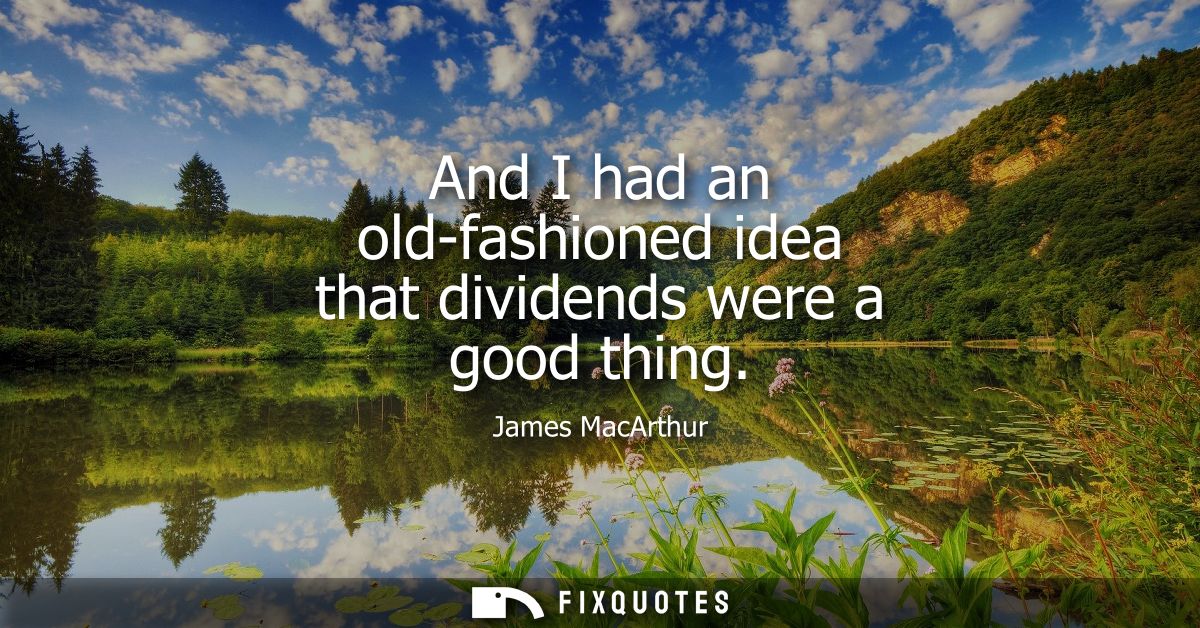
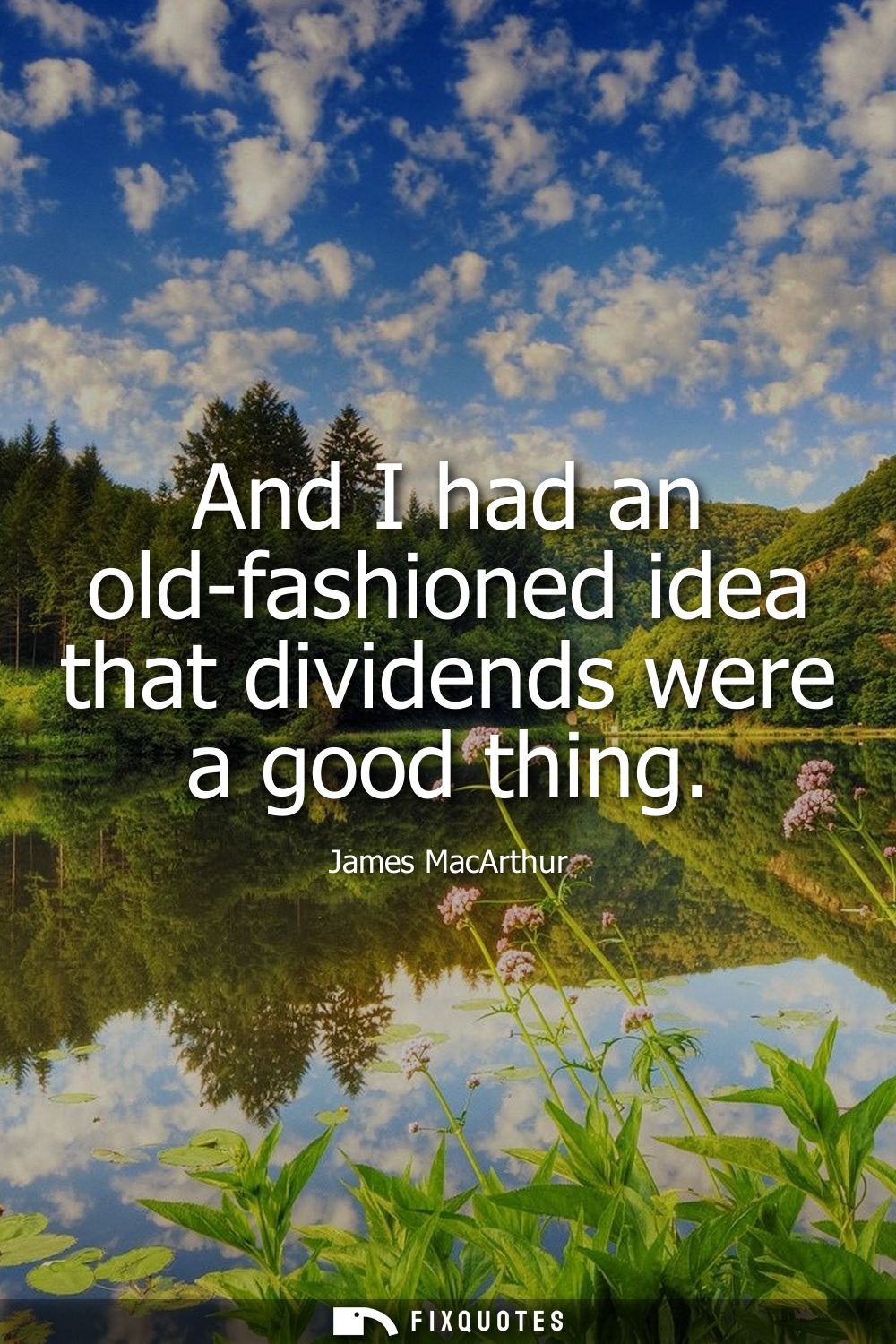
"And I had an old-fashioned idea that dividends were a good thing"
About this Quote
There is a quiet sting in that phrase, the kind you only get when someone has watched “common sense” become a punchline. “Old-fashioned” does double duty: it signals decency and prudence, but also concedes that the speaker’s values have been made unfashionable by a newer system that treats basic returns as naive. MacArthur’s line lands because it’s disarmingly small. He’s not railing against Wall Street or giving a speech about capitalism; he’s just admitting he expected the simplest bargain of investing to hold up.
The real subtext is generational whiplash. “Dividends” aren’t just a technical term; they evoke a mid-century faith in institutions that paid out steadily, rewarded patience, and pretended to be tethered to real production. By framing that expectation as “old-fashioned,” he’s naming a cultural shift: profits can be abstracted, deferred, laundered into “growth,” or siphoned upward while ordinary stakeholders get told to wait, believe, or accept volatility as a lifestyle.
As an actor, MacArthur’s instrument is timing, and this line reads like a well-placed dry aside in a larger narrative about disappointment. It’s the sound of someone realizing the rules changed without notice, and that the people who rewrote them will still call it progress. The humor is thin, the frustration thick: a polite way of saying, “I invested in the story, and the ending got rewritten.”
The real subtext is generational whiplash. “Dividends” aren’t just a technical term; they evoke a mid-century faith in institutions that paid out steadily, rewarded patience, and pretended to be tethered to real production. By framing that expectation as “old-fashioned,” he’s naming a cultural shift: profits can be abstracted, deferred, laundered into “growth,” or siphoned upward while ordinary stakeholders get told to wait, believe, or accept volatility as a lifestyle.
As an actor, MacArthur’s instrument is timing, and this line reads like a well-placed dry aside in a larger narrative about disappointment. It’s the sound of someone realizing the rules changed without notice, and that the people who rewrote them will still call it progress. The humor is thin, the frustration thick: a polite way of saying, “I invested in the story, and the ending got rewritten.”
Quote Details
| Topic | Investment |
|---|---|
| Source | Help us find the source |
| Cite |
Citation Formats
APA Style (7th ed.)
MacArthur, James. (2026, January 17). And I had an old-fashioned idea that dividends were a good thing. FixQuotes. https://fixquotes.com/quotes/and-i-had-an-old-fashioned-idea-that-dividends-65156/
Chicago Style
MacArthur, James. "And I had an old-fashioned idea that dividends were a good thing." FixQuotes. January 17, 2026. https://fixquotes.com/quotes/and-i-had-an-old-fashioned-idea-that-dividends-65156/.
MLA Style (9th ed.)
"And I had an old-fashioned idea that dividends were a good thing." FixQuotes, 17 Jan. 2026, https://fixquotes.com/quotes/and-i-had-an-old-fashioned-idea-that-dividends-65156/. Accessed 21 Mar. 2026.
More Quotes by James
Add to List