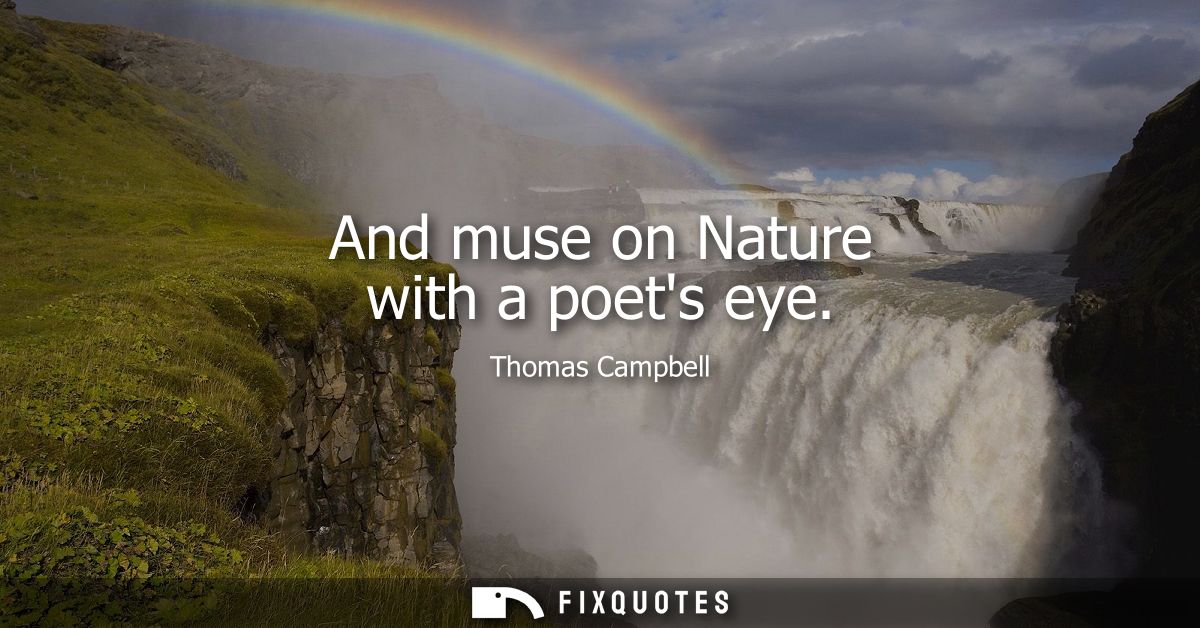
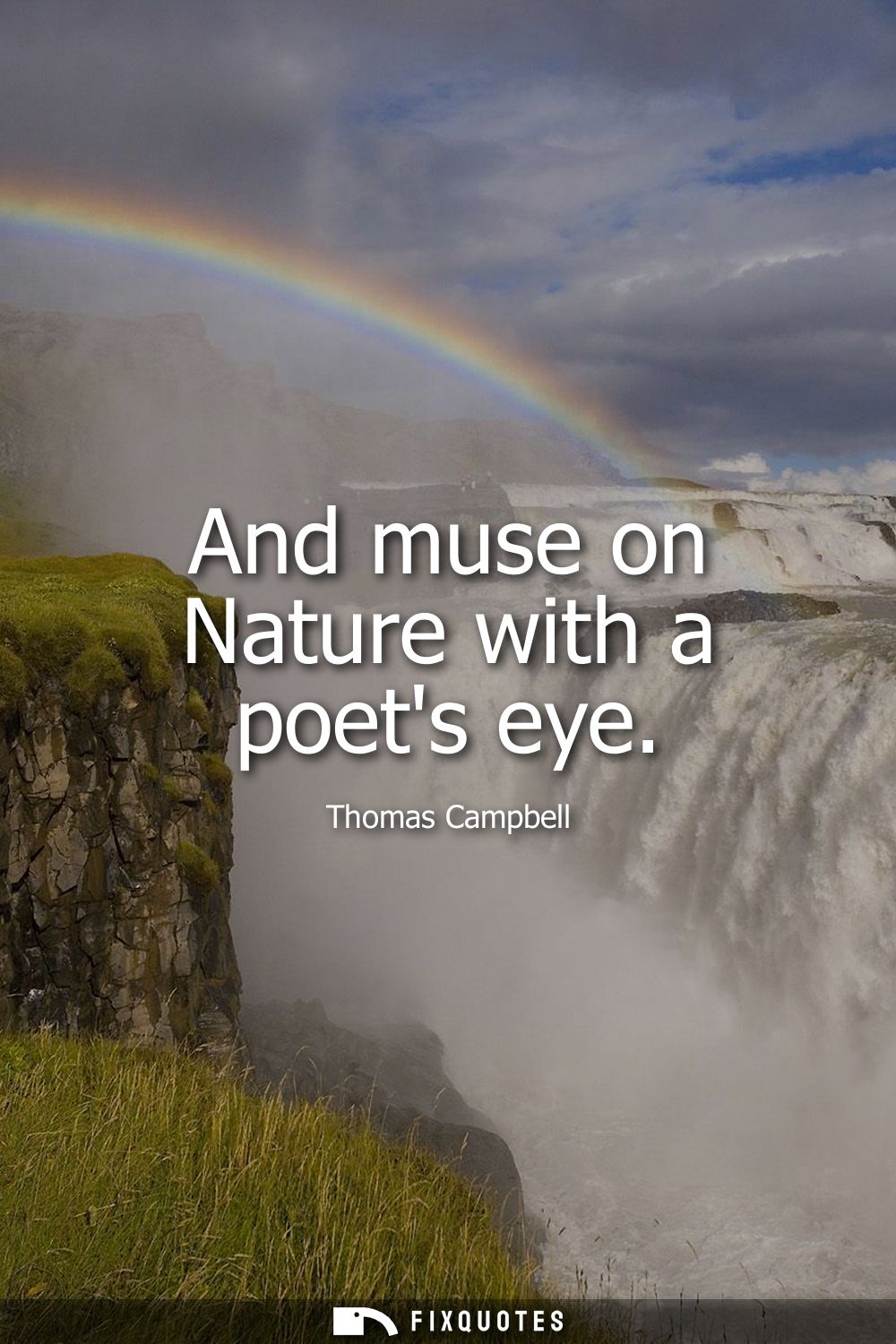
"And muse on Nature with a poet's eye"
About this Quote
A single line that quietly redraws the border between looking and seeing. Campbell’s “And muse on Nature with a poet’s eye” isn’t just an invitation to admire scenery; it’s a prescription for a particular kind of attention, one that turns the natural world into both sanctuary and instrument of moral feeling. The verb “muse” matters: it suggests slow, inward contemplation rather than collection or conquest. Nature here is not a resource or a specimen. It’s a partner in thought.
The “poet’s eye” carries subtext about who gets to interpret the world. In the Romantic era, perception becomes a form of authority: the poet doesn’t merely report reality, he refashions it through sensibility. Campbell is flattering and recruiting at once, implying that the reader can borrow this heightened vision by adopting the poet’s posture. It’s democratic on the surface, elitist underneath; not everyone sees nature this way, and the line nudges you to join the perceptive minority.
Context sharpens the intent. Campbell sits in the early 19th-century British tradition that treats Nature as a corrective to modernity’s noise: war, urban growth, industrial change, political upheaval. The line offers a counterpractice to the age’s acceleration. It also smuggles in a Romantic faith that careful looking yields ethical clarity: to “muse” is to become steadier, kinder, more awake.
Why it works is its economy. “Nature” is vast, “poet’s eye” is intimate. One pivots the cosmic into the personal, making the grand feel briefly graspable.
The “poet’s eye” carries subtext about who gets to interpret the world. In the Romantic era, perception becomes a form of authority: the poet doesn’t merely report reality, he refashions it through sensibility. Campbell is flattering and recruiting at once, implying that the reader can borrow this heightened vision by adopting the poet’s posture. It’s democratic on the surface, elitist underneath; not everyone sees nature this way, and the line nudges you to join the perceptive minority.
Context sharpens the intent. Campbell sits in the early 19th-century British tradition that treats Nature as a corrective to modernity’s noise: war, urban growth, industrial change, political upheaval. The line offers a counterpractice to the age’s acceleration. It also smuggles in a Romantic faith that careful looking yields ethical clarity: to “muse” is to become steadier, kinder, more awake.
Why it works is its economy. “Nature” is vast, “poet’s eye” is intimate. One pivots the cosmic into the personal, making the grand feel briefly graspable.
Quote Details
| Topic | Nature |
|---|---|
| Source | Help us find the source |
| Cite |
Citation Formats
APA Style (7th ed.)
Campbell, Thomas. (2026, January 18). And muse on Nature with a poet's eye. FixQuotes. https://fixquotes.com/quotes/and-muse-on-nature-with-a-poets-eye-21007/
Chicago Style
Campbell, Thomas. "And muse on Nature with a poet's eye." FixQuotes. January 18, 2026. https://fixquotes.com/quotes/and-muse-on-nature-with-a-poets-eye-21007/.
MLA Style (9th ed.)
"And muse on Nature with a poet's eye." FixQuotes, 18 Jan. 2026, https://fixquotes.com/quotes/and-muse-on-nature-with-a-poets-eye-21007/. Accessed 15 Mar. 2026.
More Quotes by Thomas
Add to List