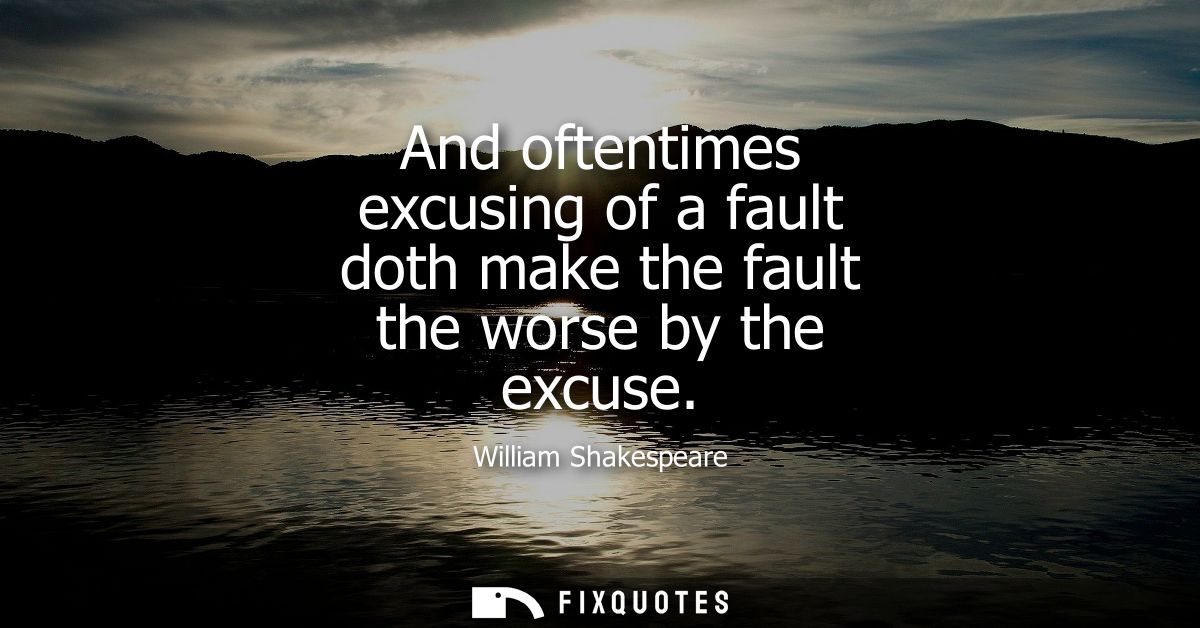
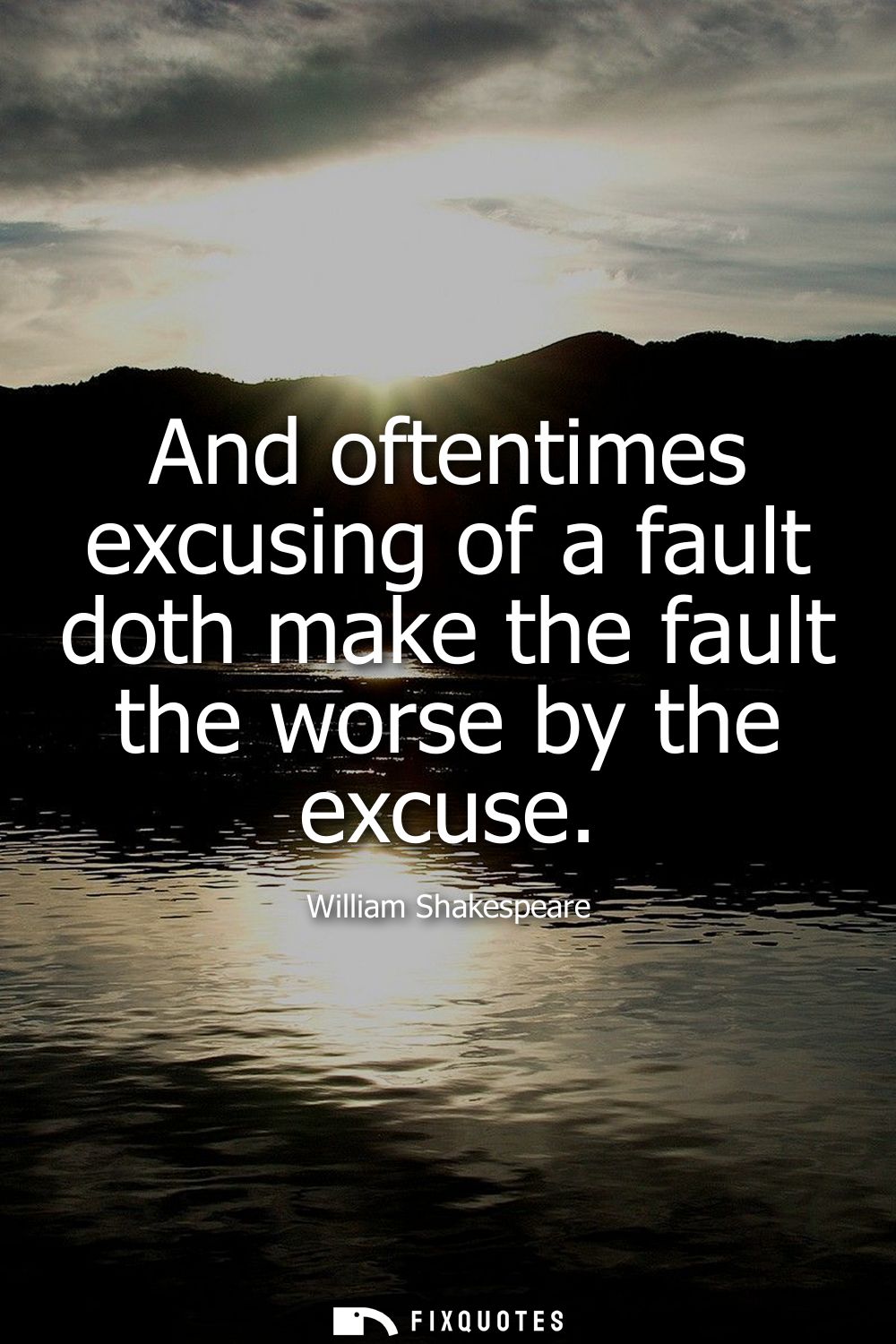
"And oftentimes excusing of a fault doth make the fault the worse by the excuse"
About this Quote
In the world of Shakespeare’s drama, that’s never a neutral move. His characters are forever performing versions of themselves, engineering alibis for desire, ambition, jealousy. An excuse is rarely a simple clarification; it’s a bid for control over how the act will be read. The subtext is about reputation as a battleground. When someone rushes to soften a fault, Shakespeare suggests, they reveal awareness of guilt and a willingness to manipulate the social ledger. The excuse becomes part of the crime because it treats the audience like a jury to be worked, not a community to be answered to.
The phrasing helps: “oftentimes” keeps it worldly rather than preachy, as if this is an observation from someone who’s watched a lot of humans talk themselves into ruin. “Doth make” gives the mechanism a grim inevitability. It’s not that excuses always fail; it’s that they can deepen the fault by turning a moment of weakness into a sustained strategy.
Shakespeare is also warning about self-deception. The excuse doesn’t only persuade others; it rehearses the story until the speaker believes it. That’s how a fault graduates into character.
Quote Details
| Topic | Learning from Mistakes |
|---|---|
| Source | Verified source: King John (William Shakespeare, 1623)
Evidence: And oftentimes excusing of a fault, Doth make the fault the worse by th'excuse: (Act 4, Scene 2; First Folio page 15 of King John (PDF page 42)). This quote is authentically Shakespeare and appears in his play King John, spoken by Pembroke in Act 4, Scene 2. The earliest verified publication I found is the 1623 First Folio, where King John was first printed. Modern editions normalize the spelling to 'the excuse,' but the original First Folio reading is 'th'excuse.' Other candidates (1) The Plays and Poems of William Shakspeare (William Shakespeare, 1833) compilation95.0% William Shakespeare. In undeserv'd extremes : See else yourself : There is no malice in this burning coal : The ... A... |
| Cite |
Citation Formats
APA Style (7th ed.)
Shakespeare, William. (2026, March 13). And oftentimes excusing of a fault doth make the fault the worse by the excuse. FixQuotes. https://fixquotes.com/quotes/and-oftentimes-excusing-of-a-fault-doth-make-the-25051/
Chicago Style
Shakespeare, William. "And oftentimes excusing of a fault doth make the fault the worse by the excuse." FixQuotes. March 13, 2026. https://fixquotes.com/quotes/and-oftentimes-excusing-of-a-fault-doth-make-the-25051/.
MLA Style (9th ed.)
"And oftentimes excusing of a fault doth make the fault the worse by the excuse." FixQuotes, 13 Mar. 2026, https://fixquotes.com/quotes/and-oftentimes-excusing-of-a-fault-doth-make-the-25051/. Accessed 31 Mar. 2026.